
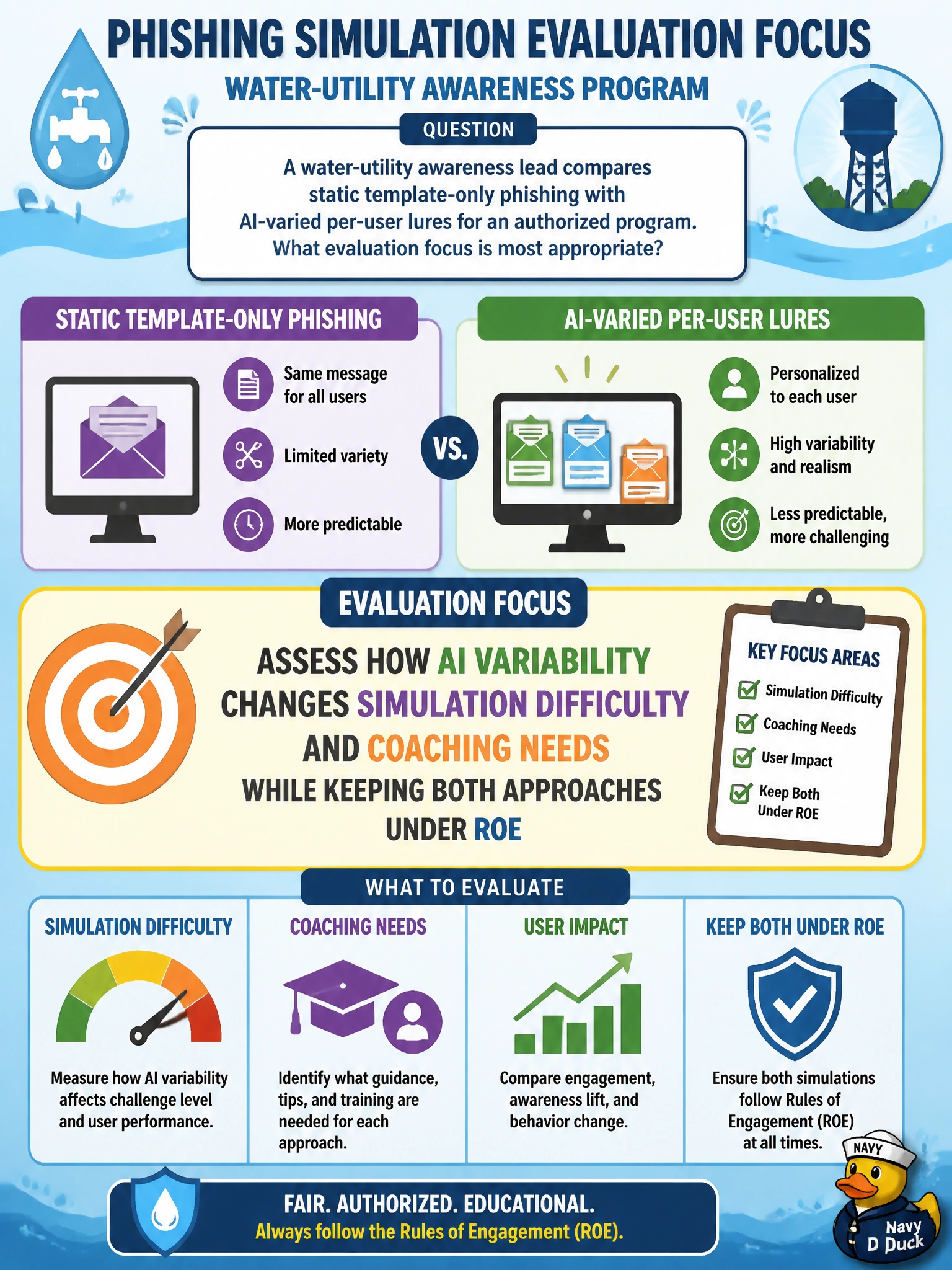
A water-utility awareness lead compares static template-only phishing with AI-varied per-user lures for an authorized program. What evaluation focus is most appropriate?
Select an answer to reveal the explanation.
Short Explanation
Same stamp versus AI remixes is a difficulty dial, not a morality play. Measure how much harder varied lures are and what coaching they need—both still live under ROE. Metrics still matter either way.
Full Explanation
A water-utility awareness lead comparing static template-only phishing with AI-varied per-user lures should focus evaluation on how AI variability changes simulation difficulty and coaching needs while keeping both approaches under ROE. Template-only campaigns remain useful for baseline measurement and consistent comparisons over time. AI variation can increase difficulty and personalization, which may require different coaching intensity and clearer metrics definitions—but variability does not remove the need for authorization or measurement. Claiming AI-varied lures are always illegal in municipal programs so only identical templates may be used is an overbroad legal absolute not grounded in the scenario; authorized programs can use either approach under policy. Declaring template-only mail obsolete and mandatory to abandon even for baseline measurements discards a valid control for trend analysis. Saying per-user AI variation removes the need for metrics because difficulty becomes subjective abandons program management; subjective feel does not replace click, report, and remediation metrics. Exam caveat: GOAA evaluation items treat AI variability as a difficulty and coaching factor under ROE, not as a morality or metrics off-switch. Operational check: run comparative cohorts or phased designs, document difficulty assumptions, keep both modes authorized, and report metrics that inform coaching rather than vanity scores.