
A housing-authority communicator asks generative AI to rewrite an authorized phishing lure into multiple languages for multilingual staff. Which condition keeps the approach in bounds?
Select an answer to reveal the explanation.
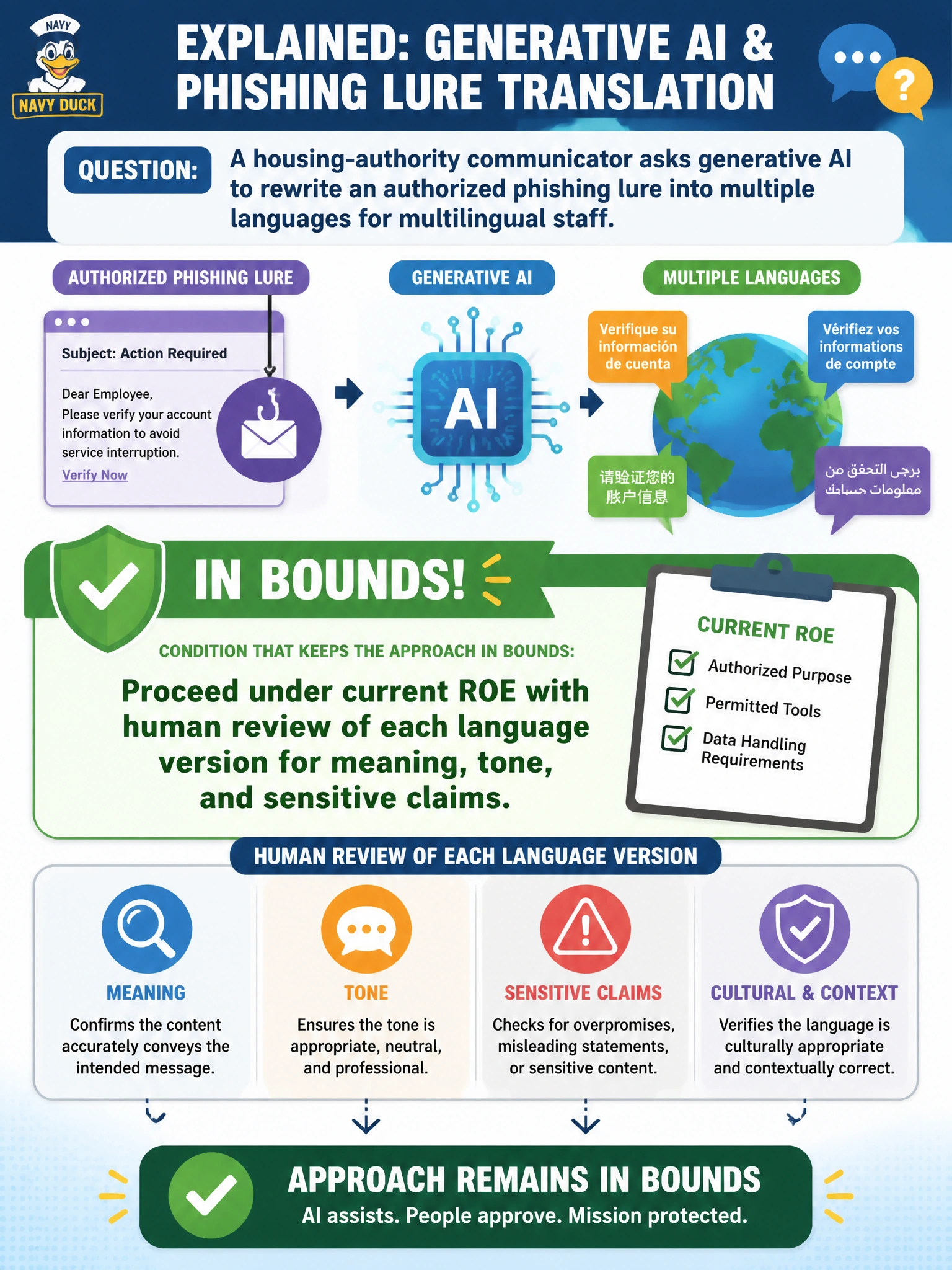
Short Explanation
AI can help say the same drill lure in more languages, but each version still needs a human ear and today’s ROE. Last year’s English approval is not a hall pass for every translation. Inclusion is the point—not unsupervised blast.
Full Explanation
When a housing-authority communicator asks generative AI to rewrite an authorized phishing lure into multiple languages for multilingual staff, the in-bounds condition is to proceed under the current ROE with human review of each language version for meaning, tone, and sensitive claims. Inclusion of multilingual staff in awareness drills is a legitimate civic goal; AI translation or rewriting can accelerate draft production, but each version can drift in meaning, intensify urgency improperly, or introduce culturally inappropriate or legally risky claims. Declaring multilingual rewrites always forbidden because AI translation voids municipal ROE is overly absolute and blocks inclusive testing without necessity. Allowing translated lures to skip legal review if the English original was approved last year ignores both language drift and the fact that ROE and legal baselines can change; prior English approval is not a perpetual hall pass. Publishing AI translations directly because multilingual staff supposedly cannot be included in drills is both operationally false and inequitable—those staff are exactly who inclusive programs must reach, with proper controls. Exam caveat: GOAA expects authorized AI assistance for phishing content to remain under present ROE plus human review per variant, including translations. Operational check: maintain a per-language review checklist, confirm current ROE coverage for multilingual sends, and block any language variant that fails meaning, tone, or sensitive-claim review.