
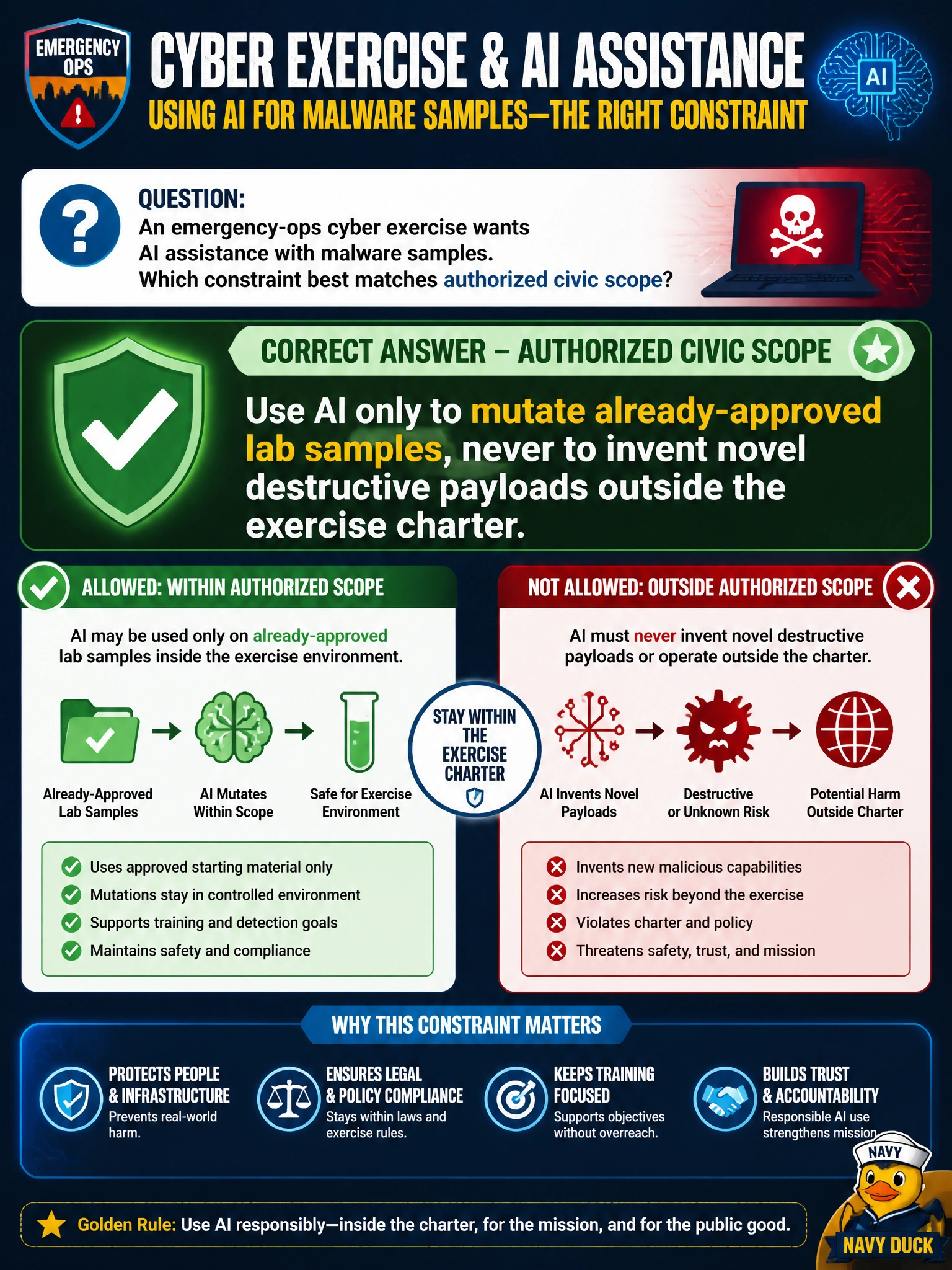
An emergency-ops cyber exercise wants AI assistance with malware samples. Which constraint best matches authorized civic scope?
Select an answer to reveal the explanation.
Short Explanation
Stick to remixing the already-approved lab toys. Emergency-ops exercises are not open-mic night for novel destructive payloads on live consoles. The charter is the fence—AI stays inside it.
Full Explanation
Emergency-ops cyber exercises that want AI assistance with malware samples should constrain AI to mutating already-approved lab samples—never inventing novel destructive payloads outside the exercise charter. Mutation of pre-approved artifacts keeps scope, legality, and safety aligned with what emergency management authorized, while still testing detection against polymorphic variation. Inventing new destructive capabilities mid-exercise expands risk beyond ROE and can threaten live emergency systems if controls fail.
Allowing AI to invent new destructive payloads for any emergency system including live radio consoles is out of charter and operationally dangerous. Skipping approval lists because the exercise clock is running subordinates safety to schedule pressure. Letting AI choose production targets autonomously for realism removes human authorization—the opposite of civic exercise discipline.
Exam caveat: authorized civic scope is mutate already-approved lab samples only—not open-ended invention, skipped approvals, or autonomous production targeting.
Operational check: maintain an approved-sample manifest for emergency-ops exercises; permit AI mutation only of listed items; require change control for any new sample class; explicitly ban live radio consoles and other production emergency systems as targets.