
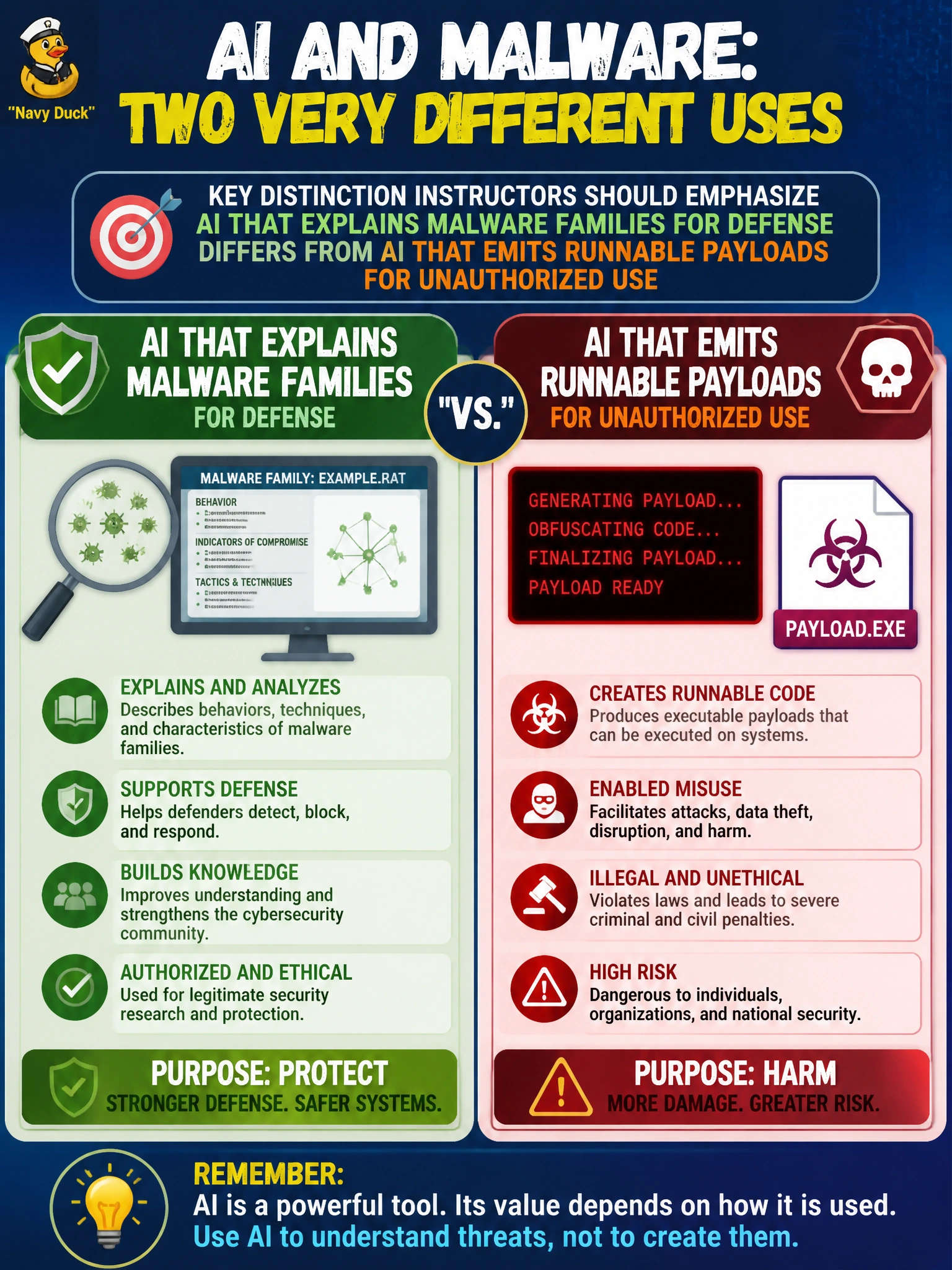
A fusion center training contrasts two AI uses related to malware. Which distinction should instructors emphasize?
Select an answer to reveal the explanation.
Short Explanation
Learning what a malware family does is classroom time; asking AI for runnable payloads without authority is a different animal. Fusion-center instructors should draw that bright line. A 'training' sticker does not mint a warrant.
Full Explanation
Fusion-center instructors should emphasize a bright-line distinction: AI that explains malware families for defense (behavioral overviews, MITRE-style mapping, detection ideas) differs from AI that emits runnable payloads for unauthorized use. Defensive explanation supports analyst education and detection engineering under civic mission. Unauthorized runnable payload emission creates legal, ethical, and operational risk and requires explicit written authorization, isolation, and custody when it is ever in scope at all.
Not all malware-related AI use is identical or equally authorized—authorization and artifact type matter. Public chatbots are not always safer than local models for payload emission; public tools add data-leakage risk and still may emit harmful content. Labeling something 'training' does not remove the need for authorization when runnable payloads are involved.
Exam caveat: the instructional distinction is defensive explanation versus unauthorized runnable emission—not 'all AI malware talk is the same' or 'training labels waive ROE.'
Operational check: training curricula should include approved defensive AI use cases, a prohibited-prompt list for payload emission without ROE, and a referral path to the authorized purple-team lab when hands-on samples are truly required.