
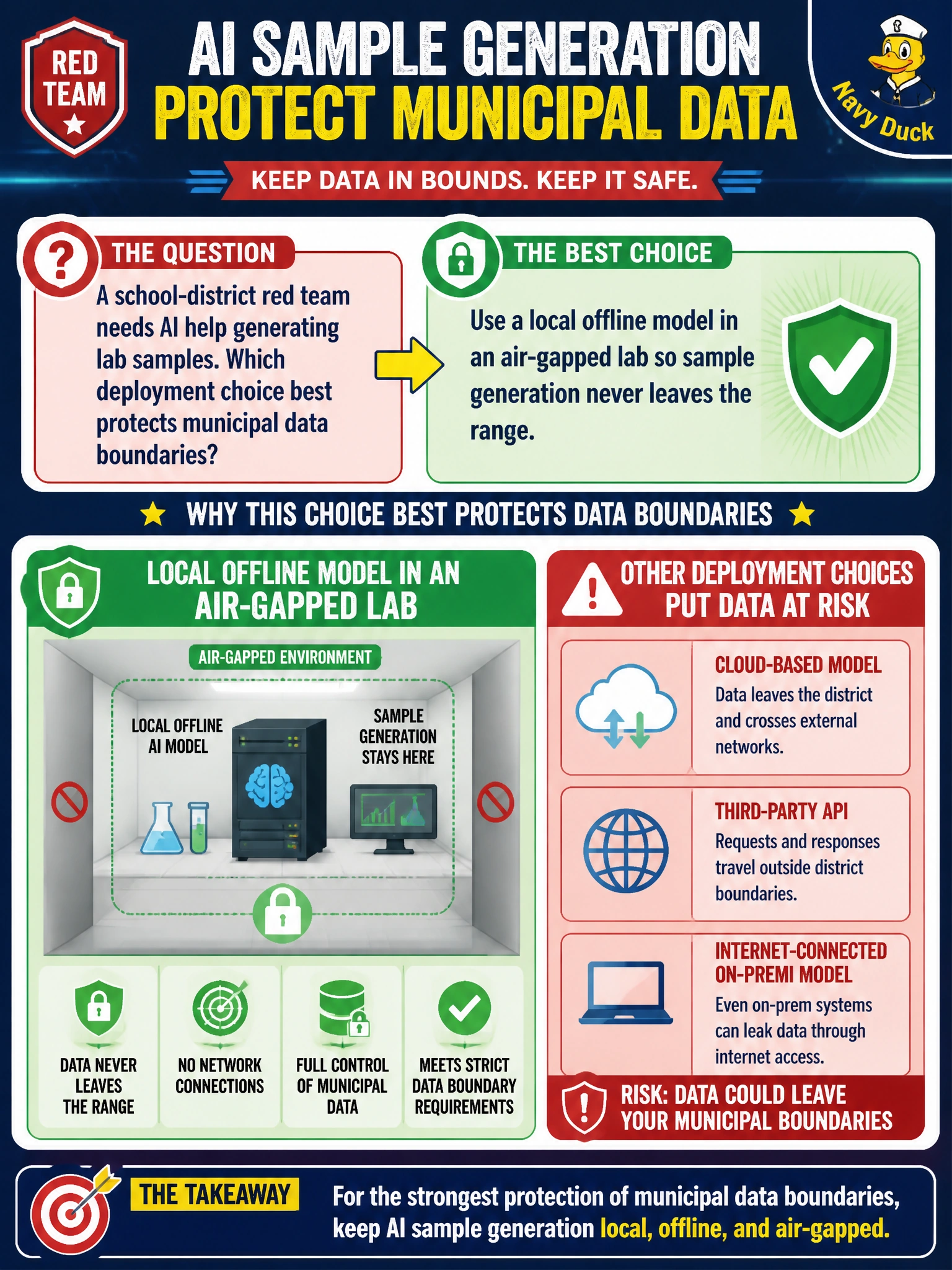
A school-district red team needs AI help generating lab samples. Which deployment choice best protects municipal data boundaries?
Select an answer to reveal the explanation.
Short Explanation
Keep the sketchy lab homework inside the building. A local offline model on an air-gapped range beats dumping district guts into a free public chatbot. Coffee-shop Wi-Fi is not a secure red-team desk.
Full Explanation
School-district red teams generating AI-assisted lab samples should protect municipal data boundaries by using a local offline model in an air-gapped lab so sample generation never leaves the range. That deployment choice keeps prompts, network diagrams, and generated artifacts inside the district's controlled environment, avoiding leakage to third-party SaaS trainers and untrusted networks while still supporting authorized sample work under ROE.
Pasting full internal network diagrams into a free public chatbot exposes sensitive topology for marginally better stubs—an unacceptable boundary breach. Generating samples on a teacher's personal laptop over coffee-shop Wi-Fi mixes personal devices, insecure networks, and offensive artifacts. Uploading Active Directory exports to any SaaS model that 'claims faster malware ideas' discloses identity infrastructure and violates data-handling rules.
Exam caveat: the best choice is the one that keeps generation offline/air-gapped on the range—not the one that maximizes convenience or model cleverness at the cost of district secrets.
Operational check: provision an air-gapped lab VLAN/host with an approved local model, ban pasting production diagrams/AD data into public LLMs, require sample custody logs, and verify no outbound connections during generation runs before school-district purple-team exercises proceed.