
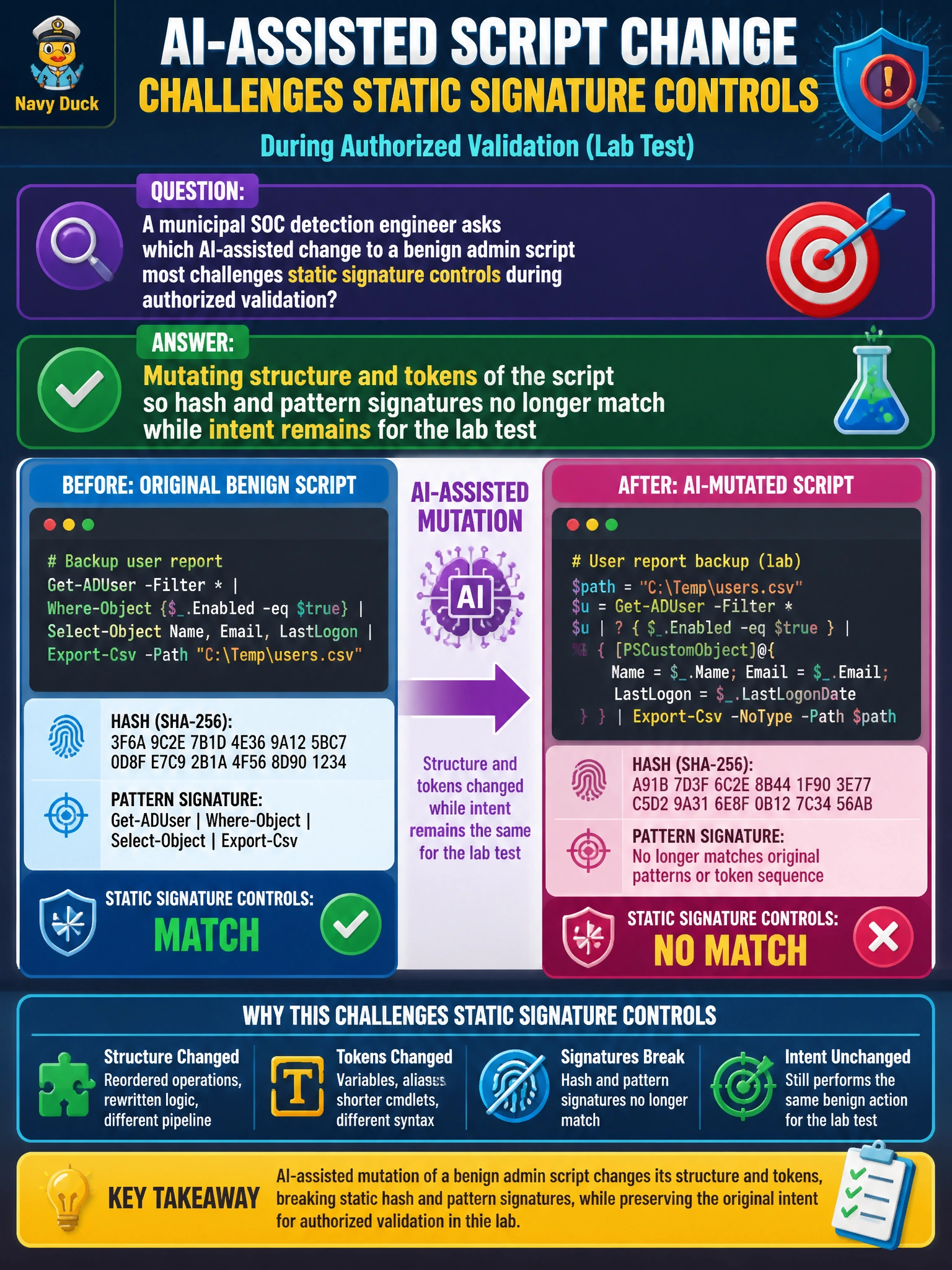
A municipal SOC detection engineer asks which AI-assisted change to a benign admin script most challenges static signature controls during authorized validation?
Select an answer to reveal the explanation.
Short Explanation
Static signatures love fixed fingerprints. When AI reshapes a lab admin script's structure and tokens, those fingerprints stop lining up even if the authorized test goal is the same. Comment-language tweaks and shortcut renames barely move the needle.
Full Explanation
In a municipal SOC lab, static signature controls primarily key on fixed fingerprints: file hashes, token sequences, and known pattern fragments. An AI-assisted mutation that rewrites structure and tokens while preserving the authorized test intent is therefore the change that most directly challenges those controls. The hash no longer matches catalogs, and pattern signatures that expected particular identifiers or layout can miss the sample even though the script still performs the same benign admin behavior the validation was designed to exercise. That is the operational point of the purple-team check: confirm whether detection still fires when only the static shape has changed.
Translating comments into another spoken language leaves executable logic and most token fingerprints intact, so hash and pattern engines usually still match. Renaming a desktop shortcut changes presentation metadata, not the script body that scanners hash and dissect. Increasing documentation verbosity may add comments or whitespace that some naive fingerprints tolerate; it does not systematically break structural and token-based signatures the way deliberate polymorphism does.
Exam caveat: the stem asks which AI-assisted change most challenges static signature controls during authorized validation—not which change is the loudest cosmetic edit or which change improves auditor readability. Do not confuse documentation hygiene with evasion of hash/pattern matching.
Operational check for city detection engineers: after mutating a lab admin script under written ROE, recompute hashes, re-run signature packs, and compare against behavioral or ASR-style detections. If signatures miss but risky actions are still observable, document the gap and tune layered controls rather than assuming a single hash catalog is sufficient for municipal endpoints.