
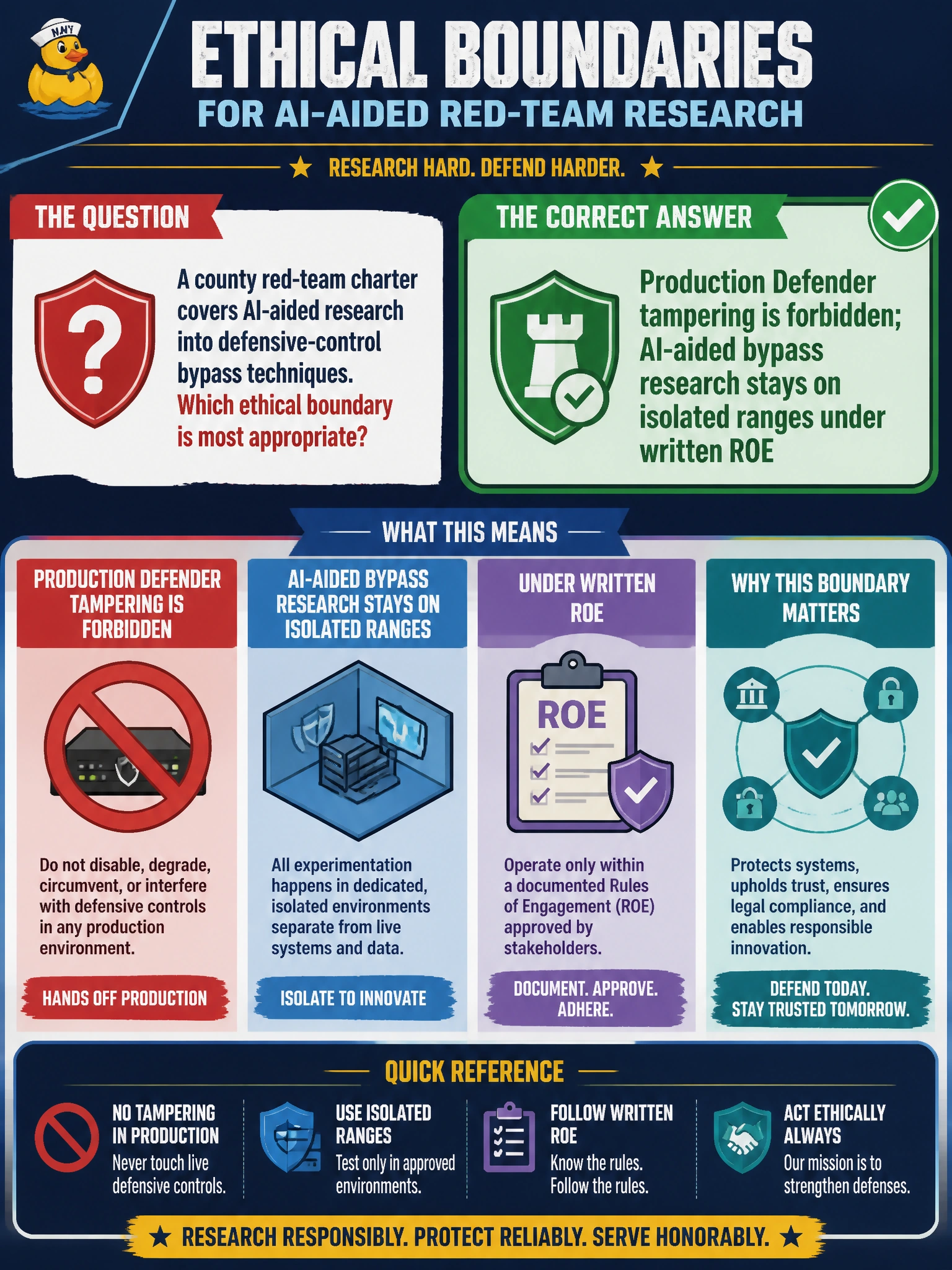
A county red-team charter covers AI-aided research into defensive-control bypass techniques. Which ethical boundary is most appropriate?
Select an answer to reveal the explanation.
Short Explanation
Curious AI prompts do not unlock the right to mess with production antivirus on live county boxes. Keep bypass research on the isolated range with paper ROE. Emergency and resident-facing systems are not playgrounds.
Full Explanation
A county red-team charter covering AI-aided research into defensive-control bypass techniques should set the ethical boundary that production Defender tampering is forbidden and that AI-aided bypass research stays on isolated ranges under written rules of engagement. Curiosity and scheduling pressure do not authorize weakening live municipal antivirus. Safety-critical and resident-facing systems such as 911 dispatch are especially out of bounds without explicit, separate authorization that still would not excuse reckless production tampering.
Allowing testers to tamper with production Defender settings whenever scheduling is tight subordinates civic safety to convenience. Targeting live 911 dispatch workstations with AI bypass research without a separate ROE addendum—and generally without isolation—is ethically and operationally unacceptable. Claiming ethical boundaries apply only to external consultants, not county employees, creates a false loophole; employees are equally bound.
Exam caveat: ethics items prioritize written ROE, isolation, and production non-interference for both staff and contractors.
Operational check for county red teams: state production non-tampering explicitly in charters; confine AI-assisted bypass ideation and execution to isolated labs; require ROE addenda for any exceptional scope; apply the same ethics to employees and consultants; and keep emergency and resident-facing systems off the playground list.