
An authorized school-district red team asks why living-off-the-land binaries can reduce antivirus signature hits during a scoped Windows assessment. What concept explains that observation?
Select an answer to reveal the explanation.
Short Explanation
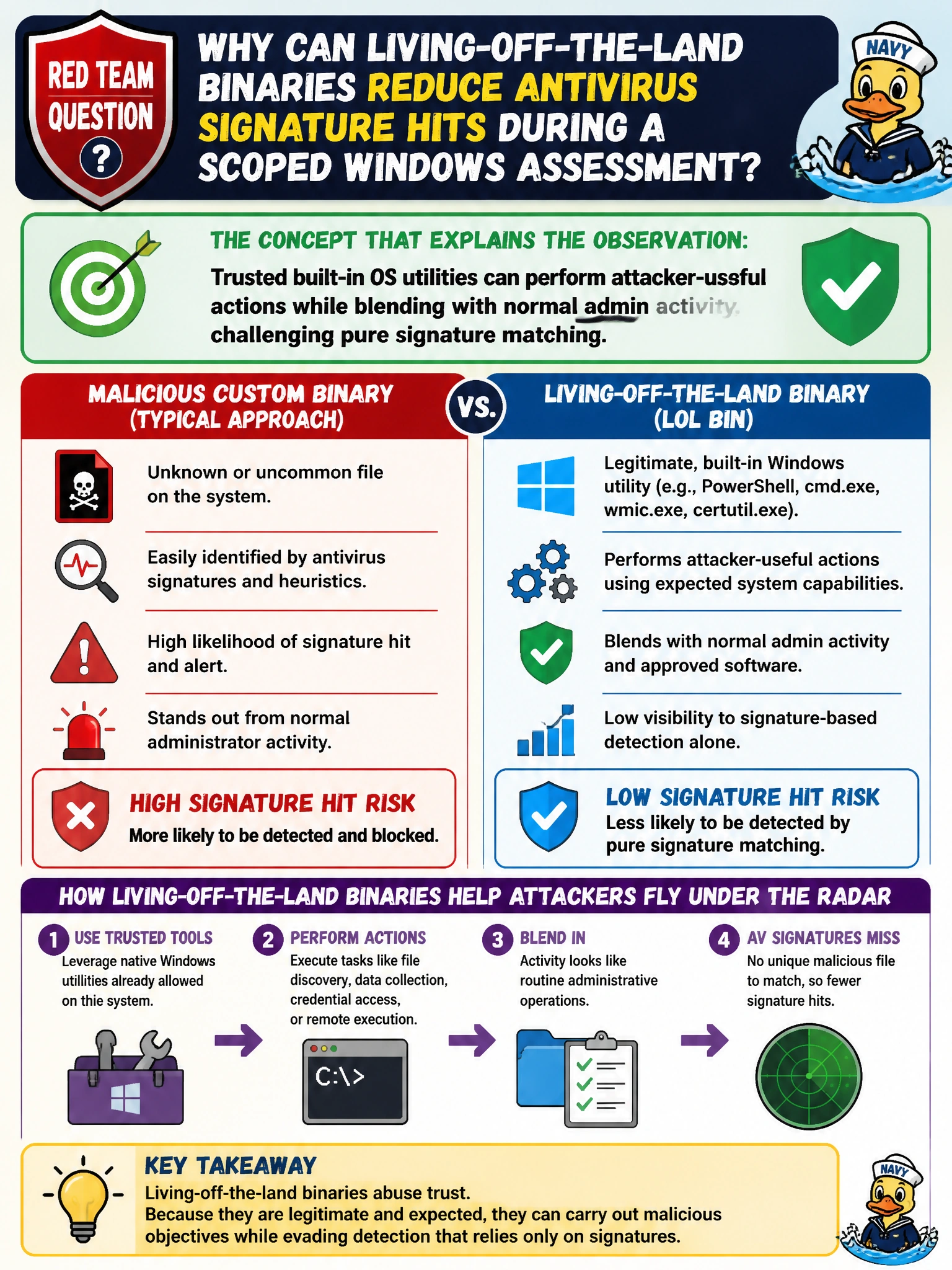
Why write custom malware when your operating system already has useful tools defenders expect to see? Living-off-the-land means using trusted utilities for attacker-useful actions, making behavior and context more important than a unique signature.
Full Explanation
Living-off-the-land binaries can reduce antivirus signature hits because trusted built-in OS utilities can perform attacker-useful actions while blending with normal administrative activity, challenging pure signature matching. In a scoped Windows assessment, expected utilities may look routine to basic scanners, so defenders may overlook suspicious use even when a process behaves unusually. Hash-based and simple signature engines have less novel malware to detect when red teams use tools already present on municipal endpoints; behavior, context, parent-child process relationships, and unusual utility arguments become important detection clues. LOLBins do not permanently disable Secure Boot on every municipal laptop, and their purpose is not limited to printing PDF agendas in board meetings; both descriptions miss their dual-use nature. Claiming Microsoft-signed utilities are automatically exempt from every antivirus and EDR scan is false: signing helps them look routine, but behavioral detection still flags misuse. Exam caveat: distinguish trusted dual-use tooling from custom malware signatures, and avoid treating “signed means never scanned” as an absolute. Practical check: baseline normal LOLBin use in civic IT and monitor suspicious use of administrative utilities; the absence of a unique evil.exe hash does not mean malicious activity is absent from Windows fleets.