
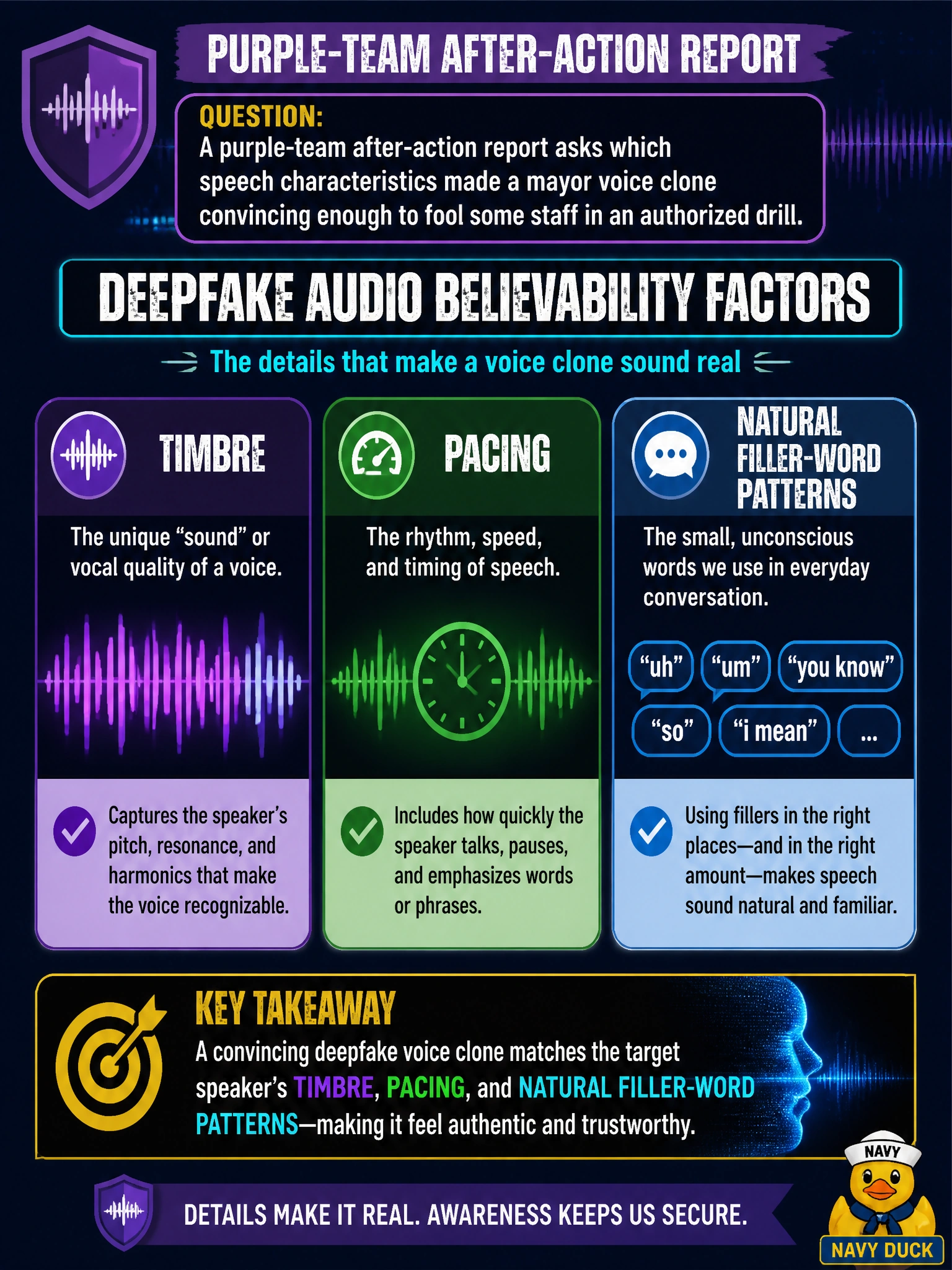
A purple-team after-action report asks which speech characteristics made a mayor voice clone convincing enough to fool some staff in an authorized drill. Which answer best reflects deepfake audio believability factors?
Select an answer to reveal the explanation.
Short Explanation
People buy a voice clone when it sounds like the person—tone color, rhythm, and those little ums and ahs—not when a filename is spelled right. After-actions should call out those speech cues. Endpoint AV settings did not make the mayor sound real.
Full Explanation
In an authorized drill after-action, speech characteristics that make a mayor voice clone convincing enough to fool some staff are typically timbre, pacing, and natural filler-word patterns that resemble the target speaker. Human listeners authenticate voices through tone color, rhythm, and habitual disfluencies more than through textual metadata. Purple-team AARs should call out those acoustic and prosodic cues so awareness training targets verification behavior rather than filename hygiene myths.
Exact spelling of the mayor's name in a transcript file does not make audio sound like the mayor. The city's TLS certificate expiration date on the public website is unrelated to voice believability. Whether Windows Defender cloud-delivered protection is set to default affects endpoint malware defense posture, not whether a cloned voice fools a human listener on a call.
Exam caveat: believability-factor questions want perceptual speech traits, not adjacent municipal IT controls used as distractors.
Operational check for civic purple teams: document which cues fooled staff; reinforce out-of-band verification; avoid publishing raw clone samples beyond ROE; and separate 'sounded real' lessons from Defender configuration discussions unless the drill explicitly tested technical detection of synthetic audio.