
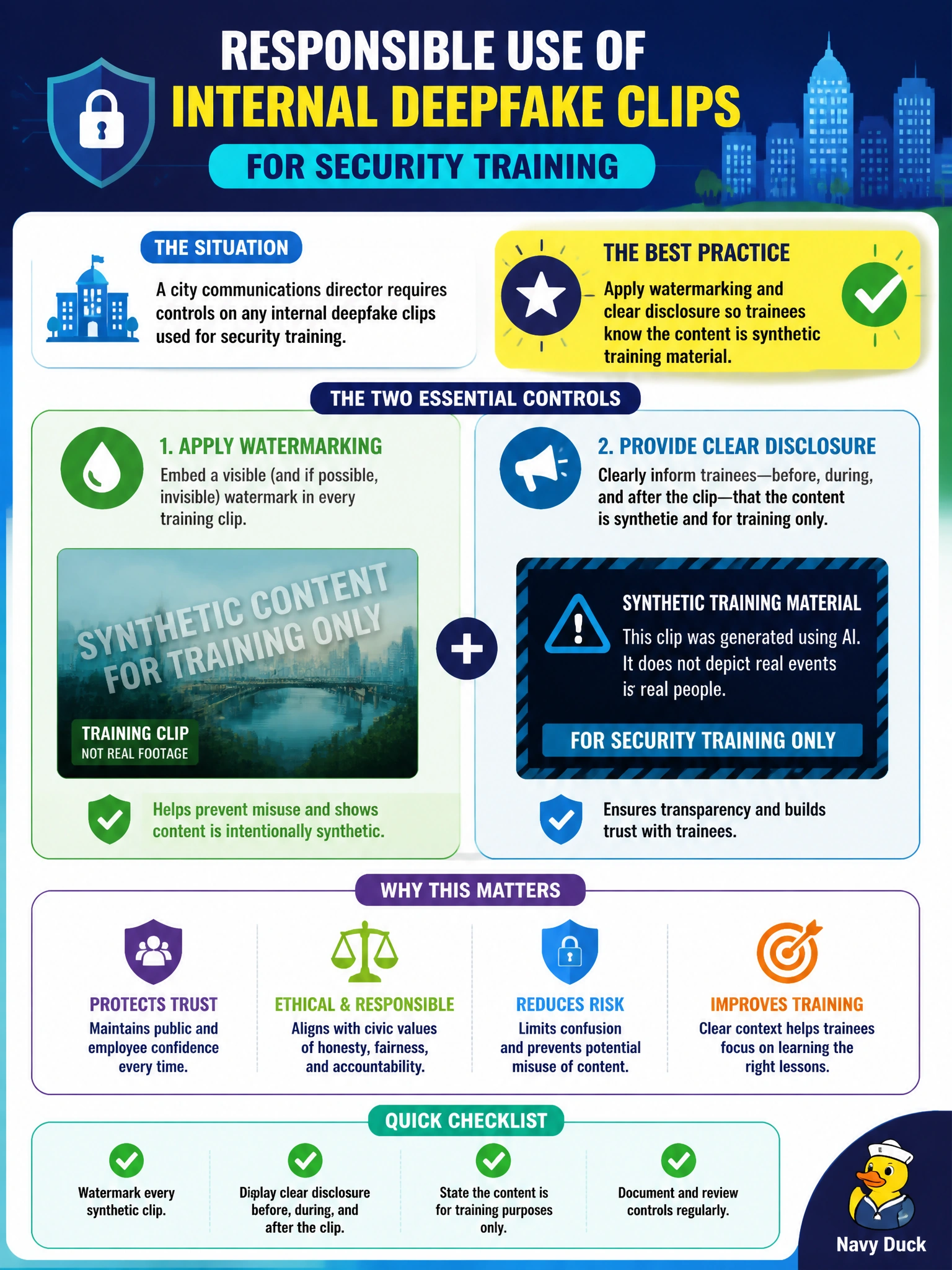
A city communications director requires controls on any internal deepfake clips used for security training. Which practice best aligns with responsible civic use?
Select an answer to reveal the explanation.
Short Explanation
If you show people a fake clip to teach them about fakes, label the jar—watermark it and say it is a drill. Unmarked official likenesses turn a lesson into a rumor factory. Disclosure keeps the training honest.
Full Explanation
Responsible civic use of internal deepfake clips for security training requires watermarking and clear disclosure so trainees know the content is synthetic training material. Labeling prevents rumor, accidental redistribution as real footage, and secondary trust damage to officials. Communications directors should treat unmarked official likenesses in training as a disinformation hazard even when intent is educational.
Distributing unmarked deepfake clips of real officials to all staff email lists without context invites confusion and viral misuse. Requiring trainees to share clips on personal social media to prove completion deliberately expands uncontrolled exposure. Storing training deepfakes in a public open-data portal for reuse by anyone removes access control and consent boundaries that municipal communications policy should enforce.
Exam caveat: responsible-use items prioritize disclosure, watermarking, and controlled distribution over transparency-theater that actually increases harm.
Operational check for city communications and security training teams: watermark every synthetic training clip; state 'training only / synthetic' in the first seconds and in accompanying text; restrict distribution to authenticated learning systems; prohibit social-media completion posting; and retain legal review for any use of real official likenesses.