
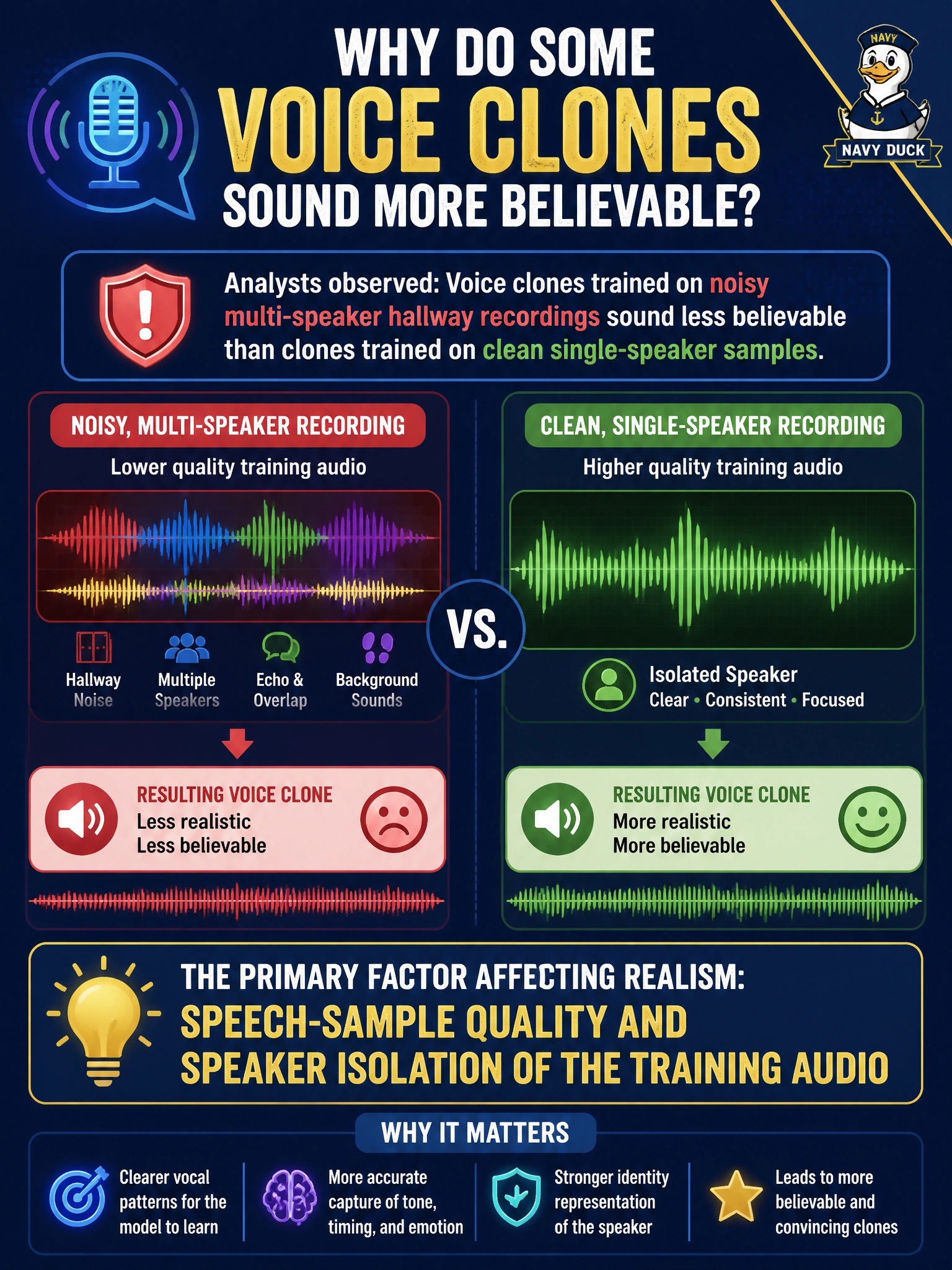
During a municipal red-team lab, analysts notice that voice clones trained on noisy multi-speaker hallway recordings sound less believable than clones trained on clean single-speaker samples. What factor is primarily affecting realism?
Select an answer to reveal the explanation.
Short Explanation
Garbage-in speech makes a garbage-out clone—hallway chatter and overlapping voices muddy the target's unique sound. Clean, isolated samples of one official produce far more convincing audio deepfakes in the lab. File container choice and email DNS are beside the point here.
Full Explanation
Convincing audio deepfakes depend heavily on the quality and purity of reference speech used for training or conditioning. Clean, isolated single-speaker samples preserve a municipal official's timbre, prosody, and phonetic detail, producing more believable clones in an authorized red-team lab. Noisy multi-speaker hallway recordings mix competing voices and ambient interference, degrading the model's ability to capture one speaker cleanly and reducing perceived realism. Civic purple teams document speech-sample quality and speaker isolation as primary realism factors so drills remain controlled and so staff understand why some clones sound stronger than others.
The city's SPF DNS record length for outbound mail governs email authentication policy, not speech-clone quality. Whether a clone file is stored as WAV or MP3 on a SOC share may affect fidelity after the fact but is not the primary training-data factor the analysts observed between noisy hallway audio and clean single-speaker samples. The number of ASR rules enabled on Windows Defender endpoints is an endpoint hardening setting unrelated to how realistic a voice clone sounds.
Exam caveat: distinguish training-data quality from unrelated municipal IT controls. Distractors often name familiar security products or mail DNS records; the stem is about clone realism from speech samples.
Operational check for municipal labs: use only authorized, consented, or synthetic reference audio under written ROE; prefer isolated samples when testing detection and verification procedures; never treat realism findings as guidance to harvest cleaner personal audio for unauthorized use; and brief that poorer training audio lowers clone believability without eliminating audio-deepfake risk entirely.