
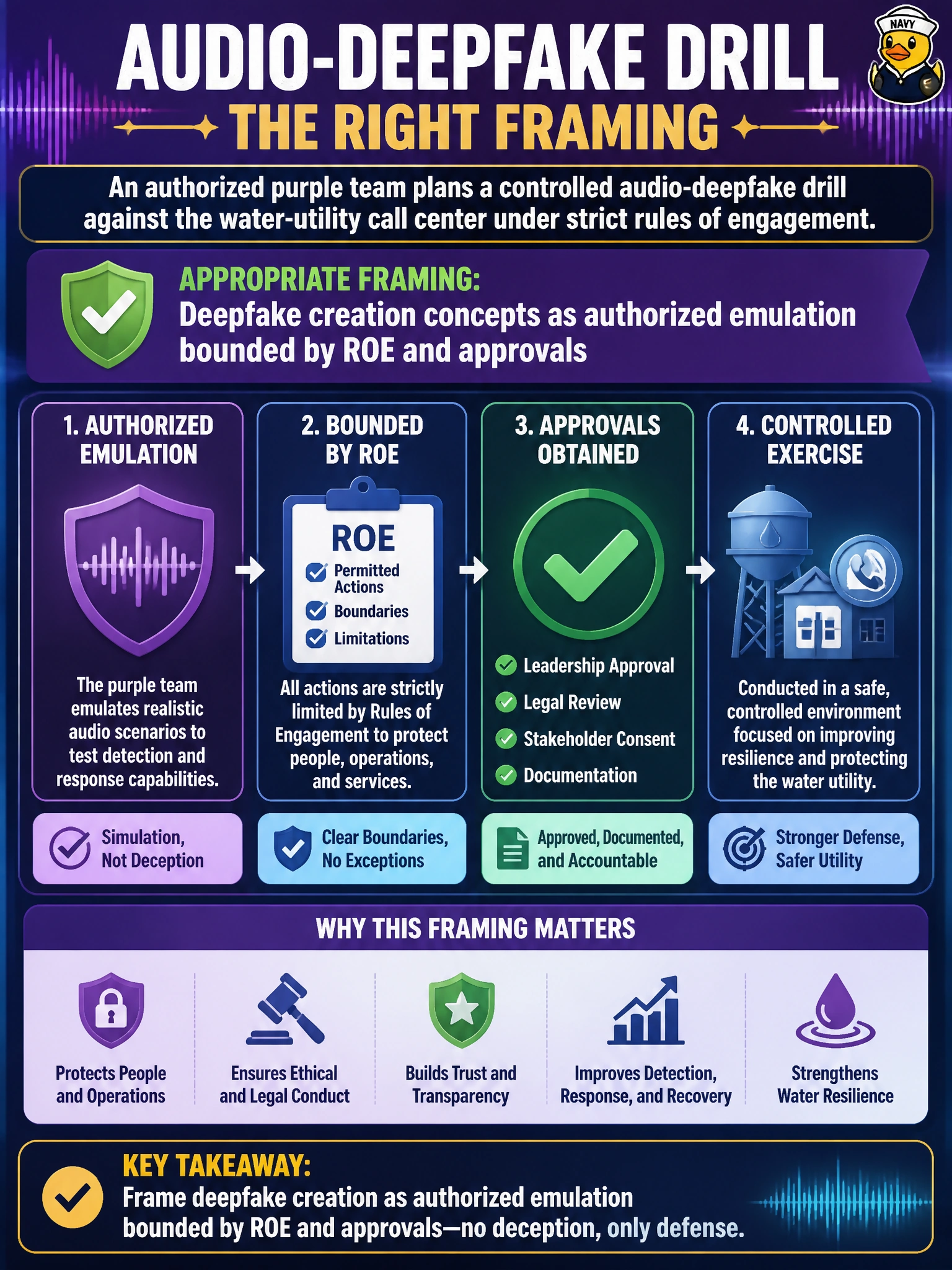
An authorized purple team plans a controlled audio-deepfake drill against the water-utility call center under strict rules of engagement. Which framing is appropriate?
Select an answer to reveal the explanation.
Short Explanation
Deepfake drills at the water call center only fly with a signed ROE and a tight scope—think fire drill, not ‘open-mic crime class.’ Authorization is the whole point of the framing.
Full Explanation
An authorized purple team planning a controlled audio-deepfake drill against the water-utility call center must frame deepfake creation concepts as authorized emulation bounded by ROE and approvals. Legal review, scope limits, and operational approvals turn a dangerous technique into a fire-drill-style recognition exercise. Authorization is the core of appropriate framing.
Unlimited production and public release of clones of random residents with no authorization is unethical and unlawful for a municipal drill. Skipping all legal review because deepfakes are always exempt from municipal policy invents a false exemption. Treating the drill as an unrestricted criminal tutorial for outside actors abandons defensive training intent and ROE discipline.
Exam caveat: civic deepfake drills = ROE-bounded authorized emulation; unbounded resident cloning, legal-review skip, and crime-howto framing are out of scope.
Operational check: obtain written ROE and legal sign-off, limit targets to consented or synthetic voices where policy requires, confine playback to the call-center exercise window, debrief recognition and escalation procedures, and destroy or vault drill artifacts under retention rules so they cannot leak as real clones.