
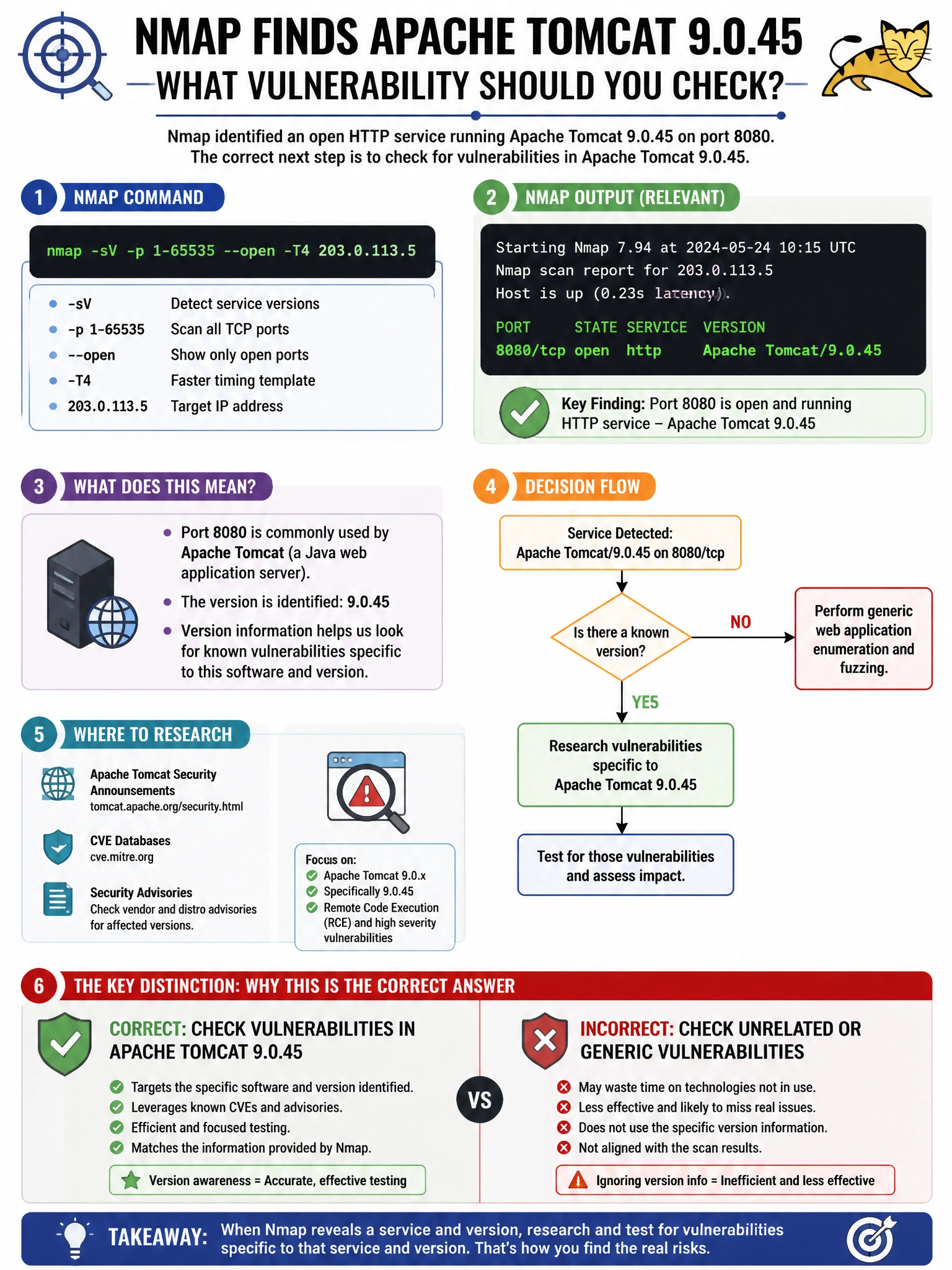
During an nmap scan, a tester runs: nmap -sV -p 1-65535 --open -T4 203.0.113.5. The output shows port 8080/tcp open http Apache Tomcat/9.0.45. What vulnerability should the tester prioritize investigating based on this result?
Select an answer to reveal the explanation.
Short Explanation and Infographic
Here's the deal — b is correct because a specific Tomcat version exposed on a non-standard port provides a precise attack surface to research; Tomcat has had critical RCEs (Ghostcat CVE-2020-1938, CVE-2019-0232, deserialization), and the Tomcat Manager application with default credentials (tomcat/tomcat) is a common high-severity finding. A is wrong because all software versions should be checked for CVEs.
Full explanation below image
Full Explanation
B is correct because a specific Tomcat version exposed on a non-standard port provides a precise attack surface to research; Tomcat has had critical RCEs (Ghostcat CVE-2020-1938, CVE-2019-0232, deserialization), and the Tomcat Manager application with default credentials (tomcat/tomcat) is a common high-severity finding. A is wrong because all software versions should be checked for CVEs. C is wrong because port 8080 hosting Tomcat indicates a Java web application, not necessarily a proxy. D is wrong because version banners are typically accurate and should be verified by research rather than dismissed.