
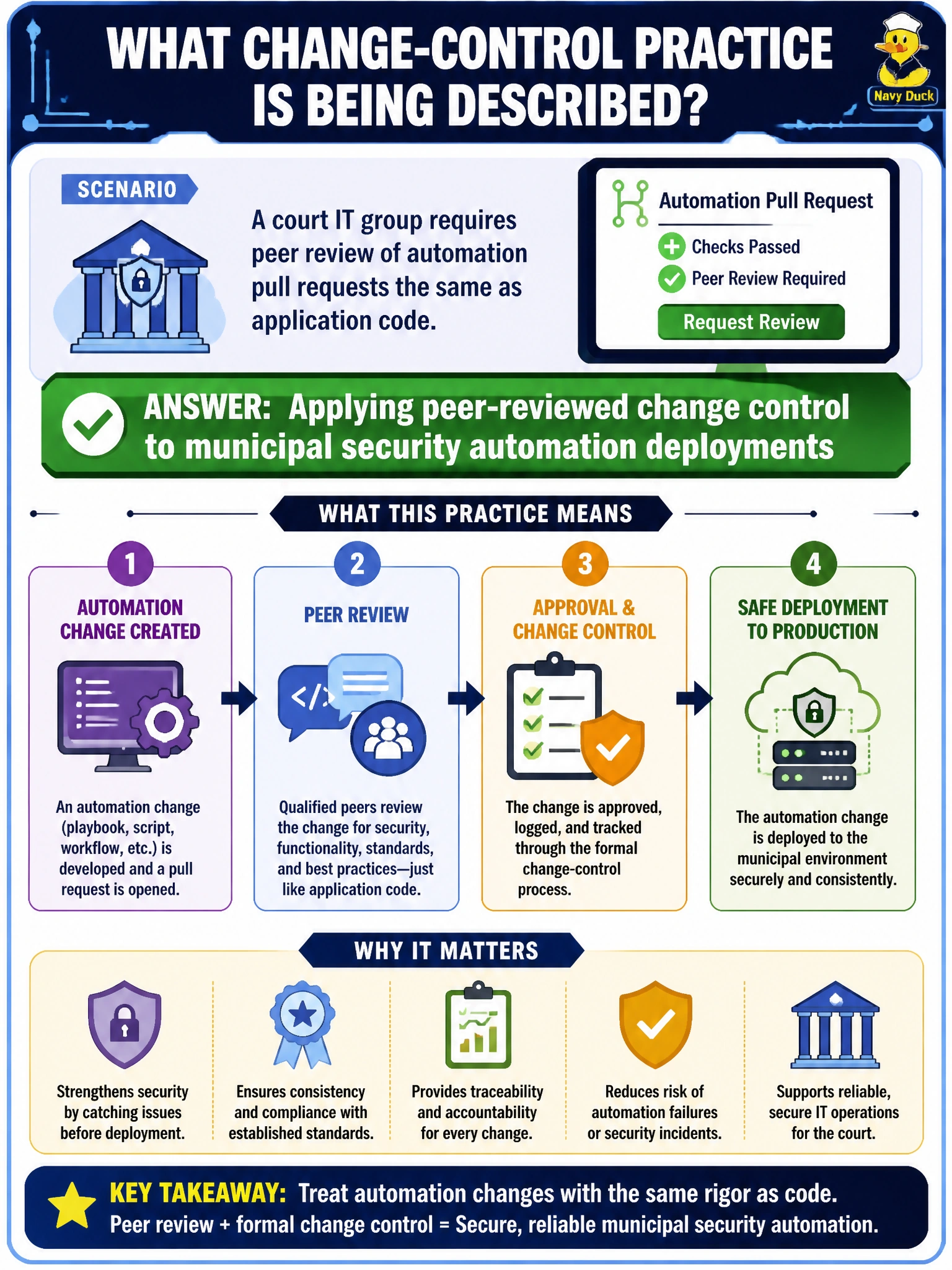
A court IT group requires peer review of automation pull requests the same as application code. What change-control practice is that?
Select an answer to reveal the explanation.
Short Explanation
Automation that can lock accounts is application code—treat the PRs that way. Coordinating peer-reviewed releases, keeping peer-reviewed rollback plans, and logging peer-reviewed approvals are useful, but you don't get it just by picking a window, vetting a backup, or recording a sign-off — you'll get it when a peer actually reviews the PR. Peer review is the civic change-control habit.
Full Explanation
A court IT group that requires peer review of automation pull requests the same as application code is applying change control to municipal security automation. Playbooks that lock accounts, quarantine mail, or isolate endpoints are privileged software. Reviewing diffs for logic errors, overly broad scopes, and missing failure handling before merge reduces the chance that an unvetted edit disrupts judicial operations or evidence handling. Treating automation PRs like app PRs aligns civic DevOps with the blast radius of the code.
Why the other options fail by concept: Coordinating peer-reviewed releases within municipal security automation change windows addresses scheduling, not the review requirement itself—it slots already-reviewed releases into authorized windows but does not establish peer review of automation pull requests the same as application code. Maintaining peer-reviewed rollback plans for municipal security automation deployments is a recovery control, not a review control—it means the fallback plan was vetted but does not stop an unreviewed automation change from being merged. Recording peer-reviewed approvals in municipal security automation audit logs creates an after-the-fact trail of vetted approvals, but it does not itself enforce peer review of the automation pull request before it is deployed.
Exam caveat: Peer review improves quality and accountability but does not replace testing, least privilege, or approval gates for high-impact steps. Operational check: require PR review and CI checks for playbook changes, block direct production edits, and keep review records with the court change ticket that authorized the deploy.
Prefer to study offline? Printable PDF study book + test engine ($7.50, unofficial). These questions stay free here.