
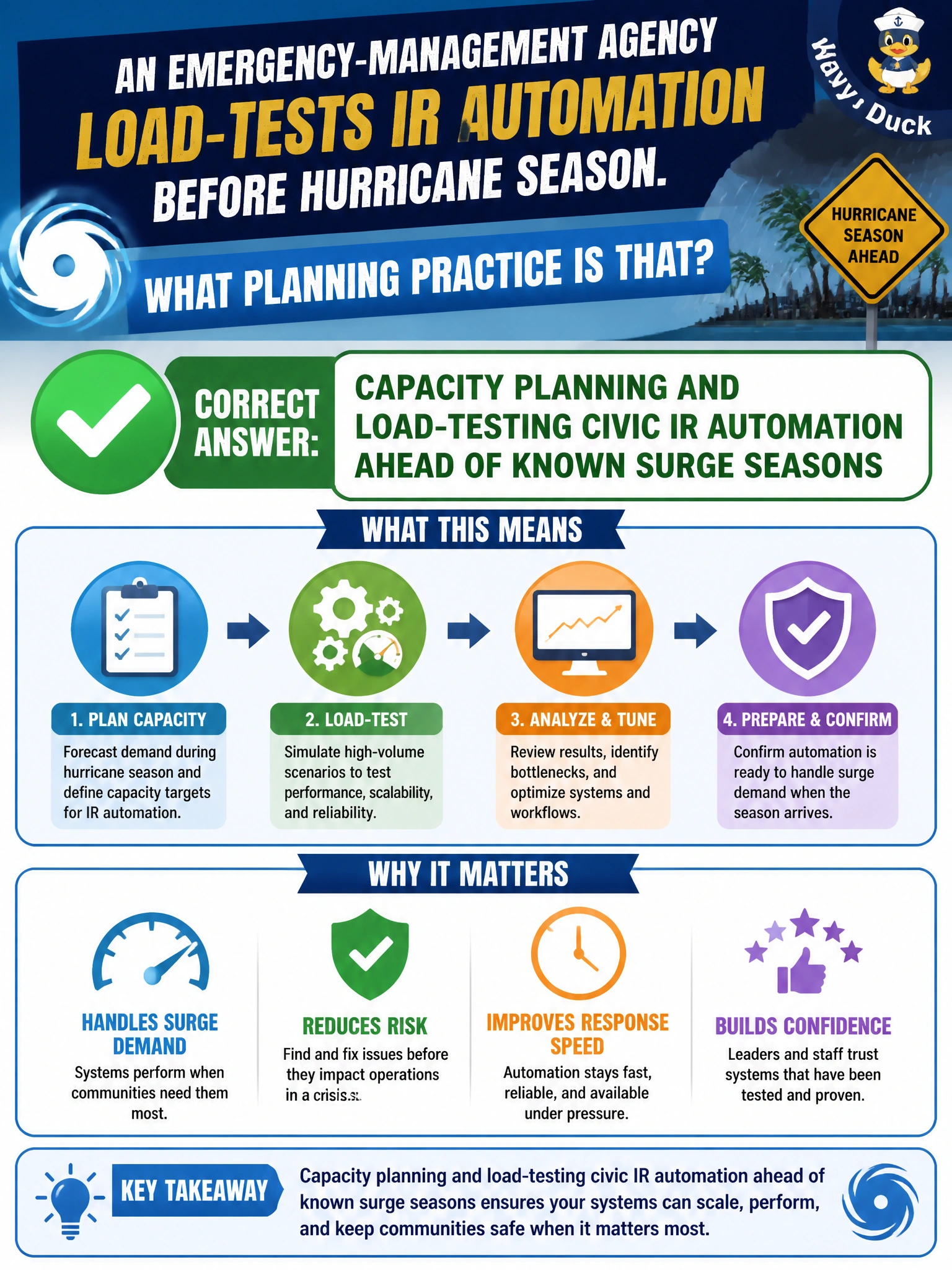
An emergency-management agency load-tests IR automation before hurricane season. What planning practice is that?
Select an answer to reveal the explanation.
Short Explanation
Storm season isn't the time to find your playbooks choke. Load-test IR automation while skies are clear. Capacity planning keeps emergency ops from drowning in their own queues.
Full Explanation
An emergency-management agency that load-tests incident-response automation before hurricane season is capacity planning for a known surge. Storm weeks multiply alerts, ticket volume, notification fan-out, and playbook concurrency far beyond quiet-week baselines. Exercising queues, workers, and connector rate limits ahead of landfall reveals backlogs, timeouts, and scaling limits while the sky is still clear, so civic IR automation can absorb surge instead of collapsing when mutual-aid partners and public-info channels need it most. Why the other options fail by concept: Penetration testing and hardening civic IR automation ahead of known surge seasons uses the right system and season-ahead timing but the wrong activity, so it finds exploitable weaknesses rather than measuring whether IR automation queues and connectors can absorb actual alert volume before landfall. Configuring auto-scaling and failover for civic IR automation ahead of known surge seasons sets up elasticity ahead of need but does not validate it, so it does not prove whether automation can handle storm-week concurrency and rate limits without an actual load test. Updating runbooks and training civic IR automation analysts ahead of known surge seasons improves procedure and people readiness but does not prove the security orchestration path that drives containment and notifications can scale under load. Exam caveat: Load tests approximate surge; real disasters add novel alert types and partner integrations, so advance IR-automation capacity work before the season should not be confused with penetration testing and hardening, configuring auto-scaling and failover, or updating runbooks and training analysts. Operational check: before peak season, define surge scenarios, load-test IR automation and connectors, record max sustainable throughput and failure modes, and pre-stage scale or queue priorities with municipal owners.
Prefer to study offline? Printable PDF study book + test engine ($7.50, unofficial). These questions stay free here.