
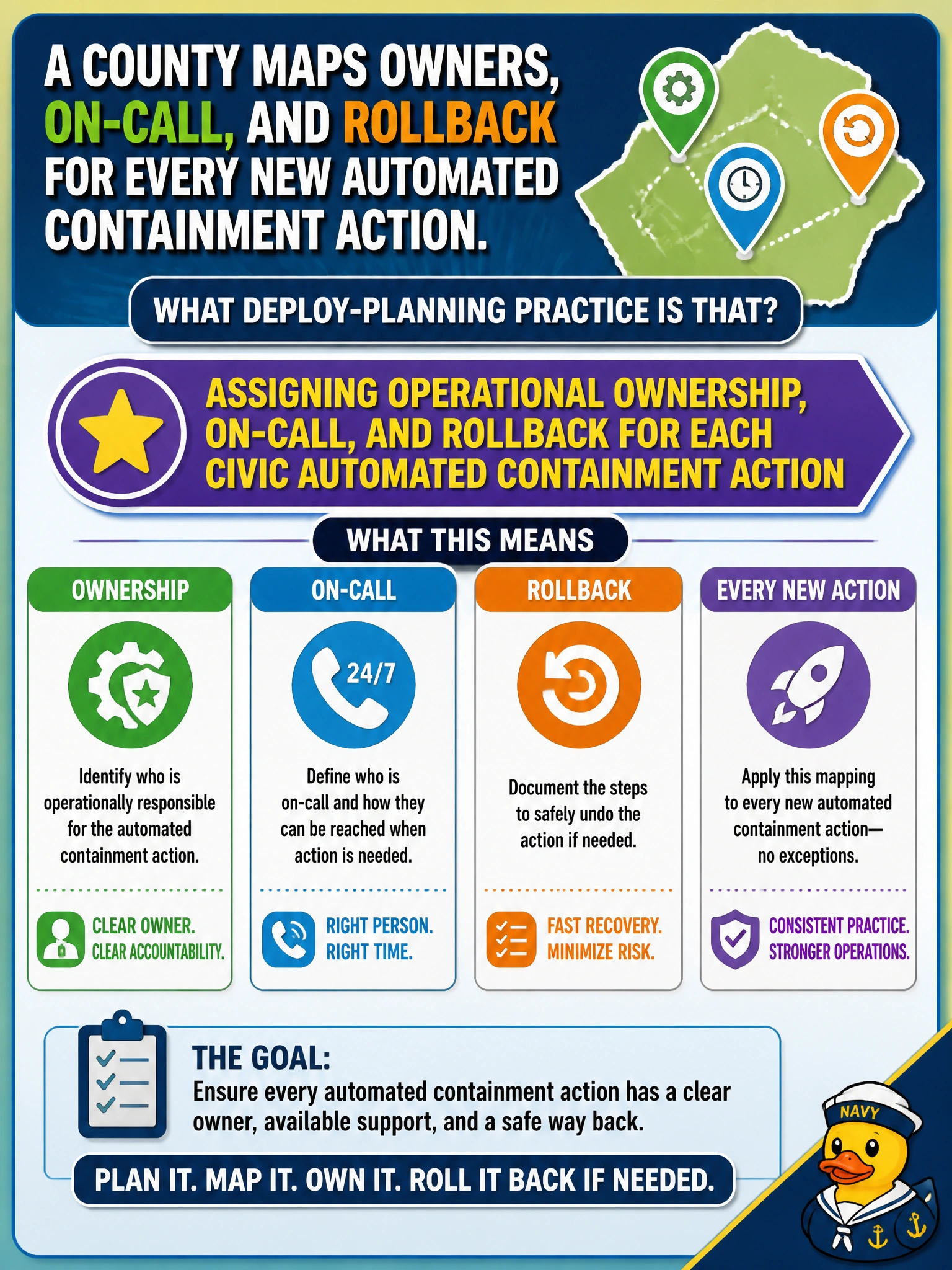
A county maps owners, on-call, and rollback for every new automated containment action. What deploy-planning practice is that?
Select an answer to reveal the explanation.
Short Explanation
Who owns it at 2 a.m., and how do you undo it? Assigning ownership to action logs, action templates, and action scenarios sounds thorough, but you still haven't named who owns the live containment action and how you'll roll it back. Map owners, on-call, and rollback before the button exists.
Full Explanation
A county that maps owners, on-call contacts, and rollback steps for every new automated containment action is applying deploy-planning discipline to civic security automation. Containment can isolate endpoints, block network paths, or lock accounts; without a named owner and undo path, the automation becomes an unowned change in production. Documenting ownership and rollback before promote means the municipal on-call can answer who authorized the action, how to reverse it, and who pages when the action misfires during a real incident.
Why the other options fail by concept: Assigning operational ownership, on-call, and rollback for each civic automated containment action log puts ownership on the audit record rather than the live containment action, so it does not name who owns the automation that isolates endpoints or how to reverse that action when it misfires. Assigning operational ownership, on-call, and rollback for each civic automated containment action template puts ownership on the generic template rather than each new civic automated containment action as deployed, so the specific production promote can still go out without a named owner and undo path. Assigning operational ownership, on-call, and rollback for each civic automated containment action scenario puts ownership on a simulated practice scenario rather than the production automation, so it does not provide the per-action deploy-planning needed before each new containment action is promoted.
Exam caveat: Ownership and rollback plans do not make every containment action safe to fully automate; high-impact civic actions may still need human approval gates. Operational check: for each civic automated containment action, record primary owner, on-call rotation, rollback steps and time target, then dry-run the rollback in a non-production civic environment before the first enforce promote.
Prefer to study offline? Printable PDF study book + test engine ($7.50, unofficial). These questions stay free here.