
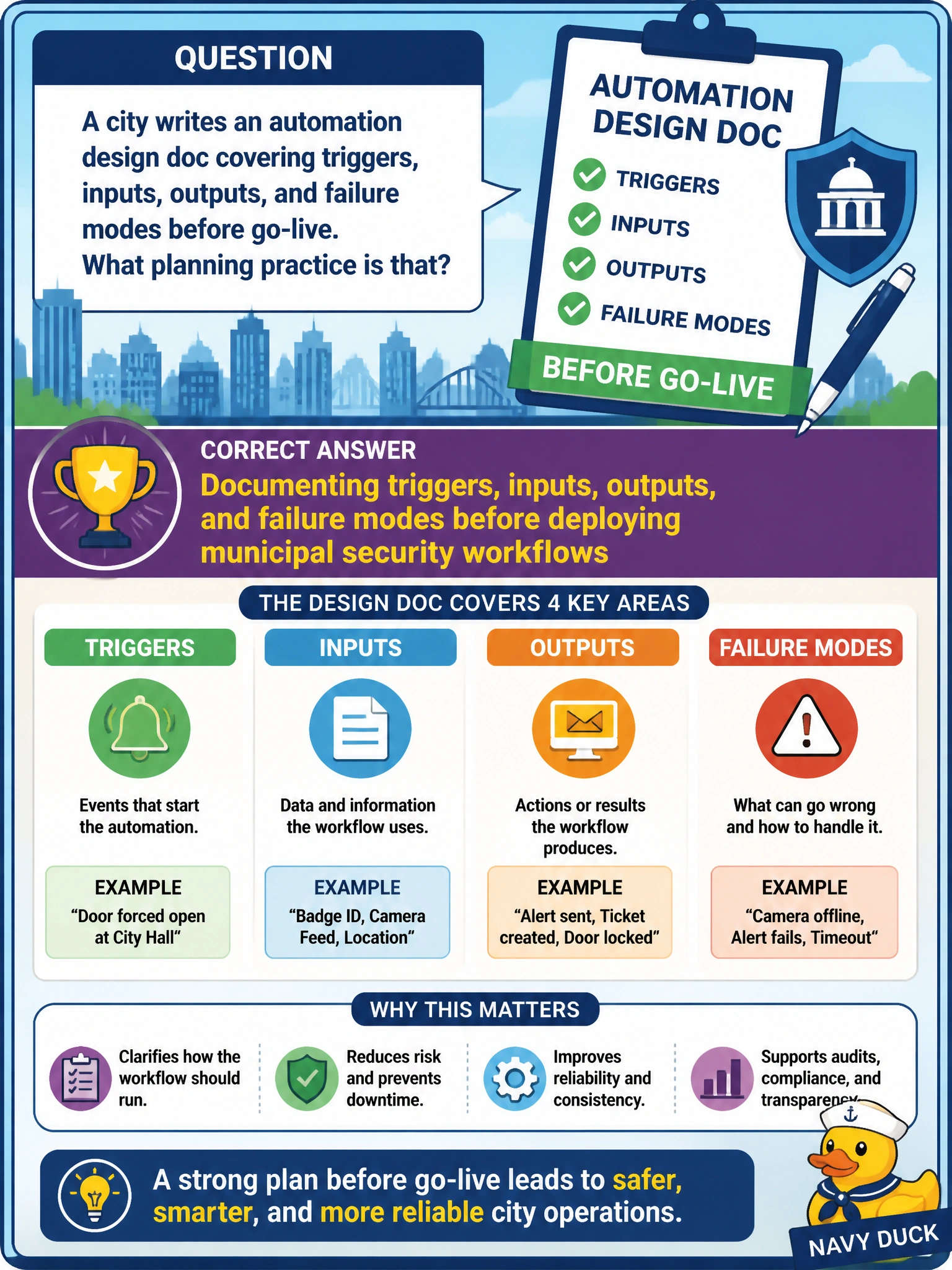
A city writes an automation design doc covering triggers, inputs, outputs, and failure modes before go-live. What planning practice is that?
Select an answer to reveal the explanation.
Short Explanation
Write the recipe before you cook—triggers, inputs, outputs, and what breaks. Retiring workflows is about shutdown, but it's not the pre-deployment planning for deploying your workflows you need. Design docs are the civic seatbelt.
Full Explanation
A city that writes an automation design document covering triggers, inputs, outputs, and failure modes before go-live is practicing disciplined planning for municipal security workflows. Those artifacts define when the workflow fires, what data it consumes, what actions or tickets it produces, and how partial failure, timeout, or bad input should behave. Capturing that before production turns civic automation from tribal knowledge into something on-call staff, auditors, and successor teams can operate safely during permit spikes, council nights, or after-hours incidents.
Why the other options fail by concept: Documenting triggers, inputs, outputs, and failure modes before scaling municipal security workflows gets the phase wrong, because scaling is post-deployment expansion, not the pre-deployment planning before go-live that makes deploying safe. Documenting triggers, inputs, outputs, and failure modes before retiring municipal security workflows changes the subject to decommissioning, which is not planning for deploying municipal security workflows. Documenting triggers, inputs, outputs, and failure modes before monitoring municipal security workflows changes the subject to ongoing operations, which does not describe planning for deploying municipal security workflows.
Exam caveat: A design doc is necessary planning hygiene, not proof that the automation is correctly implemented or authorized; peer review, testing, and change approval still apply. Operational check: before go-live, require a signed-off design covering triggers, inputs, outputs, and failure modes, walk the failure paths with on-call owners, and store the doc with the playbook version that will run in the city environment.
Prefer to study offline? Printable PDF study book + test engine ($7.50, unofficial). These questions stay free here.