
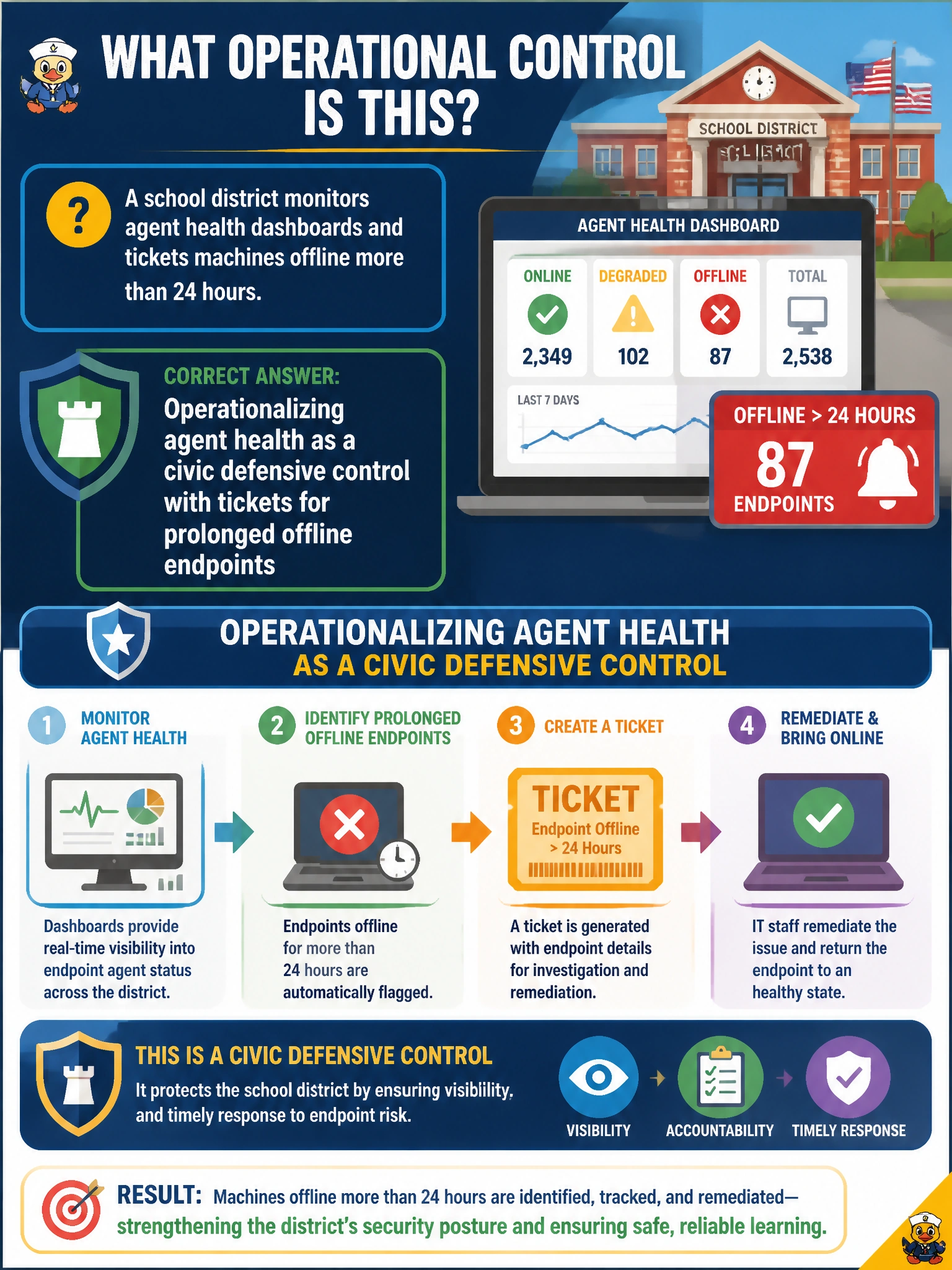
A school district monitors agent health dashboards and tickets machines offline more than 24 hours. What operational control is that?
Select an answer to reveal the explanation.
Short Explanation
If you see a school laptop's agent has been dark over a day, open a ticket—health dashboards are a control, not wallpaper. Routing that telemetry to vulnerability-management queues, bundling it into capacity-planning dashboards, or handing follow-ups to asset-inventory refresh workflows won't create the ticket you need for a prolonged-offline endpoint. Treat offline as actionable.
Full Explanation
Monitoring agent health dashboards and ticketing machines offline more than 24 hours operationalizes agent health as a civic defensive control. EDR/logging agents that stop checking in create blind spots on school endpoints that may still be powered on and in use—or silently compromised. Treating prolonged offline as a ticketable event (with owner, SLA, and resolution codes) makes sensor health actionable instead of a ignored chart on a wall display.
Routing agent health telemetry to vulnerability management queues for scan coverage validation misses the point: scan coverage validation is a different workflow and does not turn a prolonged-offline endpoint into a ticketable sensor-health event with an owner and SLA. Aggregating agent heartbeat data into infrastructure performance dashboards for capacity planning reviews misdirects the signal: capacity planning is not the same as ticketing endpoints that have been offline more than 24 hours as a defensive control. Assigning offline endpoint follow-ups to asset inventory workflows for device refresh lifecycle tracking conflates sensor health with hardware lifecycle management: device refresh tracking does not create the ticketable, SLA-driven response that prolonged offline agents need.
Exam caveat: Offline thresholds should match device classes (always-on lab servers vs. student laptops that sleep). Distinguish powered-off/vacation devices from unexpected offline on devices that should be present via attendance or Intune last-check-in correlation. Tune to limit ticket noise while still catching true gaps.
Operational check: Define >24h offline (or policy-appropriate) alerting into the school ITSM queue; assign owners by site; review daily offline backlog; escalate chronic offenders; and include agent health coverage in district security KPIs reported alongside incident counts.
Prefer to study offline? Printable PDF study book + test engine ($7.50, unofficial). These questions stay free here.