
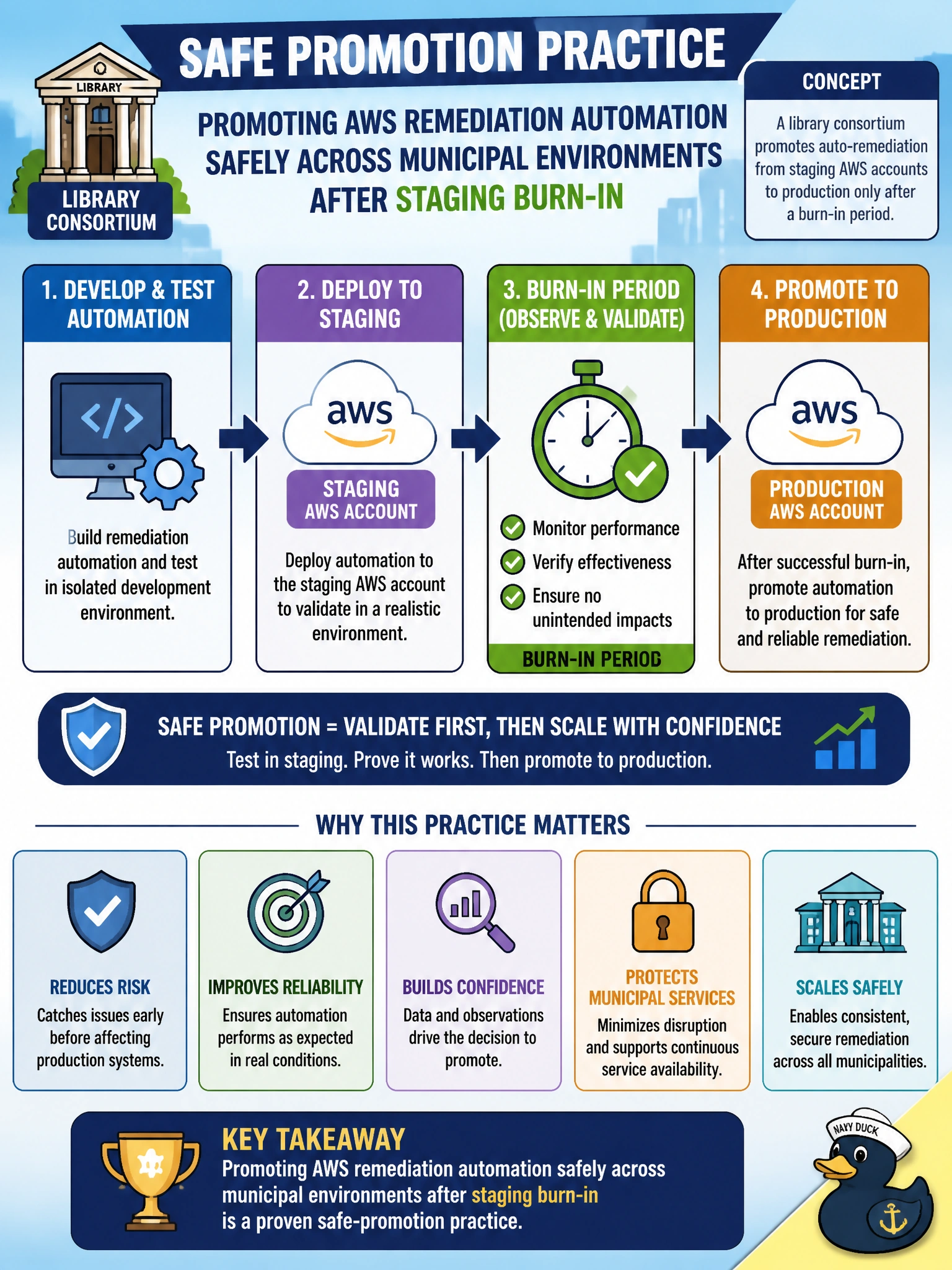
A library consortium promotes auto-remediation from staging AWS accounts to production only after a burn-in period. What safe-promotion practice is that?
Select an answer to reveal the explanation.
Short Explanation
Burn-in in staging, then promote—library production catalogs are not the first guinea pigs. You'll miss it if you pick Config detection rules, IAM permission boundaries, or CloudTrail log forwarding since they don't give prod proven remediation. Promote after proof.
Full Explanation
Promoting AWS remediation automation safely across municipal environments after staging burn-in lets a library consortium prove auto-remediation behavior against non-production catalogs before production libraries receive the same automation. Burn-in surfaces false positives, excessive blast radius, and permission mistakes where citizen-facing catalog impact is limited. Safe promotion is a continuous-improvement control: automation earns the right to protect production after observed stability in staging municipal accounts. Promoting AWS Config detection rules safely across municipal environments after staging burn-in fails because detection alone does not promote or execute auto-remediation; production libraries would receive proven finding logic without the proven remediation automation, guardrails, and promotion controls, so citizen-facing catalogs gain no proven auto-remediation protection. Promoting AWS IAM permission boundaries safely across municipal environments after staging burn-in fails because promoting permission boundaries alone does not promote the tested remediation automation itself; production libraries receive permission guardrails without the proven remediation logic and promotion controls, so citizen-facing catalogs gain no proven auto-remediation protection. Promoting AWS CloudTrail log forwarding safely across municipal environments after staging burn-in fails because log forwarding is not auto-remediation promotion; the question concerns moving proven remediation from staging to production, not centralizing audit trails. Exam caveat: Safe promotion after staging burn-in is the expected answer when stems describe moving auto-remediation from staging to production. Promoting Config detection rules only, promoting IAM permission boundaries alone, and CloudTrail log forwarding are distractors. Operational check for a library consortium cloud team: deploy auto-remediation to staging accounts first, run a defined burn-in period with success and failure injects, document promotion criteria, then promote to production with the same IAM boundaries and rollback tags used in staging.
Prefer to study offline? Printable PDF study book + test engine ($7.50, unofficial). These questions stay free here.