
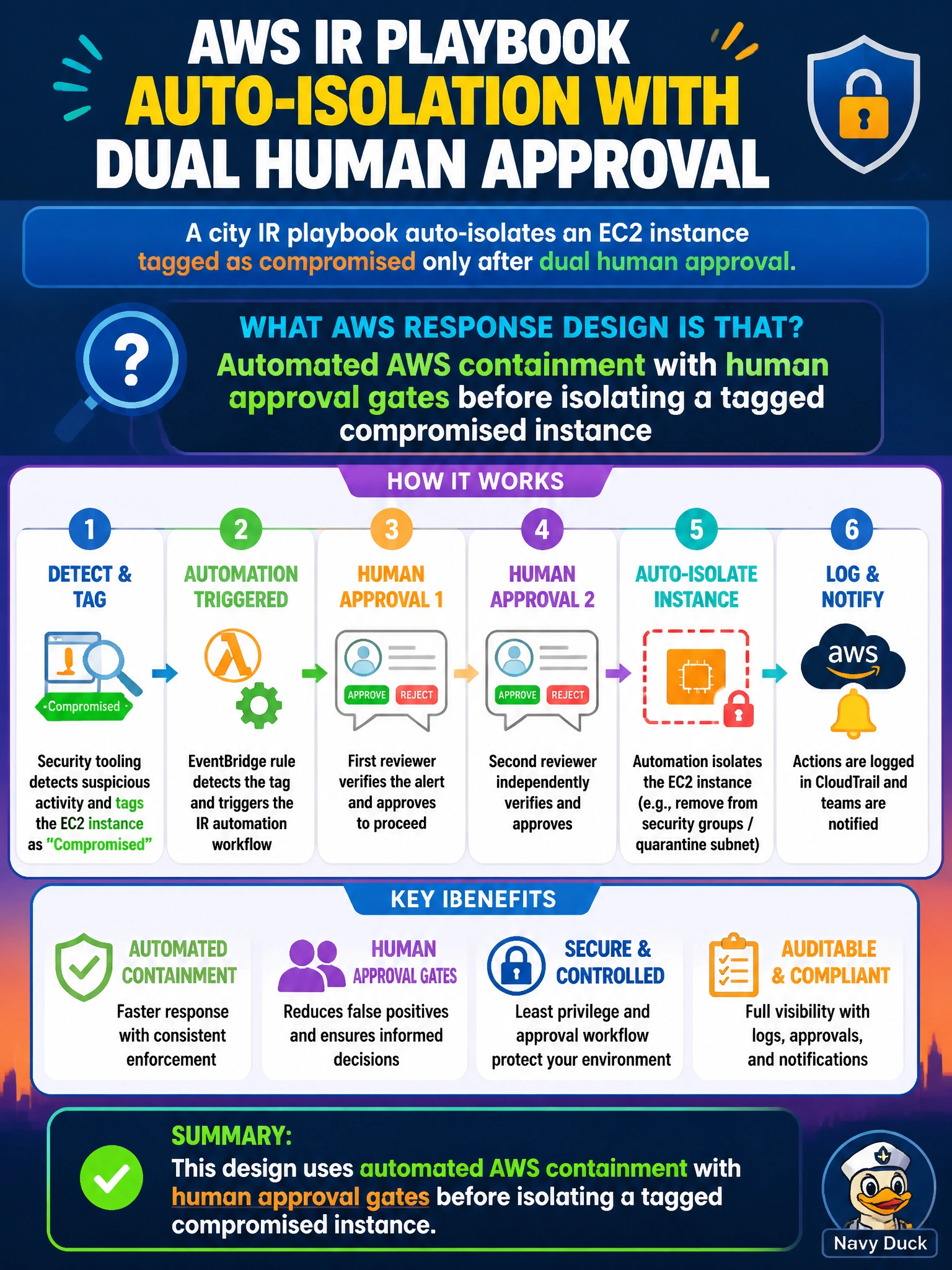
A city IR playbook auto-isolates an EC2 instance tagged as compromised only after dual human approval. What AWS response design is that?
Select an answer to reveal the explanation.
Short Explanation
Automation can pull the isolation lever, but you still need two humans nodding first in city IR. Patching keeps you uncontained, scheduling keeps you waiting on a timer, and an Inspector assessment just scans when you've got to isolate. Gate the containment.
Full Explanation
Automated AWS containment with human approval gates before isolating a tagged compromised instance balances speed and safety for city IR: automation prepares or proposes isolation of an EC2 instance marked compromised, but dual human approval authorizes the network or instance isolation action. Approval gates reduce blast-radius mistakes on production municipal systems while still allowing playbooks to move faster than purely manual console work. Tagging identifies the intended target so containment stays scoped to the compromised host rather than the whole account. Automated Systems Manager patching with human approval gates before isolating a tagged compromised instance fails because patching is remediation, not containment—it installs OS patches but leaves network connectivity intact so the host can keep exposing municipal systems, and it delays isolation, so even with dual approval it does not achieve the required immediate isolation of the tagged compromised instance. Automated EventBridge scheduling with human approval gates before isolating a tagged compromised instance fails because scheduling is time-based triggering, not IR containment—it runs on a timetable rather than executing network or instance isolation logic for investigation, so even with dual approval it is the wrong mechanism for this playbook. Automated Inspector assessment with human approval gates before isolating a tagged compromised instance fails because assessment is scanning, not containment execution—Inspector finds weaknesses and exposures but does not perform network or instance isolation, so even with dual approval it does not satisfy the playbook requirement to execute isolation of the tagged compromised instance. Exam caveat: GASAE AWS IR design questions often expect automation plus human approval for destructive or disruptive containment—not Systems Manager patching of a compromised host with approval, not EventBridge scheduling of isolation with approval, and not Inspector assessment of a compromised host that never executes containment. Operational check for city IR: in a staging account, tag a sacrificial EC2 instance as compromised, run the playbook through the dual-approval path, confirm isolation occurs only after both approvals, and verify that patching-with-approval, scheduling-with-approval, or Inspector-assessment-with-approval are not substituted for the dual-approval isolation of production municipal workloads.
Prefer to study offline? Printable PDF study book + test engine ($7.50, unofficial). These questions stay free here.