
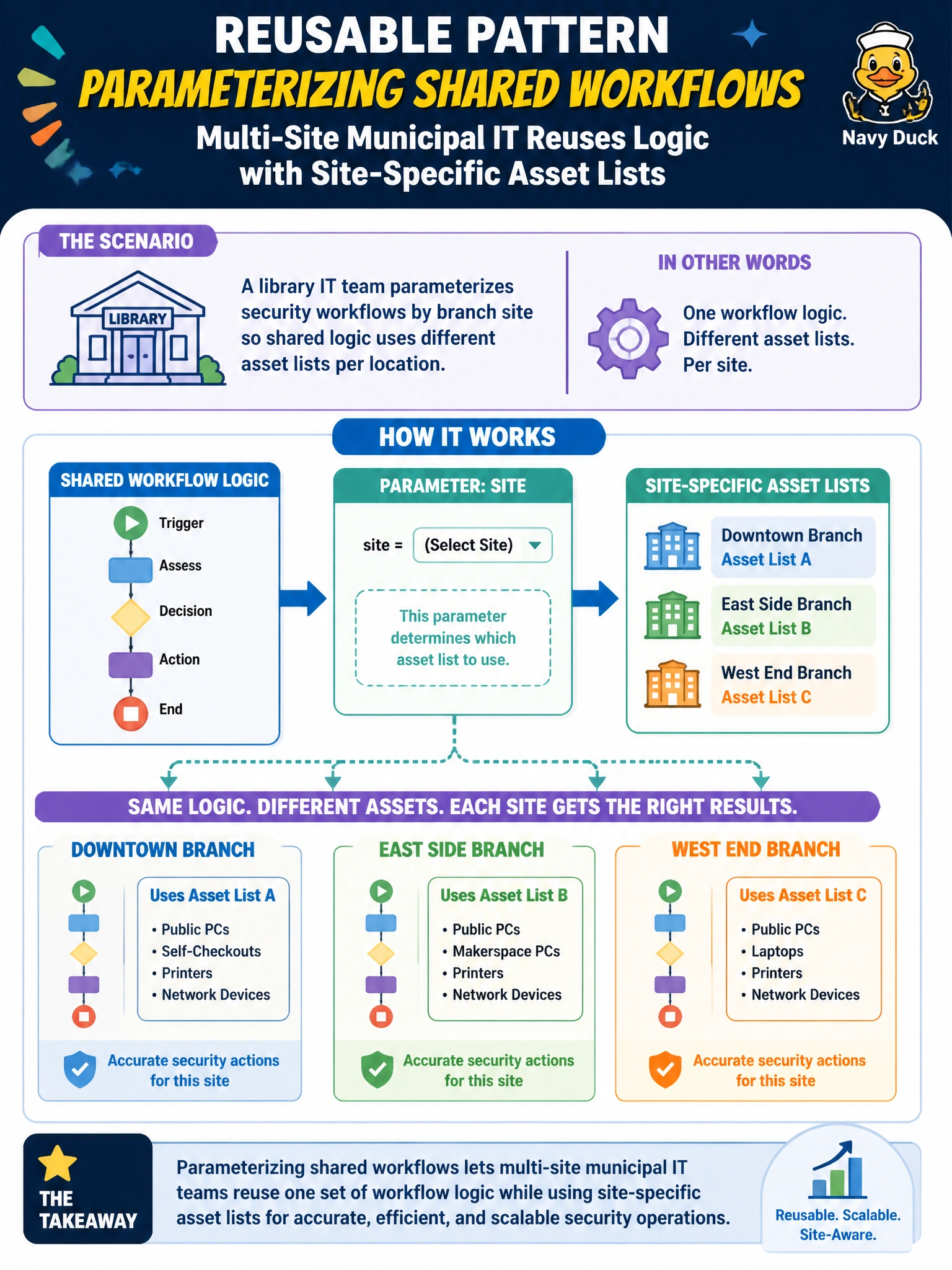
A library IT team parameterizes security workflows by branch site so shared logic uses different asset lists per location. What reusable pattern is that?
Select an answer to reveal the explanation.
Short Explanation
Same recipe, different grocery list per library branch—parameters keep the logic shared and the assets local. If you're reusing clones with site-specific asset lists, you've got to patch every clone by hand when the shared logic changes. Parameterize the sites.
Full Explanation
Parameterizing shared workflows so multi-site municipal IT reuses logic with site-specific asset lists lets a library IT team keep one enrich-and-remediate recipe while injecting branch-site parameters such as asset inventories, VLAN scopes, and notification contacts. Shared logic stays under central review; per-location data remains local to each branch. That pattern scales civic multi-site operations without forking a separate brittle script per library and without pretending headquarters assets represent every branch. Parameterizing shared workflows so multi-site municipal IT reuses clones with site-specific asset lists fails because it abandons the shared workflow model—each branch becomes its own brittle fork, so a shared control fix must be replicated into every clone instead of being updated once as a parameter. Parameterizing shared workflows so multi-site municipal IT reuses logic with site-specific telemetry views fails because it parameterizes the wrong input—it only customizes telemetry views after the fact and does not run the shared security workflow with branch-specific asset lists across the branches. Parameterizing shared workflows so multi-site municipal IT reuses logic with centralized asset lists fails because it keeps one asset list for every site, so headquarters assets misrepresent branch scopes and branch sites never get automated, site-specific asset enforcement. Exam caveat: GASAE reusable-workflow items often test parameterization for multi-site civic IT. Prefer site-specific parameters over reusing clones with site-specific asset lists, reusing logic with site-specific telemetry views, or reusing logic with centralized asset lists when the stem mentions branch locations and shared logic. Operational check for library IT: define a required site parameter on the shared workflow, bind each branch to its approved asset list and VLAN map, execute a staging enrichment for two branches, and verify outputs reference only the selected site's assets while the shared step definitions remain identical across runs.
Prefer to study offline? Printable PDF study book + test engine ($7.50, unofficial). These questions stay free here.