
A parks department rebuilds a disposable purple-team firing range from IaC overnight. What provisioning approach is that?
Select an answer to reveal the explanation.
Short Explanation
IaC overnight rebuilds give parks a fresh disposable firing range—like resetting a rental cabin before the next guests. Stateful ephemeral ranges that keep yesterday's state, mutable IaC you'll have to patch in place, and backup restores that drag old artifacts along are bad neighbors. Ephemeral and coded wins.
Full Explanation
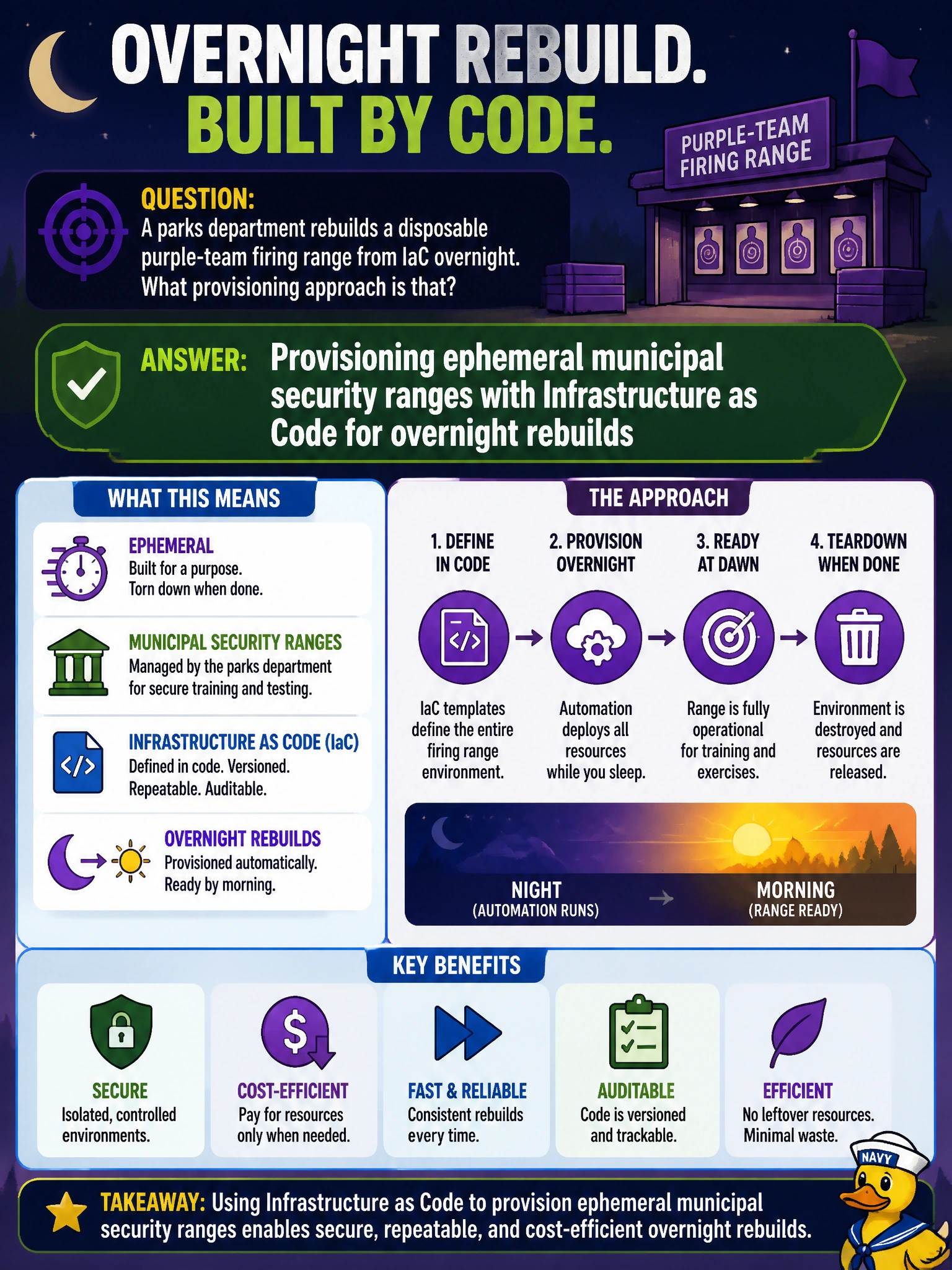
Provisioning ephemeral municipal security ranges with Infrastructure as Code for overnight rebuilds is the approach when a parks department rebuilds a disposable purple-team firing range from IaC. Provisioning ephemeral stateful security ranges with Infrastructure as Code for overnight rebuilds still carries forward saved state between overnight rebuilds, and stateful rebuilds are not the disposable clean-slate cycle the parks department actually uses—stateful ranges do not guarantee a clean ephemeral baseline each morning. IaC overnight rebuilds give parks a clean, authorized playground without permanently consuming production capacity.
Provisioning ephemeral stateful security ranges with Infrastructure as Code for overnight rebuilds still carries forward saved state between overnight rebuilds, and state-based rebuilds are not the disposable IaC-driven cycle the parks department actually uses—stateful persistence retains prior artifacts instead of resetting to a clean disposable baseline each morning. Provisioning ephemeral municipal security ranges with mutable Infrastructure as Code for overnight rebuilds fails by concept: mutable IaC allows in-place edits that are inconsistent and do not scale to clean overnight automation, and mutable infrastructure accumulates configuration drift instead of resetting to a known-good baseline each morning. Provisioning ephemeral municipal security ranges with Infrastructure as Code backups for overnight rebuilds fails by concept: backup-based restores are not IaC-driven overnight rebuilds, and reusing backed-up state risks leftover credentials or malware artifacts from prior exercises instead of a clean ephemeral baseline.
Exam caveat: ephemeral does not mean unmonitored—range networks still need isolation, logging, and teardown verification so leftover public endpoints do not remain exposed. Operational check: trigger the IaC rebuild, verify yesterday's range resources are destroyed, confirm today's range matches the template baseline, and validate it cannot route into production parks services.
Prefer to study offline? Printable PDF study book + test engine ($7.50, unofficial). These questions stay free here.