
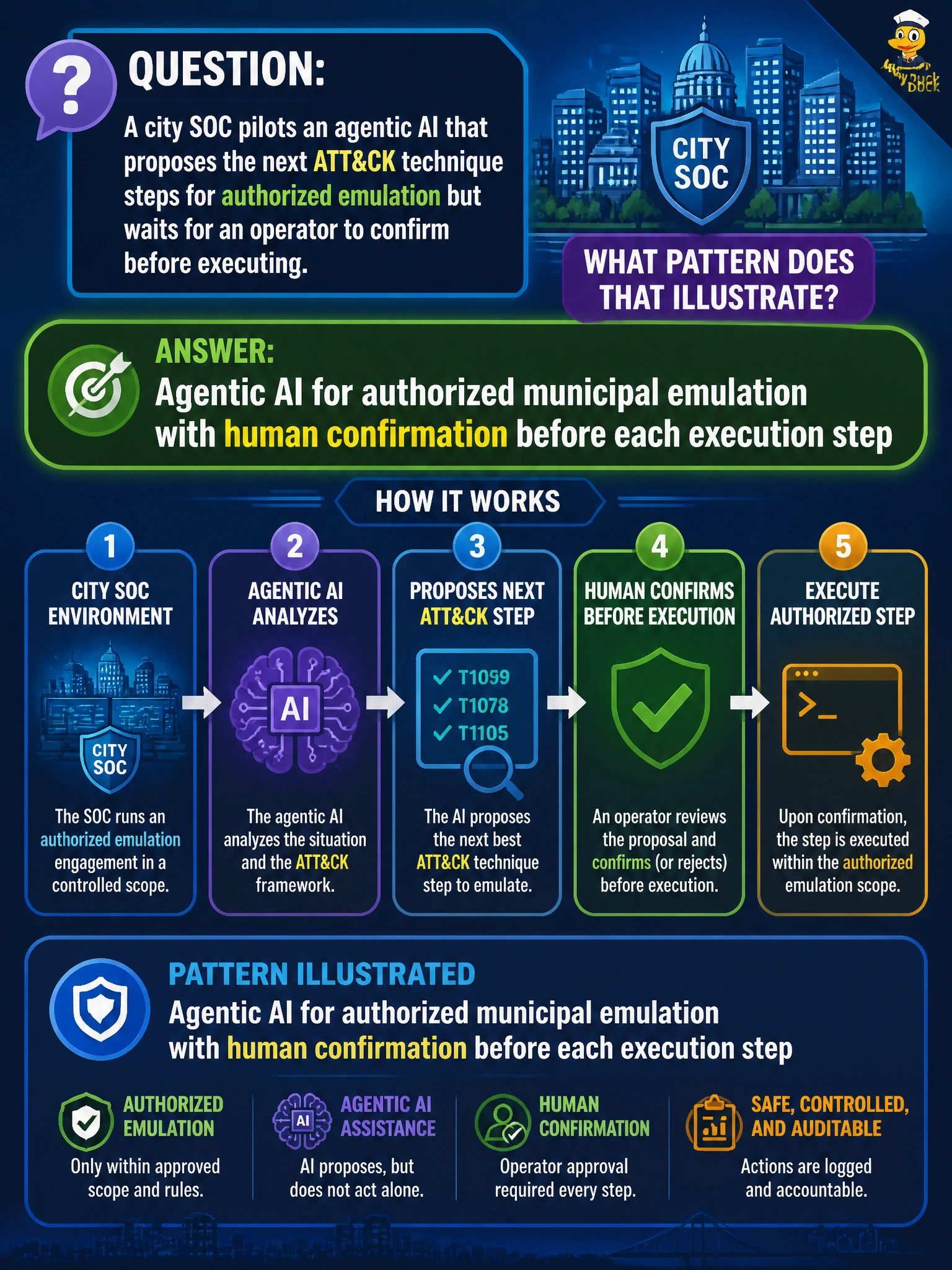
A city SOC pilots an agentic AI that proposes the next ATT&CK technique steps for authorized emulation but waits for an operator to confirm before executing. What pattern does that illustrate?
Select an answer to reveal the explanation.
Short Explanation
The agent is a navigator suggesting the next ATT&CK turn; the operator still holds the steering wheel and must say 'go.' That human-confirm pattern keeps city emulation authorized and sane. Approval for autonomous chained rollout, monitoring just for exception override, or review after you've already run the step don't give you that pre-execution gate.
Full Explanation
City SOC pilots that use agentic AI to propose the next ATT&CK technique steps for authorized emulation—but wait for operator confirmation before executing—illustrate human-in-the-loop agentic offense. The agent accelerates sequencing and suggestion; the operator preserves authorization and situational judgment at each execution boundary. That pattern fits municipal programs that want automation without unsupervised attack chains.
The correct pattern works by splitting planning from acting. Proposals can be aggressive and creative within policy; execution remains gated. Confirmation records also create an audit point for each step.
Agentic AI for authorized municipal emulation with human approval for autonomous chained rollout fails because approval for autonomous chained rollout authorizes the agent to chain steps on its own; it does not require human confirmation before each execution step.
Agentic AI for authorized municipal emulation with operator monitoring for exception override action fails because the pilot requires confirmation before each execution step, not merely monitoring for exception override action.
Agentic AI for authorized municipal emulation with human review after execution step completion fails because review after execution step completion happens after the step has run; it is not proposing the next emulation step and waiting for operator confirmation before execution.
Exam caveat: Propose-then-confirm is the hallmark answer when stems combine agentic sequencing with operator approval.
Operational check: Require an explicit confirm action before any technique execution API call, log proposal versus approved step separately, and disable unsupervised continue modes in the pilot.
Prefer to study offline? Printable PDF study book + test engine ($7.50, unofficial). These questions stay free here.