
A 311 operations center asks how BAS reporting proves detection gaps to city council IT oversight. What interpretation is most useful?
Select an answer to reveal the explanation.
Short Explanation
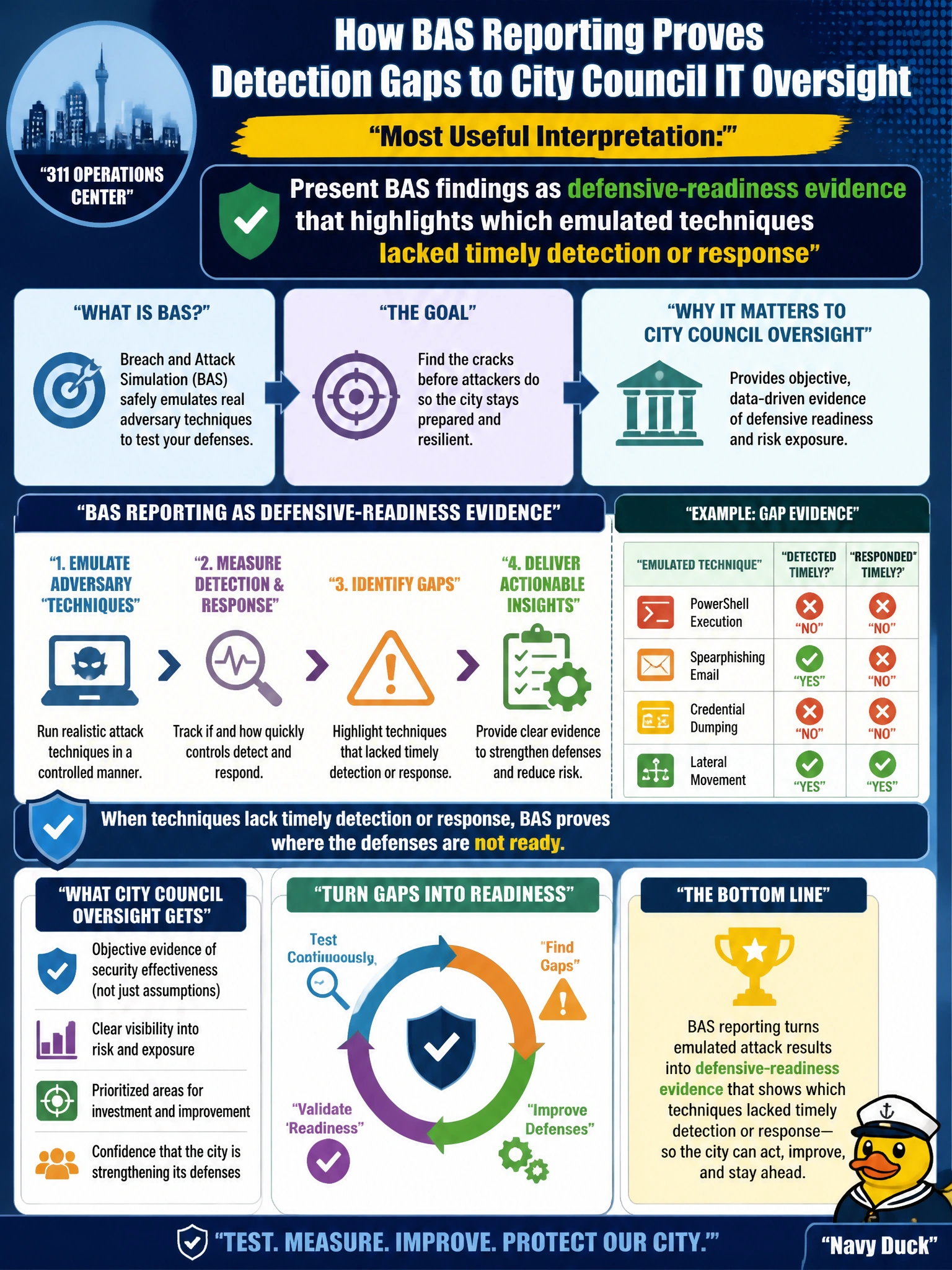
Council doesn’t need a scary headline—they need a map of which drills the blue team missed. BAS findings are readiness evidence: which techniques had no timely detection or response.
Full Explanation
A 311 operations center using BAS reporting for city council IT oversight should present findings as defensive-readiness evidence that highlights which emulated techniques lacked timely detection or response. That interpretation gives governance a concrete coverage picture: what was exercised, what the municipal SOC saw, and where playbooks or telemetry need investment. Council packets become decision support rather than vanity scores or panic narratives.
Why the other options fail by concept: Summarizing BAS findings as patch-priority evidence that uses undetected emulated techniques to prioritize workstation updates mistakes detection outcomes for patch causation; BAS shows whether the SOC saw and responded to emulated behaviors, not which updates to prioritize without separate vulnerability correlation. Reporting BAS findings as coverage-readiness evidence that uses agent connectivity to confirm timely detection of emulated techniques confuses tool availability with detection effectiveness; connected agents only prove the exercise ran, not that the emulated techniques were detected or that response was timely. Presenting BAS findings as prevention-success evidence that validates detection coverage from blocked delivery of emulated payloads conflates prevention with detection; a blocked payload does not prove the SOC can detect and respond to the technique when it executes.
Exam caveat: BAS misses are hypotheses about gaps under the scenarios run; they must be correlated with scope, timing, and environment before major org changes. Operational check: for each council-facing BAS summary, list emulated ATT&CK techniques, detection/response outcomes, residual gaps, and proposed remediations—never suppress misses or leap to outsourcing without that evidence chain.
Prefer to study offline? Printable PDF study book + test engine ($7.50, unofficial). These questions stay free here.