
Emergency operations needs a path when GenAI advice conflicts with the official Incident Action Plan. What governance control belongs in the strategy?
Select an answer to reveal the explanation.
Short Explanation
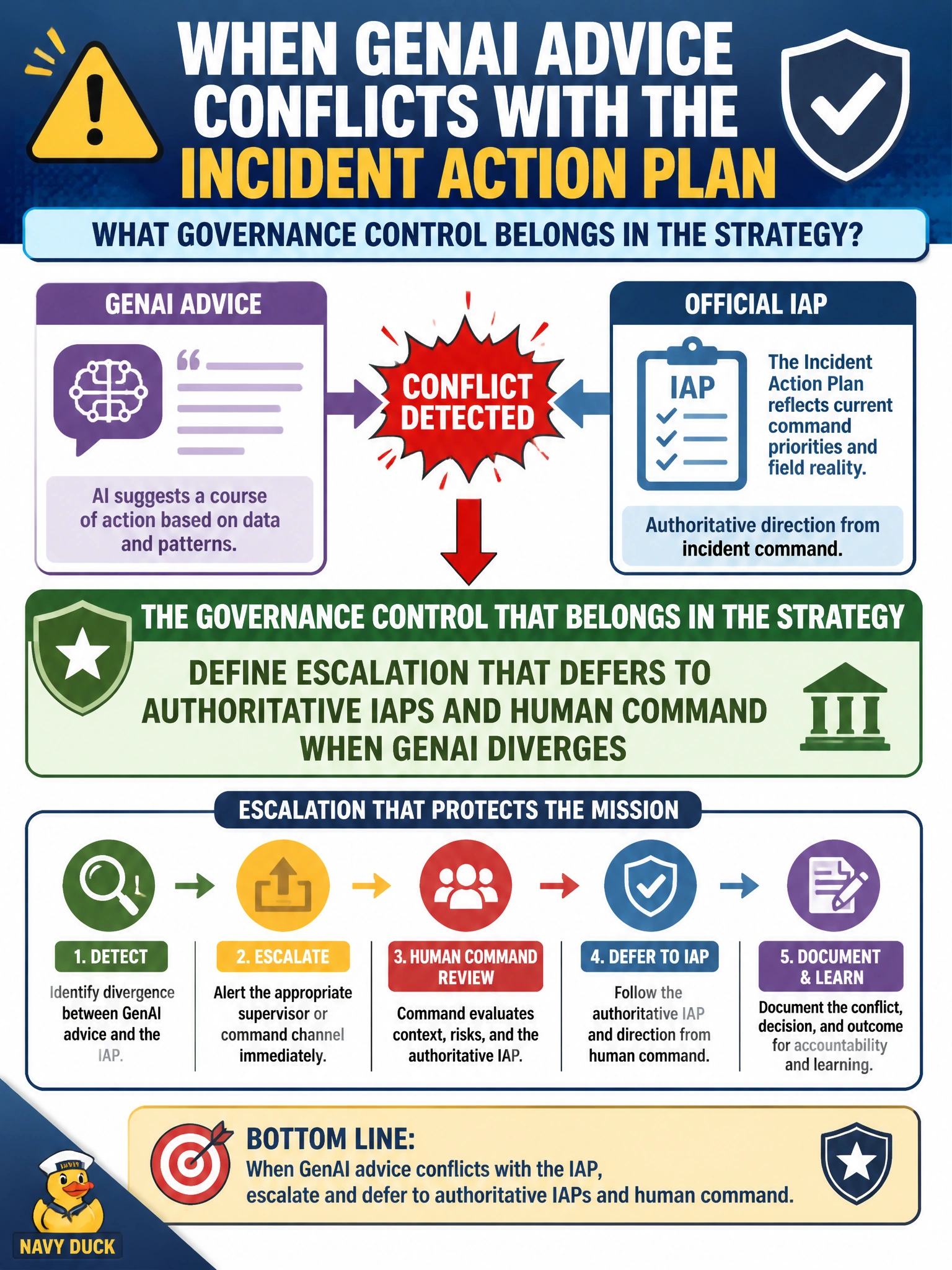
When the bot and the Incident Action Plan disagree, the signed plan and human command win—full stop. Blind chatbot loyalty, silencing operators, and equating model text with orders are unsafe.
Full Explanation
Emergency operations strategy must define escalation that defers to authoritative Incident Action Plans (IAPs) and human command when GenAI advice diverges. In municipal emergency management, GenAI is a decision-support aid, not a replacement for signed command guidance. Operators need a written rule: detect conflict, stop relying on the model for that decision path, escalate through the command structure, and follow the IAP and human chain of command. That governance control prevents automation bias and conflicting public direction during high-stress incidents when hallucinated routes, shelter status, or resource advice can cause real harm.
Always preferring the chatbot over the IAP without human review inverts authority and can send the public to incorrect locations or unsafe actions. Silencing operators who notice conflicts so the pilot “looks successful” suppresses safety reporting and converts a learning system into a political liability. Treating GenAI output as automatically equal to signed command guidance erases the legal and operational primacy of official plans and accountable officers.
Exam caveat: this control is about authority and escalation, not anti-AI absolutism—GenAI may still assist when outputs are consistent with the IAP and local policy, and when humans remain in the loop for consequential directions. Operational check: publish an EOC GenAI use rule stating IAP and human-command precedence, train on at least one conflict scenario in the next tabletop, and verify operators can demonstrate when to discard model advice and whom to escalate to under time pressure.