
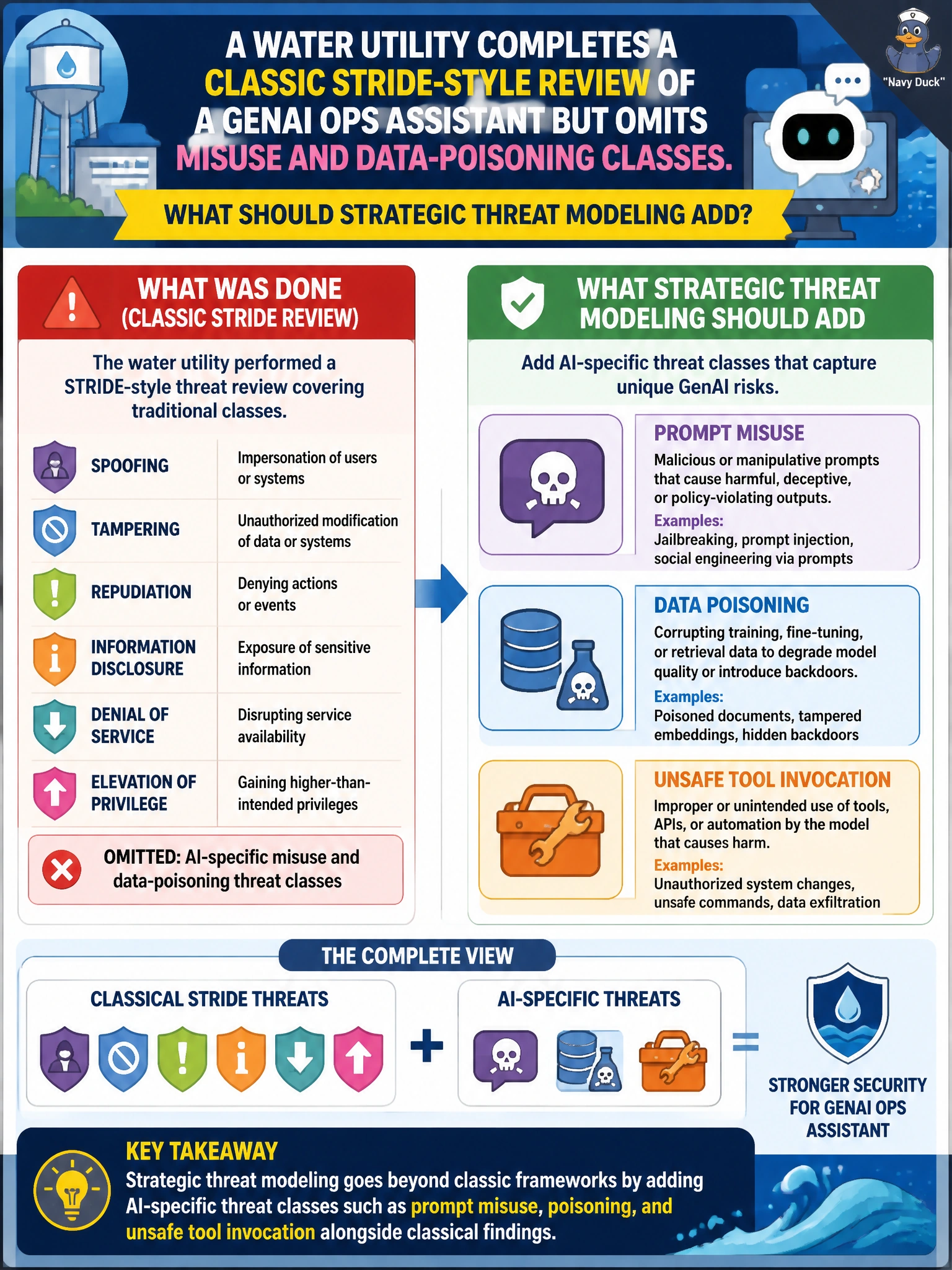
A water utility completes a classic STRIDE-style review of a GenAI ops assistant but omits misuse and data-poisoning classes. What should strategic threat modeling add?
Select an answer to reveal the explanation.
Short Explanation
You can keep classic STRIDE findings and extend the review to cover AI-specific risks such as prompt misuse, poisoning, and unsafe tool invocation. Physical fence locks and the assistant’s hard-hat avatar do not address those risks, and conventional network and facility threats alone leave them out of scope.
Full Explanation
Classic STRIDE reviews remain valuable for a water-utility GenAI operations assistant, but strategic threat modeling should add AI-specific classes such as prompt misuse and injection, training or retrieval data poisoning, model theft or extraction, unsafe tool invocation against SCADA-adjacent systems, and supply-chain risks in models and plugins. These additions help address GenAI failure modes that classical analysis of spoofing, tampering, repudiation, information disclosure, denial of service, and elevation of privilege may under-specify when a probabilistic agent can use tools. Focusing only on physical lock picks on the treatment-plant fence addresses physical security, not AI misuse. The assistant’s hard-hat avatar is cosmetic. Expanding only conventional network and facility threats still leaves the assistant’s AI-specific misuse risks out of scope. The exam caveat is that you do not discard STRIDE: extend it, or overlay an AI threat taxonomy, so GenAI assets and misuse are explicit. As a practical check, update the utility’s threat-model template with AI-specific categories, review the assistant again, and assign mitigations for prompt misuse, poisoning, and tool-invocation boundaries before production changes.