
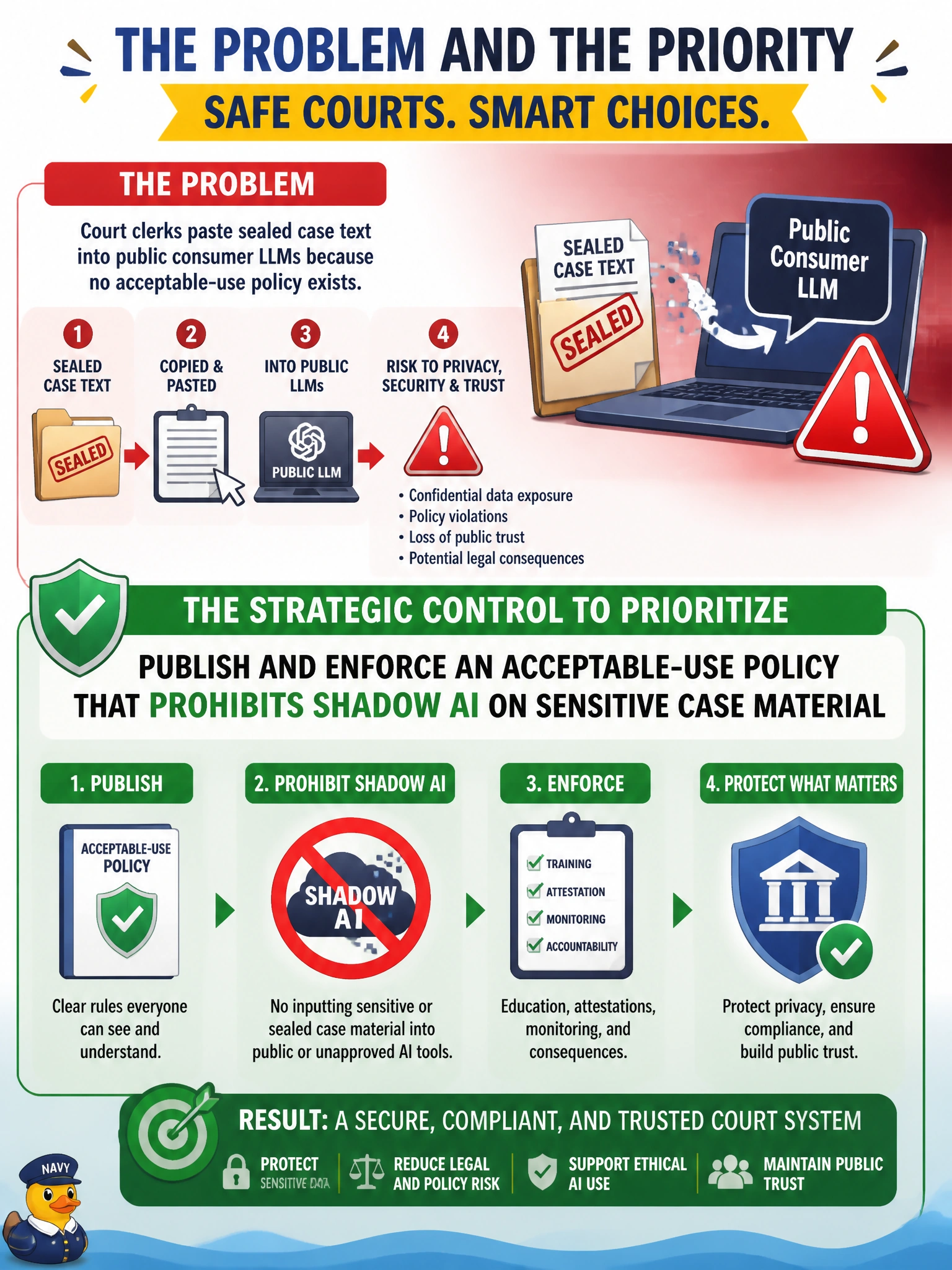
Court clerks paste sealed case text into public consumer LLMs because no acceptable-use policy exists. What strategic control should leadership prioritize?
Select an answer to reveal the explanation.
Short Explanation
Public LLMs and sealed case text do not mix. Leadership needs a real acceptable-use ban on shadow AI for sensitive filings—not friendlier avatars, personal email “backups,” or coffee-machine posters.
Full Explanation
Court clerks pasting sealed case text into public consumer LLMs is a classic shadow-AI failure driven by missing acceptable-use policy. Leadership must publish and enforce an AUP that prohibits sending sensitive, sealed, or non-public case material to unapproved public models, defines approved platforms, and states consequences and escalation. Policy plus monitoring and sanctioned alternatives reduces both confidentiality breaches and unauthorized disclosure risk in the justice context.
Encouraging clerks to pick whichever public chatbot has the friendliest avatar optimizes UX cosmetics over confidentiality of sealed filings. Mandating that sealed filings be emailed to personal Gmail for “backup summarization” multiplies shadow channels and personal-account exposure. Replacing policy with a poster that says “be careful” near the coffee machine provides awareness theater without enforceable rules, approved tools, or auditability.
Exam caveat: AUP alone is insufficient without technical controls and training, but policy is the strategic prerequisite that defines prohibited shadow AI on sensitive case material. Operational check: issue the AUP, block or detect high-risk public LLM destinations where feasible, provide an approved summarization path for clerks, and sample for sealed-content leakage in the first 30–60 days.