
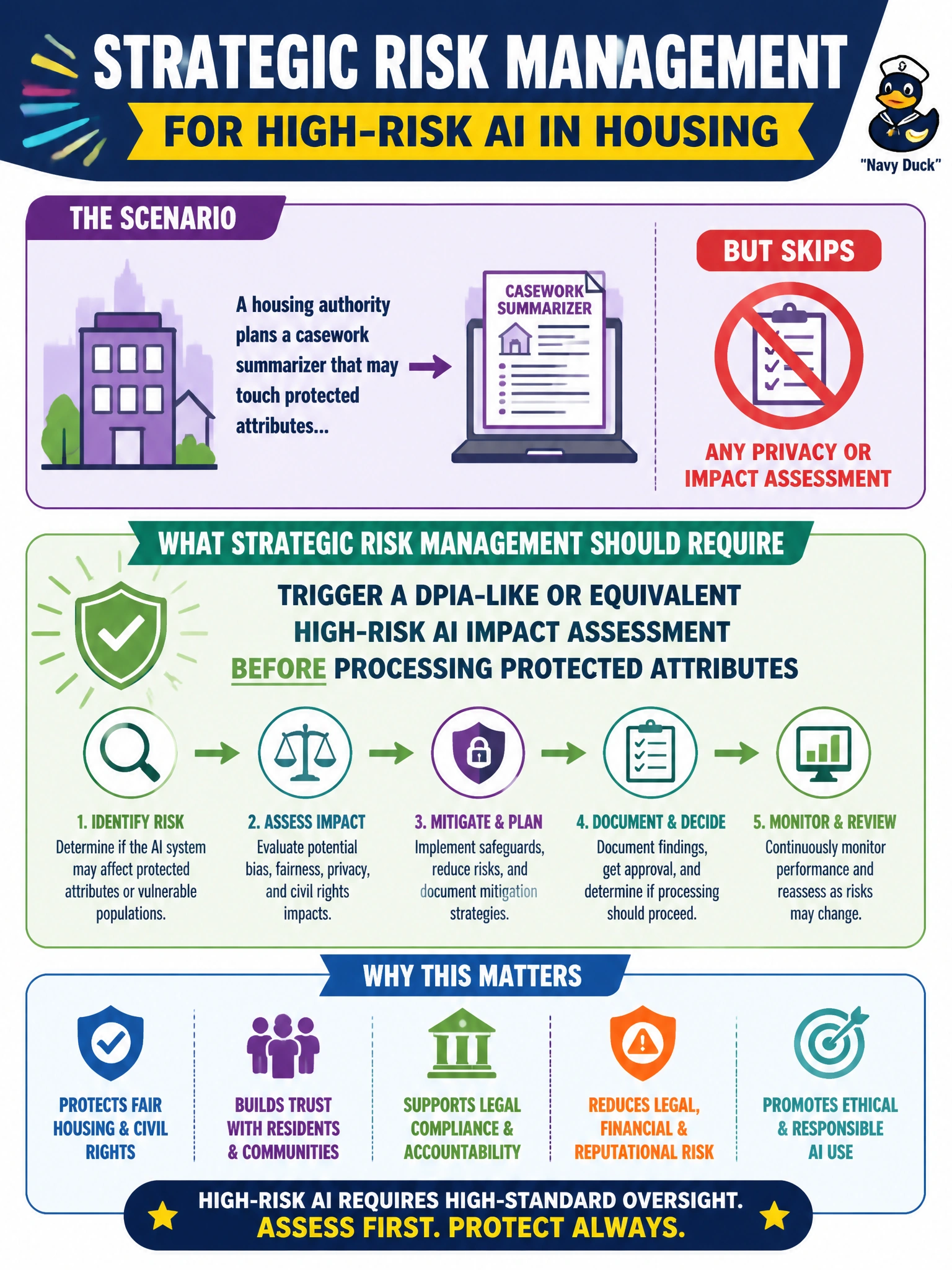
A housing authority plans a casework summarizer that may touch protected attributes but skips any privacy or impact assessment. What should strategic risk management require?
Select an answer to reveal the explanation.
Short Explanation
When a summarizer can brush against protected attributes, that is a high-stakes civic use — pause for a DPIA-style impact look. Theme checks, click-through licenses, and “summaries are always safe” assumptions skip the real privacy trigger.
Full Explanation
When a housing-authority casework summarizer may process or surface protected attributes, strategic risk management requires a DPIA-like or equivalent high-risk AI impact assessment before processing. That assessment examines lawful purpose, necessity, data minimization, special-category or sensitive attributes, fairness and discrimination risks, security controls, retention, resident rights, and residual risk. It is the planning control that prevents “ship first, justify later” on high-stakes civic casework.
Shipping immediately because summarization is “always low risk by definition” ignores that summarization can reconstruct sensitive narratives, leak attributes across cases, or amplify biased language from source files. Assessing only the chatbot’s color theme for accessibility while ignoring data impacts addresses a narrow UX concern and misses privacy and rights impacts that drive regulatory and constitutional exposure. Relying solely on end-user license click-throughs as the privacy review mistakes adhesion contracts for a municipal impact assessment; EULAs do not evaluate housing-case sensitivity or authority-specific processing.
Exam caveat: terminology varies (DPIA, AIA, algorithmic impact assessment); the exam concept is a structured high-risk impact review before processing sensitive or protected attributes—not a particular form title. Operational check: block production processing until an impact assessment is complete, reviewed by privacy/counsel, and linked to mitigations (access controls, redaction, human review, retention limits) with an owner and re-assessment trigger.