
Transit leadership wants rapid GenAI pilots while security insists on stage gates tied to residual risk. How should planning balance agility with responsible AI?
Select an answer to reveal the explanation.
Short Explanation
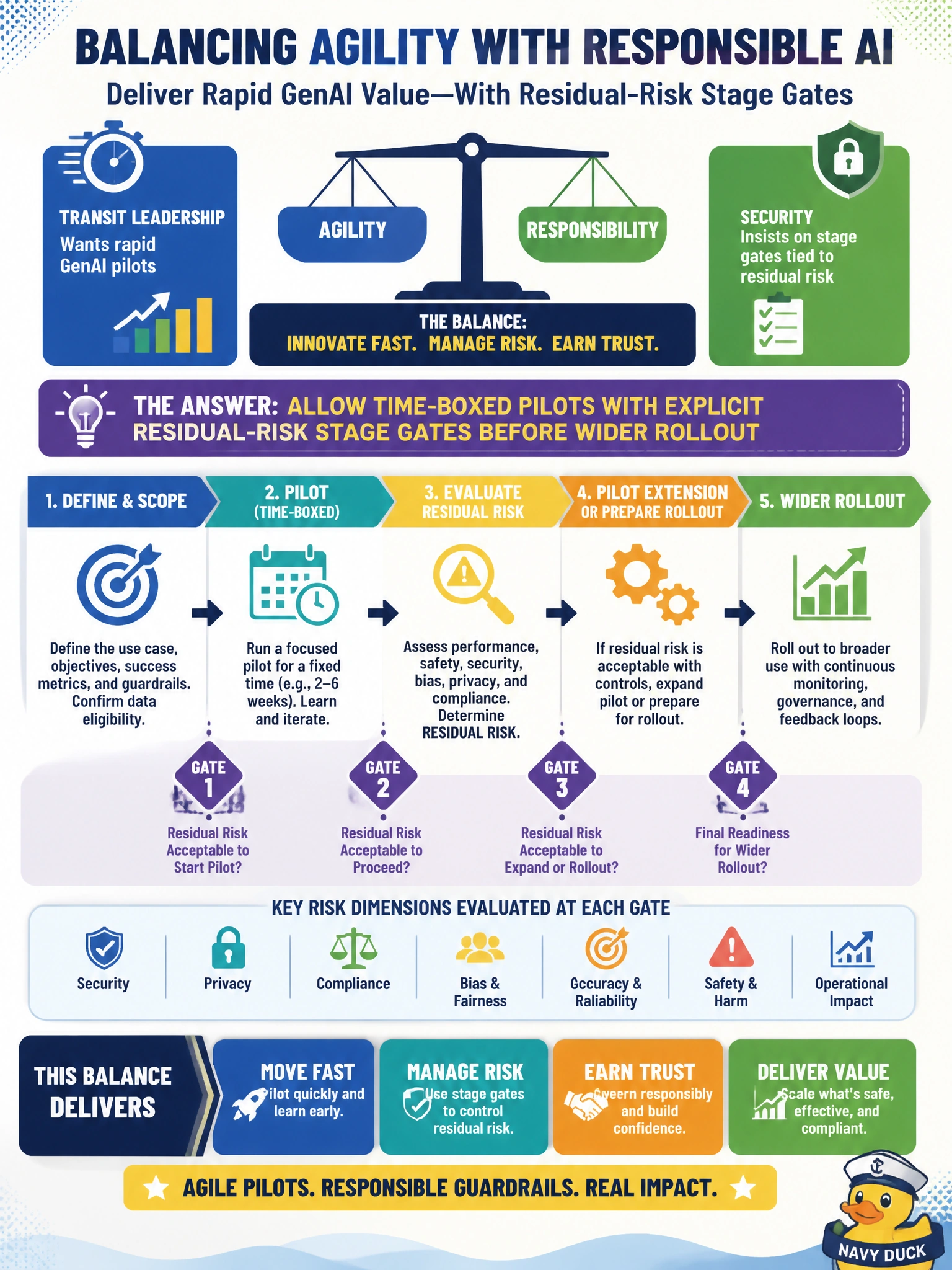
Agility and safety can share the road: short pilots are fine if residual-risk gates decide when they graduate. Blanket freezes or same-day production dumps miss that balance, and prompt-count vanity metrics are not risk gates.
Full Explanation
Responsible municipal GenAI planning balances learning speed with controlled exposure. Time-boxed pilots with explicit residual-risk stage gates allow transit teams to experiment while requiring documented risk acceptance before wider rollout. Gates typically cover threat-model closure, access and logging readiness, privacy review, abuse monitoring, and a go/no-go decision tied to residual risk—not vanity progress metrics. That pattern preserves agility without treating production as a free-for-all.
Banning all pilots until a five-year federal AI statute is final freezes learning and still leaves the city exposed to shadow tools staff already use. Law will keep evolving; proportionate controls based on known threats are required now. Shipping every pilot to production the same afternoon with no gates collapses pilot and production risk postures and skips assurance that residual risk is acceptable for riders and operators. Measuring success only by prompts per day optimizes for activity, not safety, equity, or control effectiveness, and can reward unsafe volume.
Exam caveat: “agile” in Domain 8 does not mean unconstrained; it means iterative delivery under risk-based gates. Operational check: for each transit GenAI pilot, publish a stage-gate checklist, residual-risk statement, time box, success criteria beyond prompt volume, and the named approver who can authorize broader rollout or mandate rollback.