
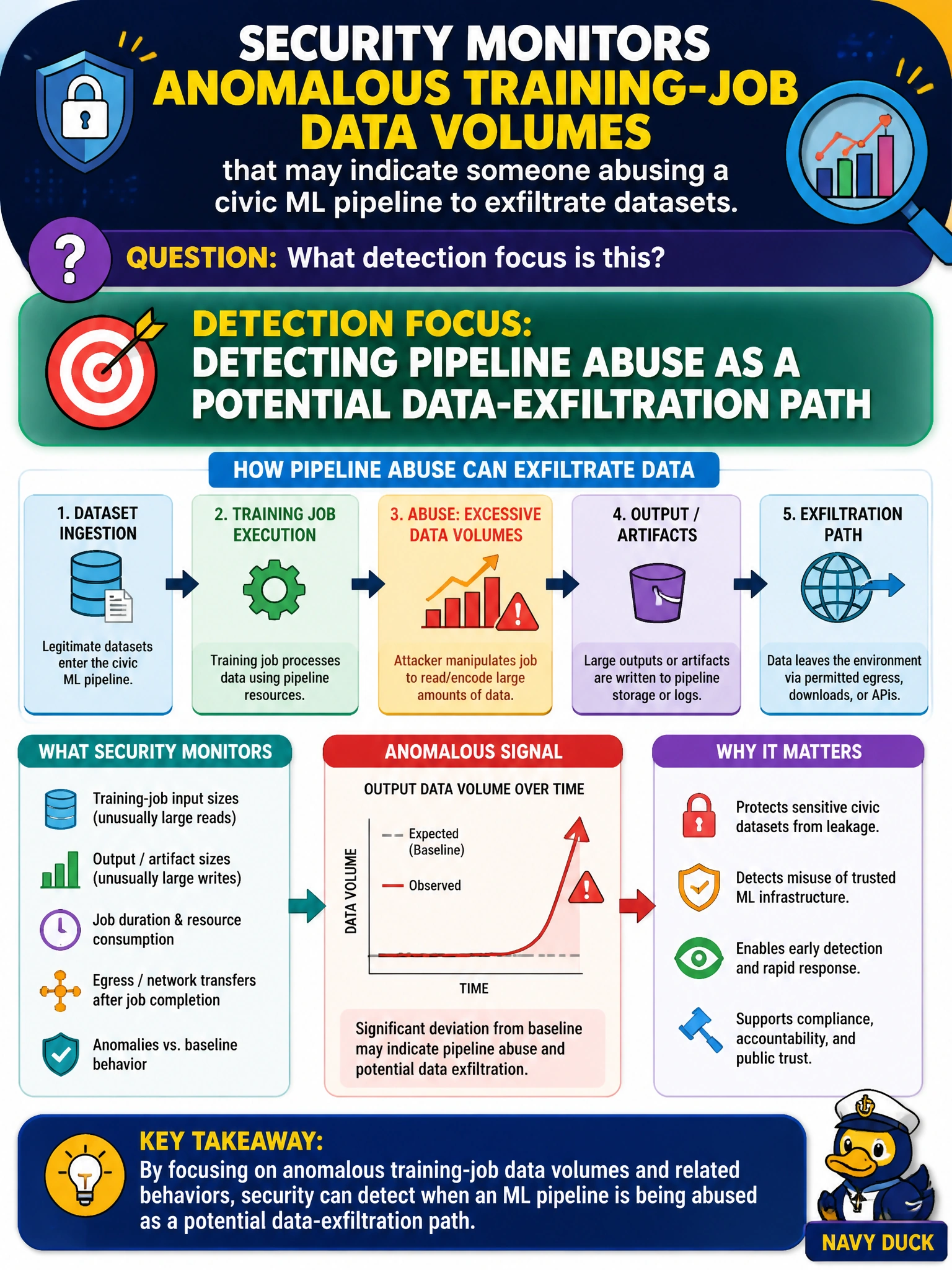
Security monitors anomalous training-job data volumes that may indicate someone abusing a civic ML pipeline to exfiltrate datasets. What detection focus is this?
Select an answer to reveal the explanation.
Short Explanation
Weirdly huge training pulls can be a moving truck, not just a hungry model. Watch volume anomalies as possible exfil via the pipeline. Ignoring spikes, GPU heat-only alerts, and killing access logs miss the signal.
Full Explanation
When security monitors anomalous training-job data volumes that may indicate someone abusing a civic ML pipeline to exfiltrate datasets, the detection focus is pipeline abuse as a potential data-exfiltration path. Compromised accounts or insider misuse can move large municipal datasets under the guise of legitimate training pulls. Volume and access-pattern anomalies—unusual tables, off-hours bulk reads, atypical destinations—are signals that the ML pipeline itself is being used as a moving truck, not merely as a hungry model.
Ignoring volume spikes because training always looks noisy fails because it abandons a useful detection channel. Alerting only when GPU temperature exceeds a comfort threshold fails because thermal metrics do not indicate data theft. Turning off dataset access logs to reduce storage cost fails because it destroys the evidence needed for exfil investigations.
Exam caveat: treat anomalous training I/O as a possible exfil technique; distractors that dismiss noise, watch GPUs only, or delete access logs are wrong.
Operational check: baseline normal training read volumes per job type; alert on spikes and novel dataset access; retain access logs; investigate with job identity, source tables, and egress destinations; tabletop an insider using a training job to stage civic data.