
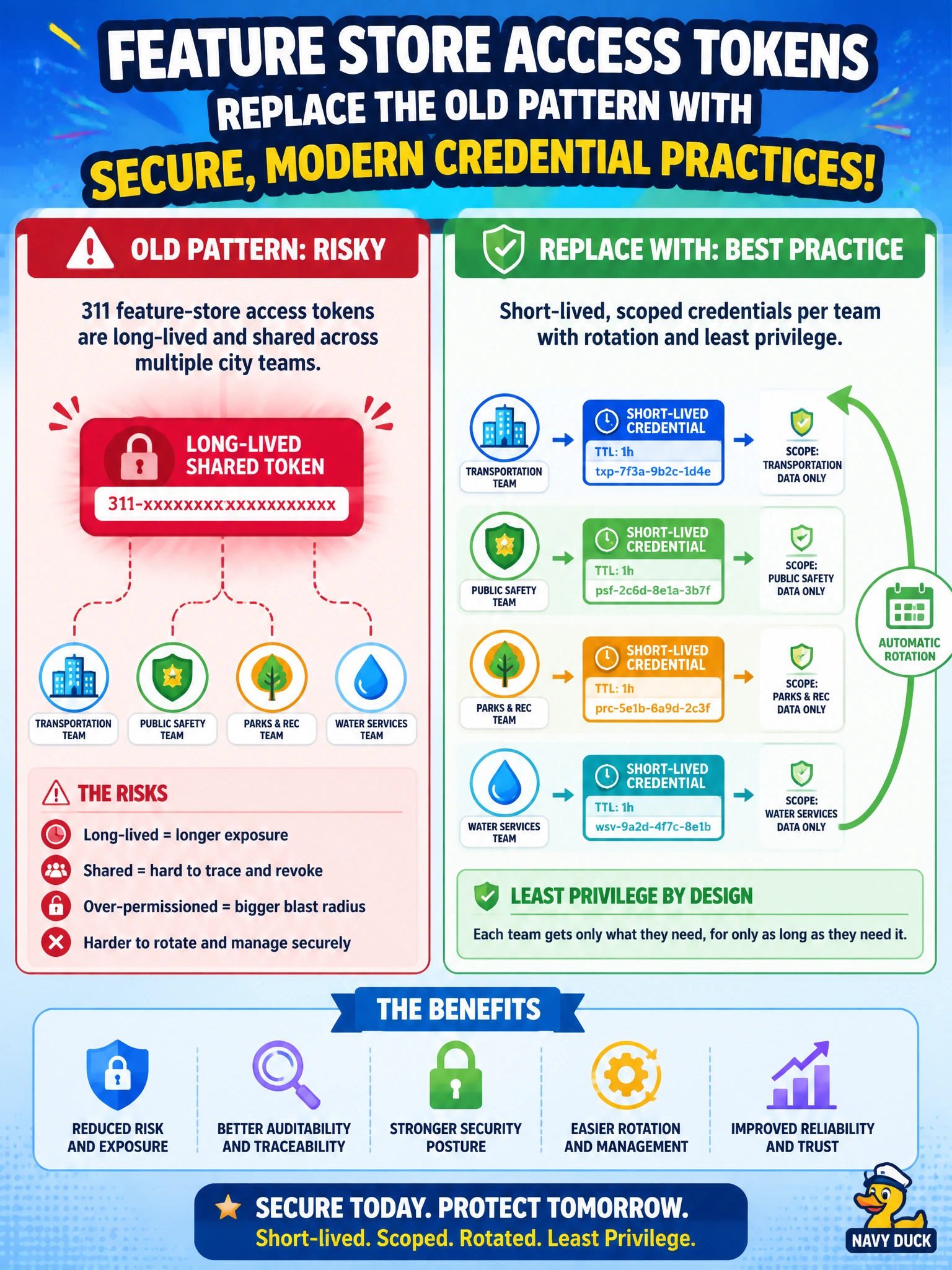
311 feature-store access tokens are long-lived and shared across multiple city teams. What credential practice should replace that pattern?
Select an answer to reveal the explanation.
Short Explanation
A forever shared 311 feature-store token is a master key taped under every desk. Issue short-lived, scoped creds and rotate them. Wiki posts, open auth, and demo reuse keep the blast radius huge.
Full Explanation
When 311 feature-store access tokens are long-lived and shared across multiple city teams, the credential practice that should replace that pattern is short-lived, scoped credentials per team with rotation and least privilege. Shared standing tokens maximize blast radius: any leak from one team’s notebook, CI job, or laptop grants broad feature-store access indefinitely. Per-team scoped tokens limit which feature sets are readable; short lifetimes and rotation shrink the usefulness of stolen credentials; least privilege aligns with municipal need-to-know for resident service data.
One permanent citywide token posted in the wiki fails because it concentrates and publishes a standing secret. Disabling authentication on the feature store for speed fails because it removes the control plane entirely. Reusing the same token in public demo notebooks fails because demos often leave municipal networks and version-control histories.
Exam caveat: convenience tokens shared “across teams” are almost always wrong on civic ML credential questions; prefer scoped, short-lived, rotated secrets.
Operational check: migrate the feature store to workload identity or vault-issued short-lived tokens; revoke the shared long-lived token; assign team-scoped roles; scan wikis and notebooks for residual static tokens; confirm rotation jobs succeed.