
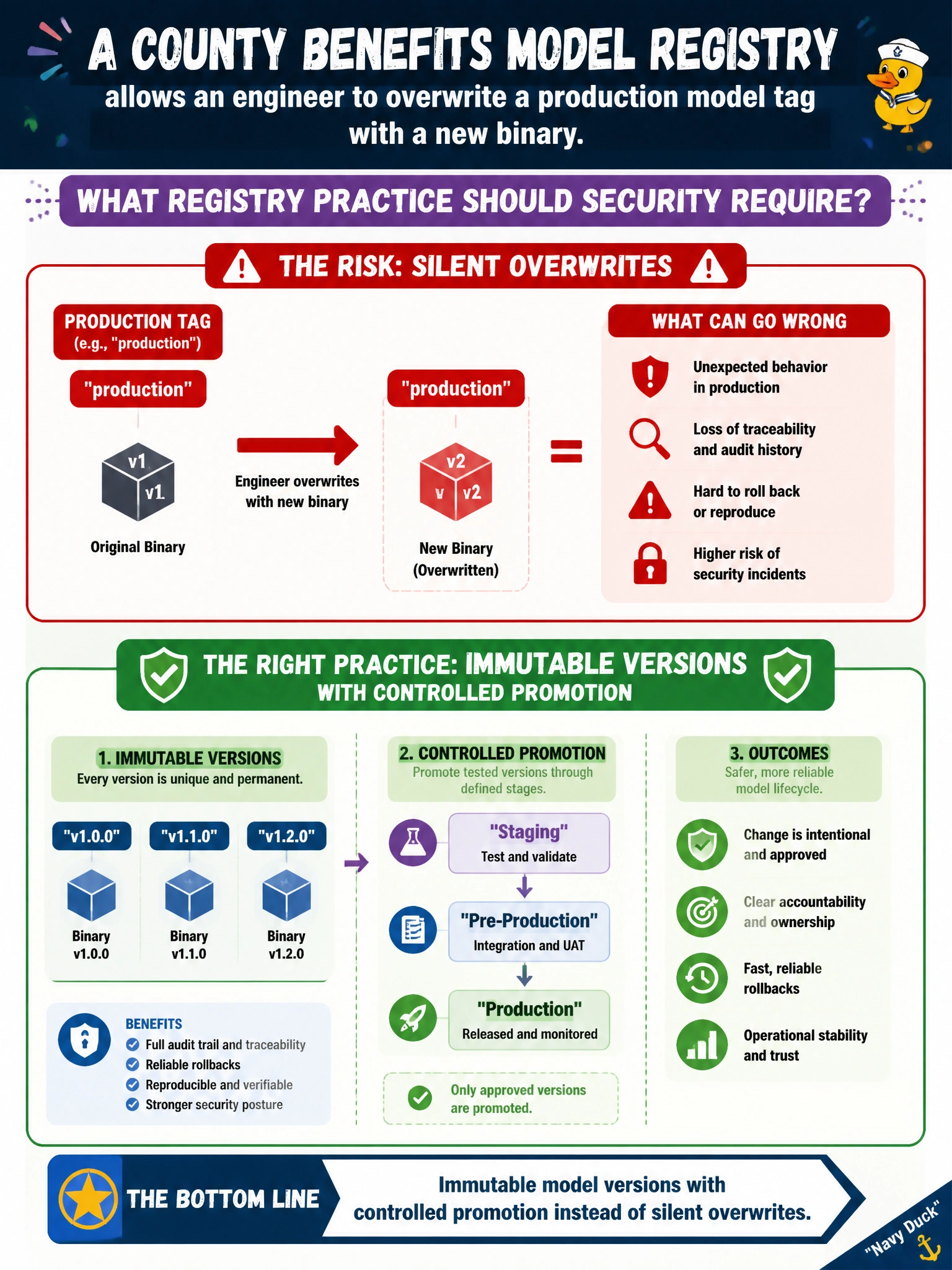
A county benefits model registry allows an engineer to overwrite a production model tag with a new binary. What registry practice should security require?
Select an answer to reveal the explanation.
Short Explanation
If “prod” can be quietly overwritten, yesterday’s known-good model can vanish under a stranger’s binary. Use immutable versions and controlled promotion. Deleting history, mutable tags, and USB hosting invite tampering.
Full Explanation
A county benefits model registry that allows an engineer to overwrite a production model tag with a new binary needs immutable model versions with controlled promotion instead of silent overwrites. Immutability preserves forensic history and prevents an unreviewed binary from inheriting a trusted “prod” name. Controlled promotion—new version IDs, policy checks, approvals—makes production admission explicit. Silent tag mutation on benefit-related models can change who is scored or routed without a clear audit trail for county oversight.
Letting any analyst delete registry history to free storage fails because it destroys evidence and rollback options. Using the same mutable “prod” tag with no audit trail fails because it is the anti-pattern described in the stem. Hosting registry artifacts on unmanaged USB drives fails because removable media bypasses registry controls, encryption policy, and chain of custody.
Exam caveat: mutable “latest/prod” tags are a frequent ML registry weakness; exams expect immutability plus promotion workflow, not storage shortcuts.
Operational check: enable immutable version digests; forbid force-overwrite on production tags; require promotion tickets and dual control for benefits models; verify that prior versions remain retrievable for rollback and audit.