
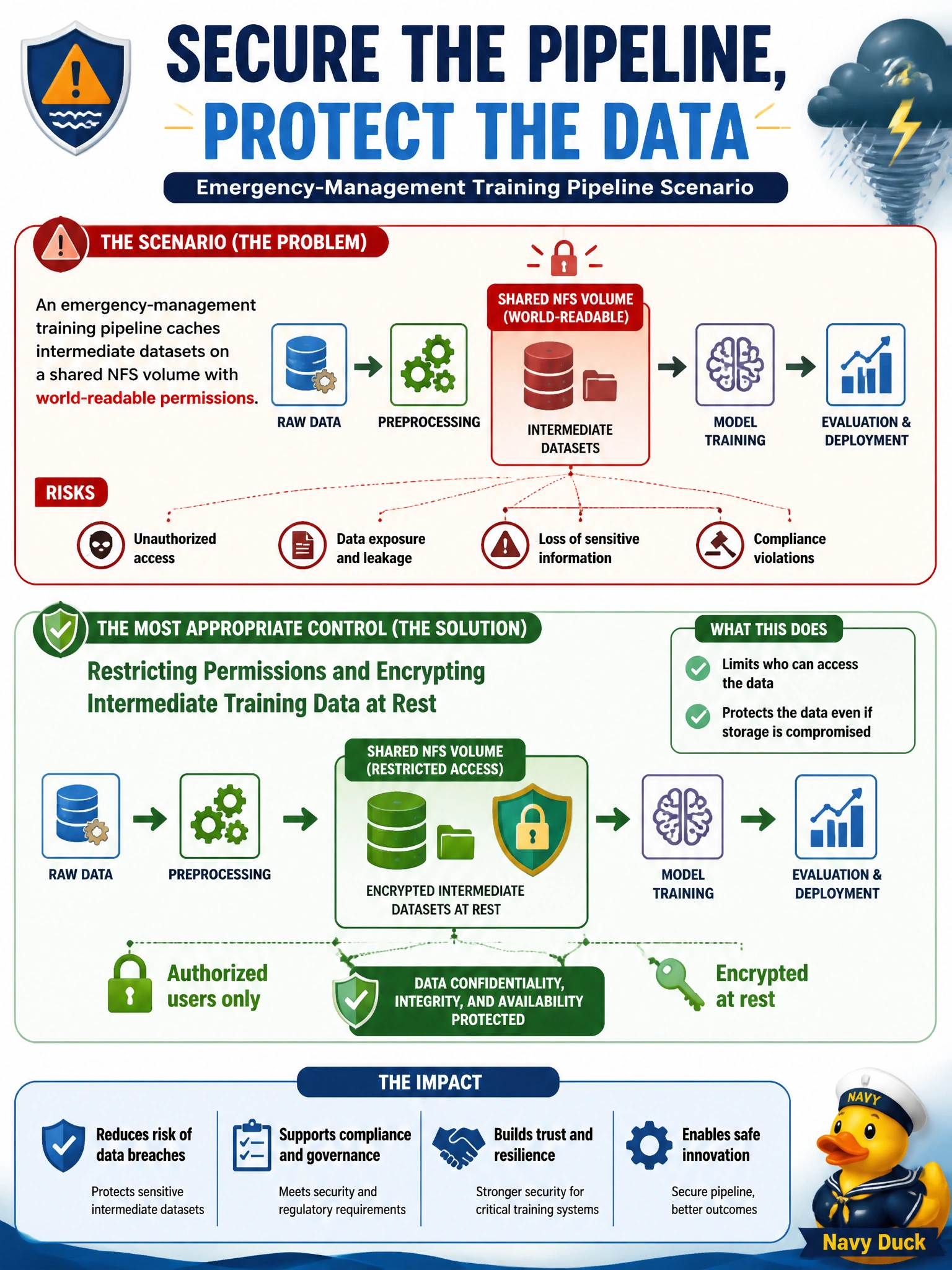
An emergency-management training pipeline caches intermediate datasets on a shared NFS volume with world-readable permissions. What control is most appropriate?
Select an answer to reveal the explanation.
Short Explanation
World-readable training caches are a filing cabinet left unlocked in the hallway. Lock down permissions and encrypt at rest. Public mirrors, tossing keys, and anonymous write make the leak larger.
Full Explanation
An emergency-management training pipeline that caches intermediate datasets on a shared NFS volume with world-readable permissions needs restricting permissions and encrypting intermediate training data at rest. Intermediate caches often contain raw or lightly processed civic data—shelter lists, contact fields, geospatial traces—that remain sensitive even when not labeled “production database.” World-readable NFS expands confidentiality failure to every principal that can mount the share. Encryption at rest plus least-privilege mount ACLs reduce casual and opportunistic access while supporting shared training infrastructure.
Mirroring the NFS share to a public object bucket for redundancy fails because redundancy via public mirroring multiplies exposure. Deleting encryption keys so analysts cannot reopen the cache fails because it is destructive availability sabotage, not a controlled access model, and may violate retention needs. Granting anonymous NFS write so any team can contribute features fails because write-anywhere enables tampering and poisoning of intermediate features.
Exam caveat: emergency-management context stresses sensitivity of intermediates; “make it public for resilience” and “throw away keys” are anti-patterns.
Operational check: inventory NFS ACLs on training caches; enforce group-based read mounts; enable encryption at rest for the volume or objects underneath; verify anonymous and world-writable modes are off; sample cache contents for unexpected PII breadth.