
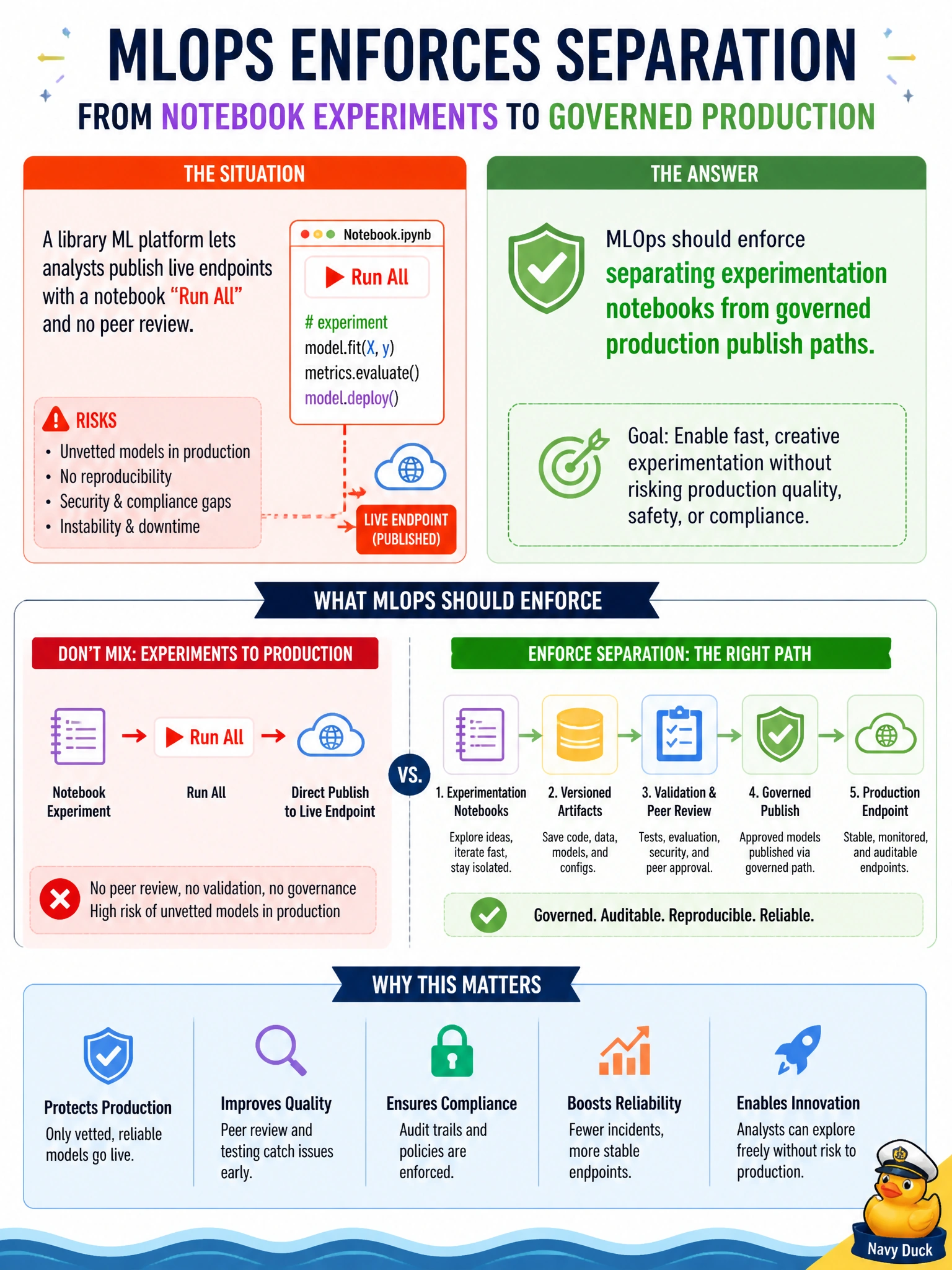
A library ML platform lets analysts publish live endpoints with a notebook “Run All” and no peer review. What separation should MLOps enforce?
Select an answer to reveal the explanation.
Short Explanation
Notebooks are great for experiments, terrible as an unsupervised prod deploy button. Keep explore separate from a reviewed publish path. Root runs, auto-publish, and laptop-only weights blur that line.
Full Explanation
A library ML platform that lets analysts publish live endpoints with a notebook “Run All” and no peer review lacks separation between experimentation and governed production publish paths. Notebooks are appropriate for exploration; they are poor unsupervised deploy buttons. Civic MLOps should require a reviewed promotion path—artifact validation, policy checks, and peer review—before resident-facing endpoints go live. That separation reduces accidental exposure of unstable, noncompliant, or privacy-unsafe models from exploratory cells.
Requiring every notebook to run as root on the shared cluster fails because elevating privileges increases blast radius rather than improving governance. Auto-publishing any notebook that finishes without errors fails because absence of runtime exceptions is not security, fairness, or privacy review. Storing production weights only inside personal laptop folders fails because it destroys controlled provenance, backup, and access audit.
Exam caveat: “it ran without errors” is a classic distractor for missing promotion governance. Municipal platforms must separate explore vs. publish.
Operational check: disable direct endpoint publish from notebooks; route publishes through CI with peer review; ensure production weights live in the managed registry with ACLs; audit recent library endpoints for notebook-origin publishes that skipped review.