
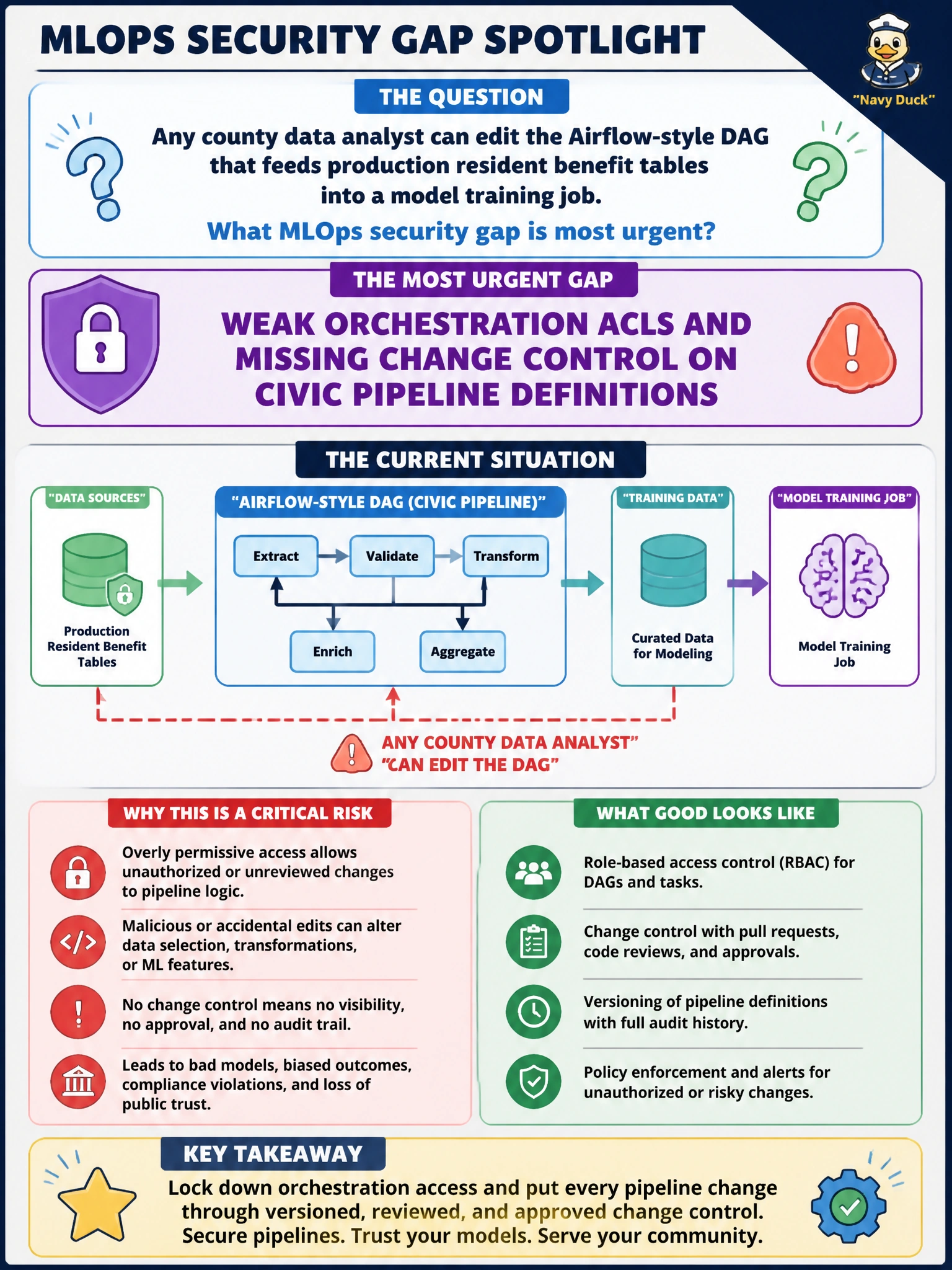
Any county data analyst can edit the Airflow-style DAG that feeds production resident benefit tables into a model training job. What MLOps security gap is most urgent?
Select an answer to reveal the explanation.
Short Explanation
If anyone can point the county DAG at live resident tables, the pipeline is a skeleton key. Lock who can edit orchestration and require change control. Extra model cards, GPU vs CPU, and README-only reviews miss the ACL problem.
Full Explanation
When any county data analyst can edit the Airflow-style DAG that feeds production resident benefit tables into model training, the most urgent MLOps security gap is weak orchestration ACLs combined with missing change control on civic pipeline definitions. Orchestration code is effectively privileged infrastructure: it selects source tables, credentials, schedules, and destinations. Unrestricted edits allow silent redirection to sensitive benefit systems, bypass of non-production environments, or insertion of unapproved extract steps. Change control and least-privilege ACLs on DAG repositories restore accountability, peer review, and separation between analysts who consume features and operators who may alter production-adjacent pipelines.
Too many model cards attached to the DAG repository fails as a diagnosis because documentation volume is not an access-control failure; excess cards do not grant table access. Using GPU workers instead of CPU-only nodes for feature joins fails because compute class is unrelated to who may redefine the pipeline’s data sources. Requiring peer review only for README updates fails because it protects narrative docs while leaving the executable orchestration path unreviewed—the inverse of a sound control.
Exam caveat: do not confuse documentation hygiene or hardware choices with orchestration governance. Municipal benefit data often sits behind strict need-to-know rules; pipeline definitions that can read those tables inherit that sensitivity.
Operational check: inventory who can merge DAG changes; enforce CODEOWNERS or equivalent for production-adjacent pipelines; require ticketed change review before edits that touch resident benefit sources; audit recent DAG diffs for unauthorized table bindings.