
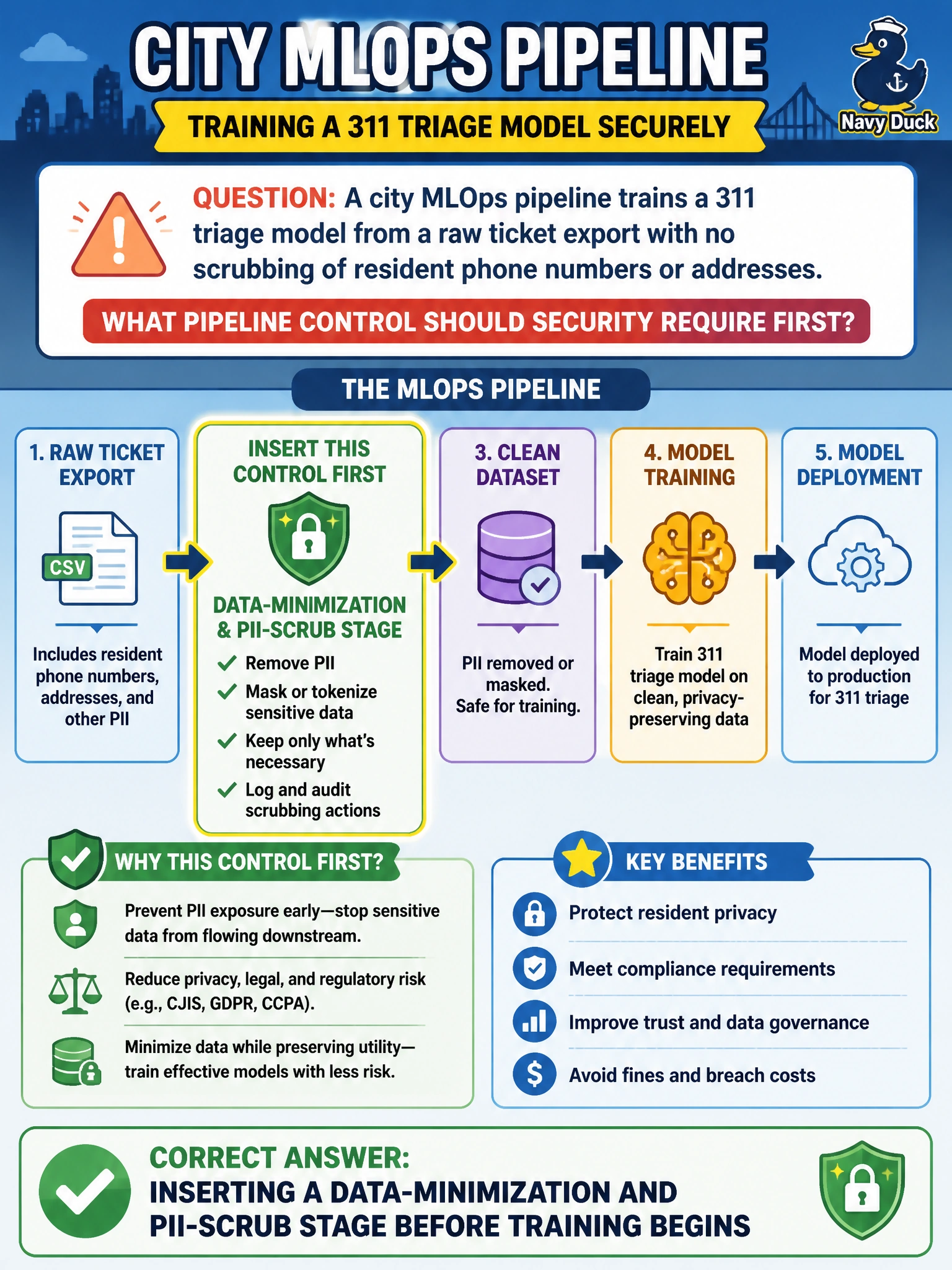
A city MLOps pipeline trains a 311 triage model from a raw ticket export with no scrubbing of resident phone numbers or addresses. What pipeline control should security require first?
Select an answer to reveal the explanation.
Short Explanation
Raw 311 tickets are full of phones and home addresses — dumping them straight into training is like leaving case files on the break-room table. Scrub and minimize first. Open-data dumps, log blackouts, and weekend-only training do not fix the data stage.
Full Explanation
Municipal MLOps pipelines that train 311 triage models from operational ticket exports inherit the full privacy surface of those tickets: resident phone numbers, home addresses, unit identifiers, and free-text narratives that often contain additional personal details. Security should therefore require a data-minimization and PII-scrub stage before any training job begins. That control reduces what enters feature stores, checkpoints, worker disks, and model artifacts; it also limits how long identifiable fields remain in intermediate caches. Without scrubbing, leakage risk expands across every downstream consumer of the training path, including debugging notebooks and shared object storage.
Publishing the raw ticket dump to the open-data portal for transparency fails because transparency does not override privacy law or municipal retention policy; open data releases require deliberate redaction, not wholesale export of operational case fields. Disabling all pipeline logs so PII never appears in observability tools fails because it conflates log hygiene with dataset hygiene: turning off observability hides incidents without removing identifiers from training inputs, and it impairs detection of pipeline abuse. Training only on weekends so fewer analysts can see the export fails because scheduling does not change access rights, retention, or the presence of PII in artifacts; it is obscurity, not a control.
Exam caveat: candidates sometimes treat open-data publication as an automatic privacy control or assume logging blackouts equal minimization. On municipal exams, distinguish minimization/scrubbing of training inputs from transparency portals and from observability settings.
Operational check: verify the DAG (or equivalent) includes an enforced scrub/minimization step with documented field allowlists before feature extraction; sample training shards for residual phone/address patterns; confirm that rejected PII never lands in model registries or shared caches used by civic triage models.