
Transit exposes Jupyter on the same GPU nodes that serve production rider-assistant models. What separation is required?
Select an answer to reveal the explanation.
Short Explanation
Jupyter on the same boxes as live rider assistants is a lab bench bolted to the ticket machine. Split research from production serving. Open unbound notebooks, inference-in-kernels, and shared root SSH blur that line badly.
Full Explanation
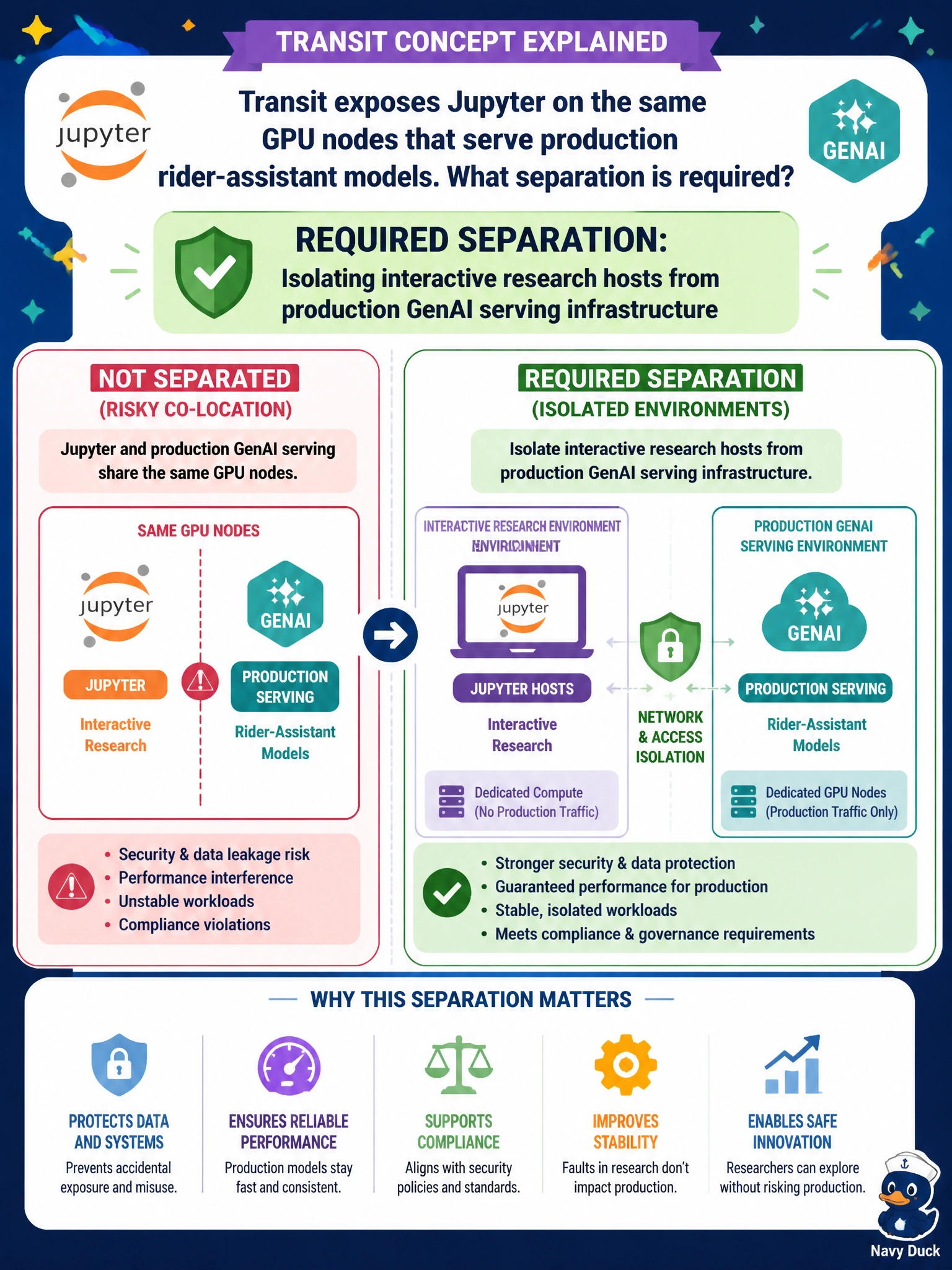
Exposing Jupyter on the same GPU nodes that serve production rider-assistant models collapses research and production GenAI infrastructure. Required separation is isolating interactive research hosts from production GenAI serving infrastructure so notebook users, experimental code, and ad-hoc data mounts cannot interfere with live transit assistant endpoints or share privilege with serving daemons that residents depend on.
Binding Jupyter to 0.0.0.0 with no authentication maximizes remote code-execution risk on GPU nodes that also host production models. Running production inference inside notebook kernels makes serving dependent on fragile interactive sessions and blurs change control for transit-facing GenAI. Sharing root SSH keys between notebooks and serving daemons creates credential equivalence across trust tiers and enables lateral movement from a research compromise into production serving.
Exam caveat: shared GPU hardware can be acceptable with strong partition—MIG, separate VMs, or separate node pools—but co-hosting unmanaged Jupyter with production serving without isolation is the failure mode. Operational check: inventory processes and listeners on rider-assistant GPU nodes, relocate Jupyter to a research pool with its own identity and network path, and verify production serving credentials cannot be used from notebook environments.