
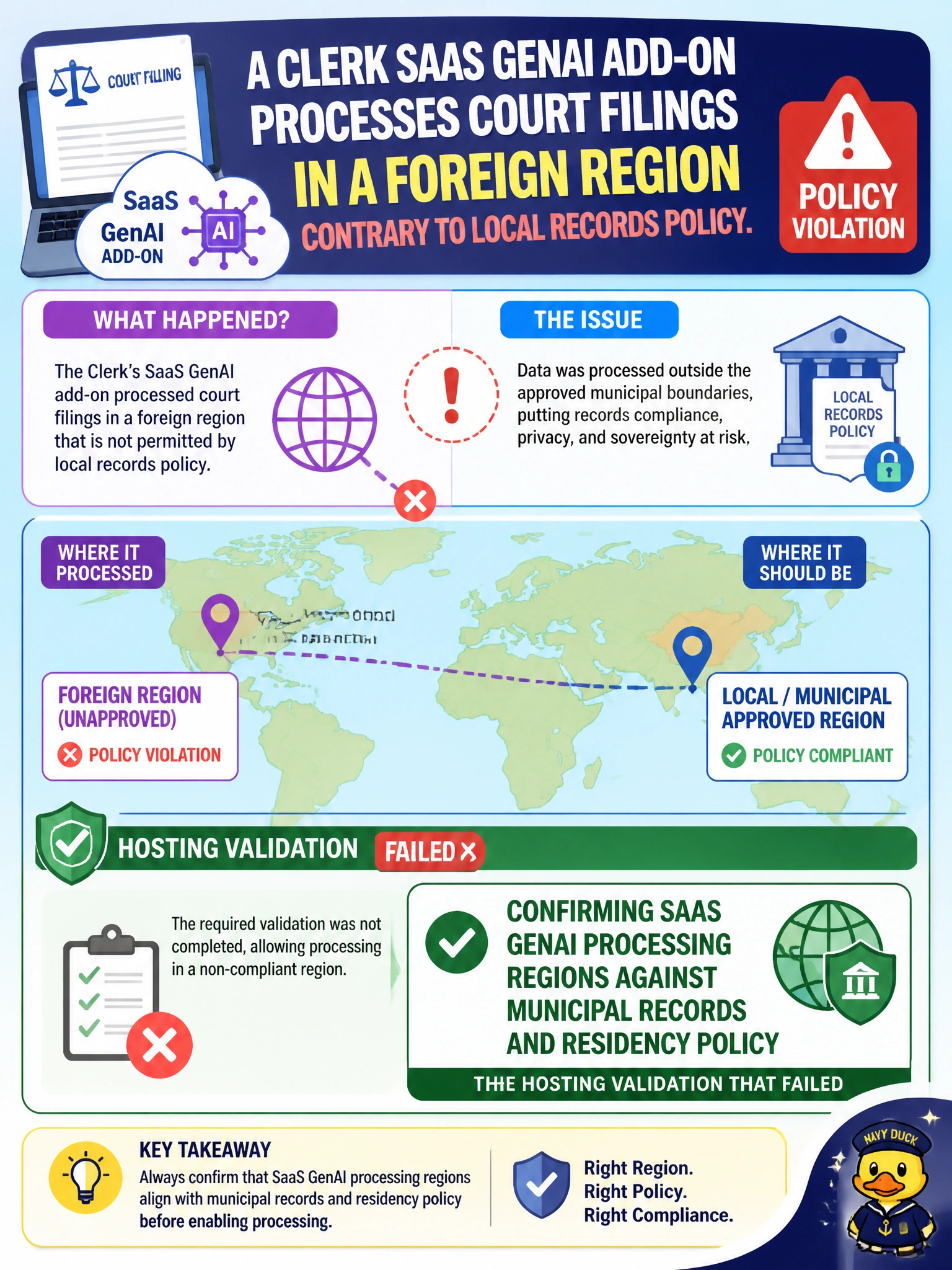
A clerk SaaS GenAI add-on processes court filings in a foreign region contrary to local records policy. What hosting validation failed?
Select an answer to reveal the explanation.
Short Explanation
If filings land in the wrong country, local records policy just got outsourced by accident. Validate where that SaaS GenAI actually processes. Marketing pages, “summaries aren’t records,” and timezone tricks are not validation.
Full Explanation
A clerk SaaS GenAI add-on processing court filings in a foreign region contrary to local records policy failed hosting validation: confirming SaaS GenAI processing regions against municipal records and residency policy. Before enabling GenAI features on court filings, the city must obtain contractual and technical assurance of where prompts and documents are processed, stored, logged, and subprocessed—not merely that a feature toggle exists in the vendor console.
Vendor marketing sites are not binding residency proof; contracts, data-processing agreements, and region-pinning configuration matter for civic records. Filings do not cease to be records because an LLM summarized them; summaries, prompts, and source artifacts often remain records under municipal retention rules. Changing the clerk desktop timezone does not move processing geography of the SaaS backend and is irrelevant to residency validation.
Exam caveat: multi-region SaaS may offer in-country processing only on specific SKUs or configurations—validate the enabled product path, not the brochure’s best-case region list. Operational check: review the add-on’s configured processing region, sample data-flow diagrams in the vendor agreement, disable or relocate the integration if filings would leave the approved jurisdiction, and re-test with a non-production filing surrogate.