
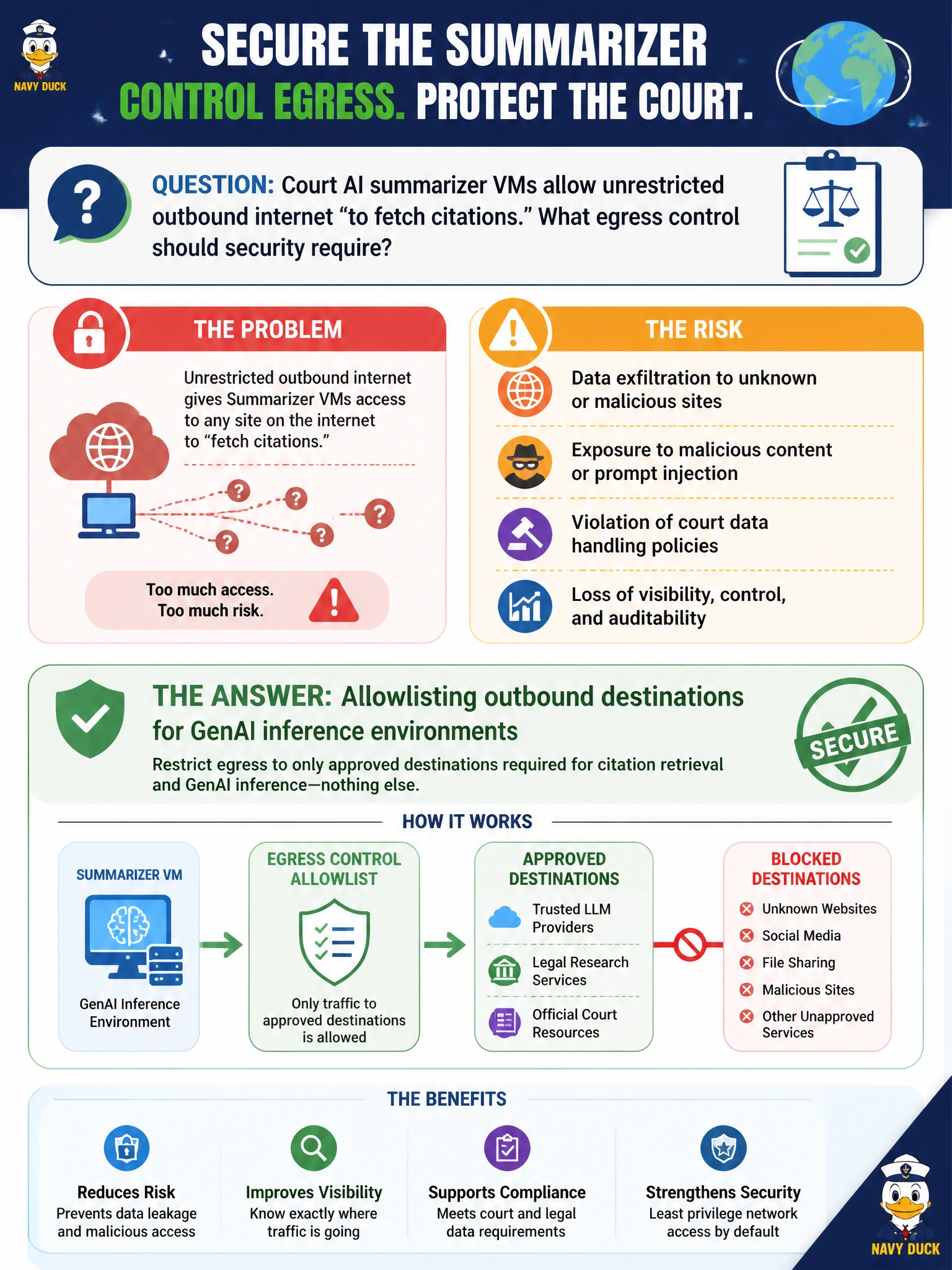
Court AI summarizer VMs allow unrestricted outbound internet “to fetch citations.” What egress control should security require?
Select an answer to reveal the explanation.
Short Explanation
“Need citations” is not a free pass to the whole internet from court VMs. Allowlist where those summarizers can go. Killing DNS, pasting traffic publicly, or peering everywhere makes egress worse.
Full Explanation
Court AI summarizer VMs with unrestricted outbound internet “to fetch citations” expand egress to the entire network, enabling data exfiltration of filings, supply-chain pulls from untrusted hosts, and uncontrolled dependencies. Security should require allowlisting outbound destinations for GenAI inference environments so citation or tool calls go only to approved legal research and municipal endpoints. Constrained egress is a core hosting control for civic GenAI compute handling court content.
Disabling all DNS so summarizers invent citations offline breaks legitimate resolution and does not safely constrain destinations; it encourages unreliable behavior and operational workarounds. Forwarding every outbound packet to a public paste site is active exfiltration dressed as peer review, not a control. Granting full VPC peering to every city environment widens lateral reach instead of narrowing outbound paths from court summarizers.
Exam caveat: allowlists must be maintained as approved citation sources change; overly brittle lists can drive shadow IT unless change control remains usable for the clerk and legal IT teams. Operational check: review egress proxy or firewall rules on court summarizer subnets, attempt connections to non-allowlisted hosts, confirm denied attempts are logged with workload identity, and document the approved citation destination set.