
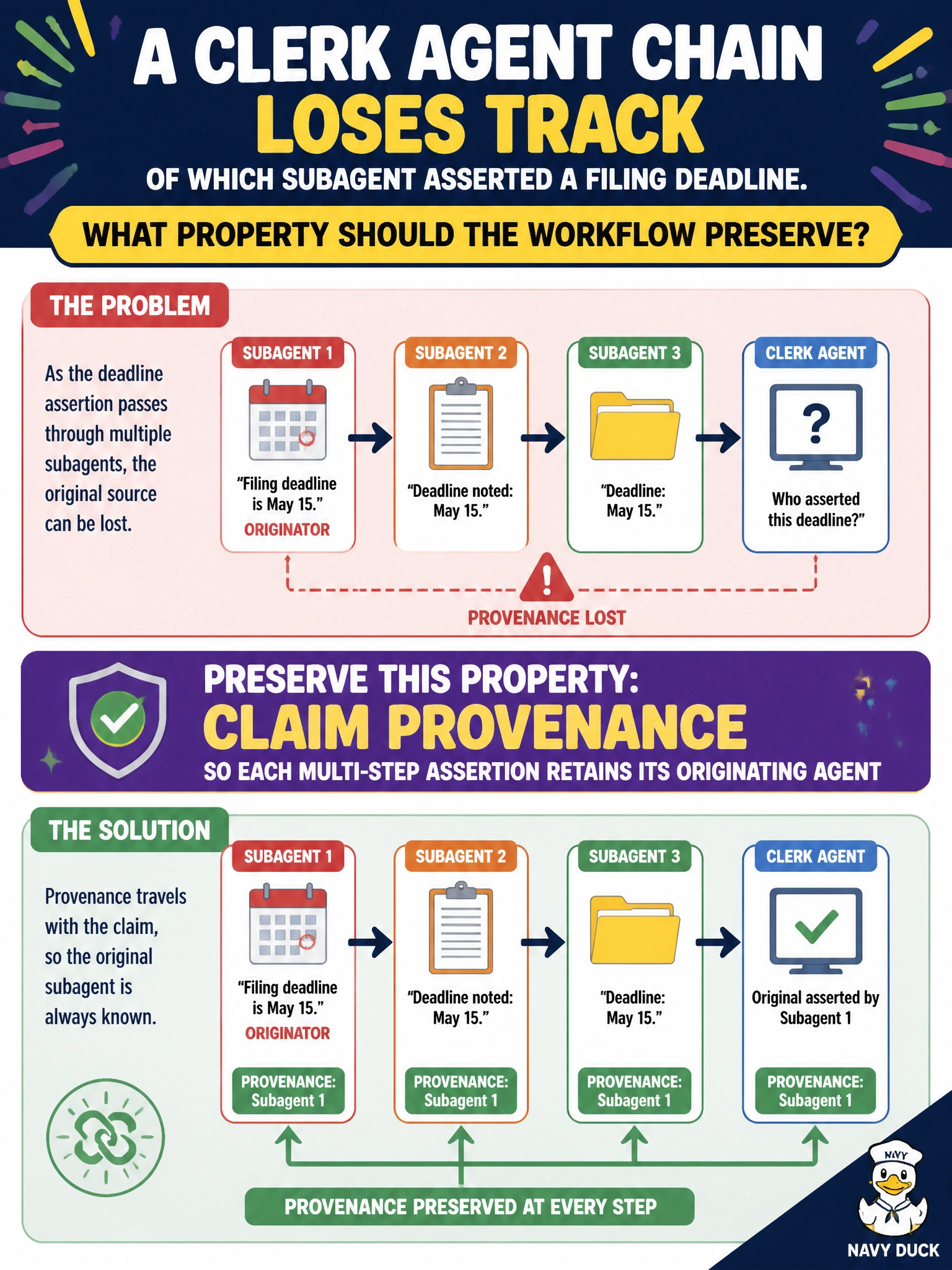
A clerk agent chain loses track of which subagent asserted a filing deadline. What property should the workflow preserve?
Select an answer to reveal the explanation.
Short Explanation
If nobody knows which helper agent invented the filing deadline, the clerk cannot defend the record. Keep provenance so every claim stays tagged to its source. Lost provenance is how confident nonsense becomes official.
Full Explanation
A clerk agent chain that loses track of which subagent asserted a filing deadline lacks claim provenance across multi-step civic workflows. The workflow should preserve claim provenance so each multi-step assertion retains its originating agent. Courts and clerk offices need to know which automated helper introduced a deadline claim for audit, correction, and defensibility of the official record.
Anonymous assertions so no subagent can be blamed for errors fails by concept: anonymity destroys accountability and makes remediation guesswork. Deleting audit trails after each handoff to reduce storage costs erases the provenance trail precisely when handoffs create risk. Allowing any subagent to rewrite prior deadline claims without markers permits silent history tampering without attribution.
Exam caveat: provenance identifies origin of a claim; humans must still validate legally operative deadlines against authoritative case systems rather than trusting agent assertions alone. Operational check: run a multi-subagent filing workflow in staging, inspect the deadline assertion metadata for originating agent IDs and timestamps, attempt an unmarked rewrite, and confirm the system flags or versions the change with actor identity.