
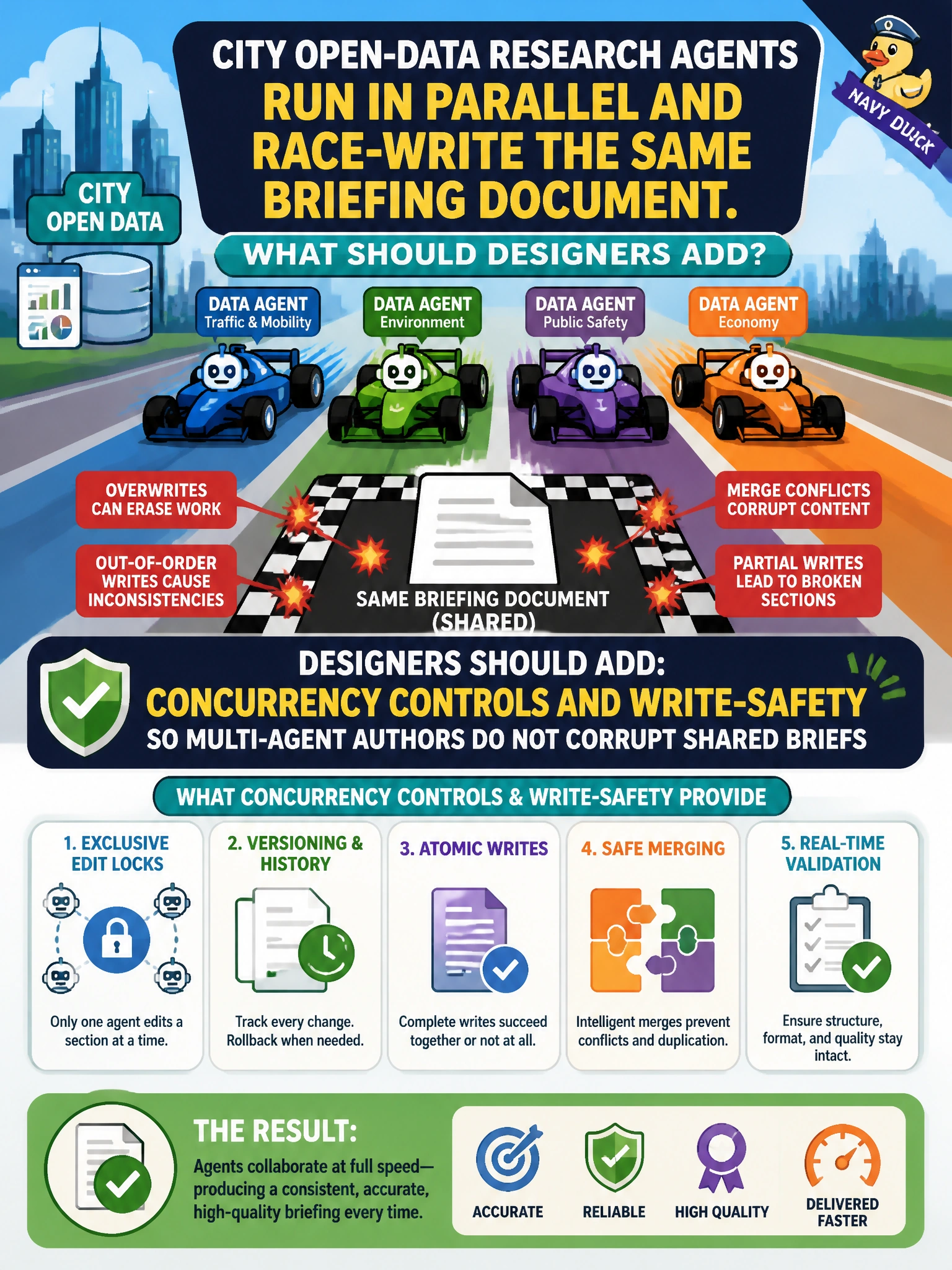
City open-data research agents run in parallel and race-write the same briefing document. What should designers add?
Select an answer to reveal the explanation.
Short Explanation
Two agents typing over the same briefing at once is a recipe for scrambled paragraphs and lost citations. Add concurrency and write-safety so parallel civic authors do not stomp each other. Race-writes are not collaboration — they are corruption.
Full Explanation
City open-data research agents running in parallel that race-write the same briefing document can corrupt shared civic work products through lost updates and interleaved sections. Designers should add concurrency controls and write-safety so multi-agent authors do not corrupt shared briefs—locking, atomic compare-and-swap, version checks, or single-writer coordination. Municipal research briefs used for public communication need integrity of authorship as much as factual accuracy.
Letting every agent overwrite the briefing without version checks fails by concept: last-write-wins without conflict detection is the race condition. Disabling file locks so agents finish dashboards sooner removes the coordination primitive that prevents concurrent corruption. Granting all research agents delete-all rights on the open-data lake expands destructive privilege unrelated to safe concurrent editing of one brief.
Exam caveat: concurrency controls protect shared mutable artifacts; they do not replace content review for accuracy of open-data citations in the briefing. Operational check: launch two research agents tasked to update the same briefing section simultaneously and confirm locking or version conflict handling prevents silent overwrite; verify delete-all lake permissions are not granted to briefing authors.