
Appsec tests whether MCP and agent tool-protocol messages are integrity-protected in transit. What property is being verified?
Select an answer to reveal the explanation.
Short Explanation
If somebody can quietly rewrite an agent’s tool message mid-flight, the agent will do the wrong thing with confidence. Integrity protection on the wire keeps MCP-style traffic honest. Skipping those checks for “speed” is how tampering wins.
Full Explanation
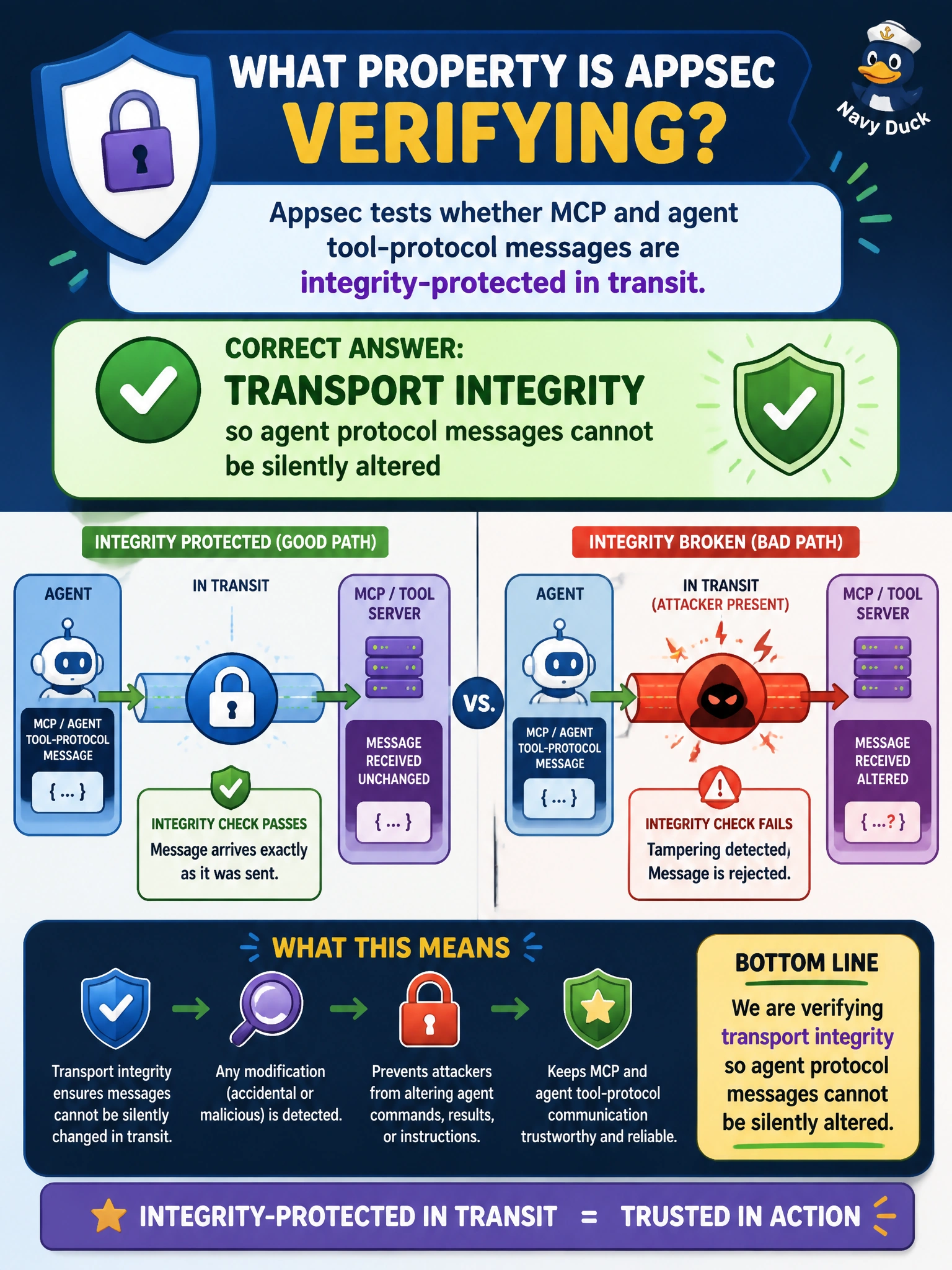
Appsec testing whether MCP and agent tool-protocol messages are integrity-protected in transit is verifying transport integrity so agent protocol messages cannot be silently altered. If an on-path attacker modifies tool names, arguments, or results between agent and tool server, the civic agent will execute or trust the wrong action with high confidence. Integrity protection (typically via TLS with proper validation, and optionally application-level signatures) preserves the authenticity of municipal agent protocol traffic.
Whether agents can ignore TLS errors when calling payment tools fails by concept: ignoring TLS errors weakens integrity and authenticity rather than verifying them. Whether tool calls should be sent as unauthenticated UDP broadcasts describes an insecure datagram pattern with no integrity or authentication suitable for agent tool control. Whether integrity checks should be skipped to reduce municipal latency proposes disabling the very property under test for speed.
Exam caveat: transport integrity prevents silent alteration in transit; it does not by itself stop a compromised legitimate endpoint from sending bad content—endpoint authentication and tool-output validation remain necessary. Operational check: in a lab, attempt a controlled MITM or message-tamper against MCP/tool traffic and confirm the agent or gateway detects failure (certificate/hostname/signature mismatch); verify payment tool calls never proceed under ignored TLS errors.