
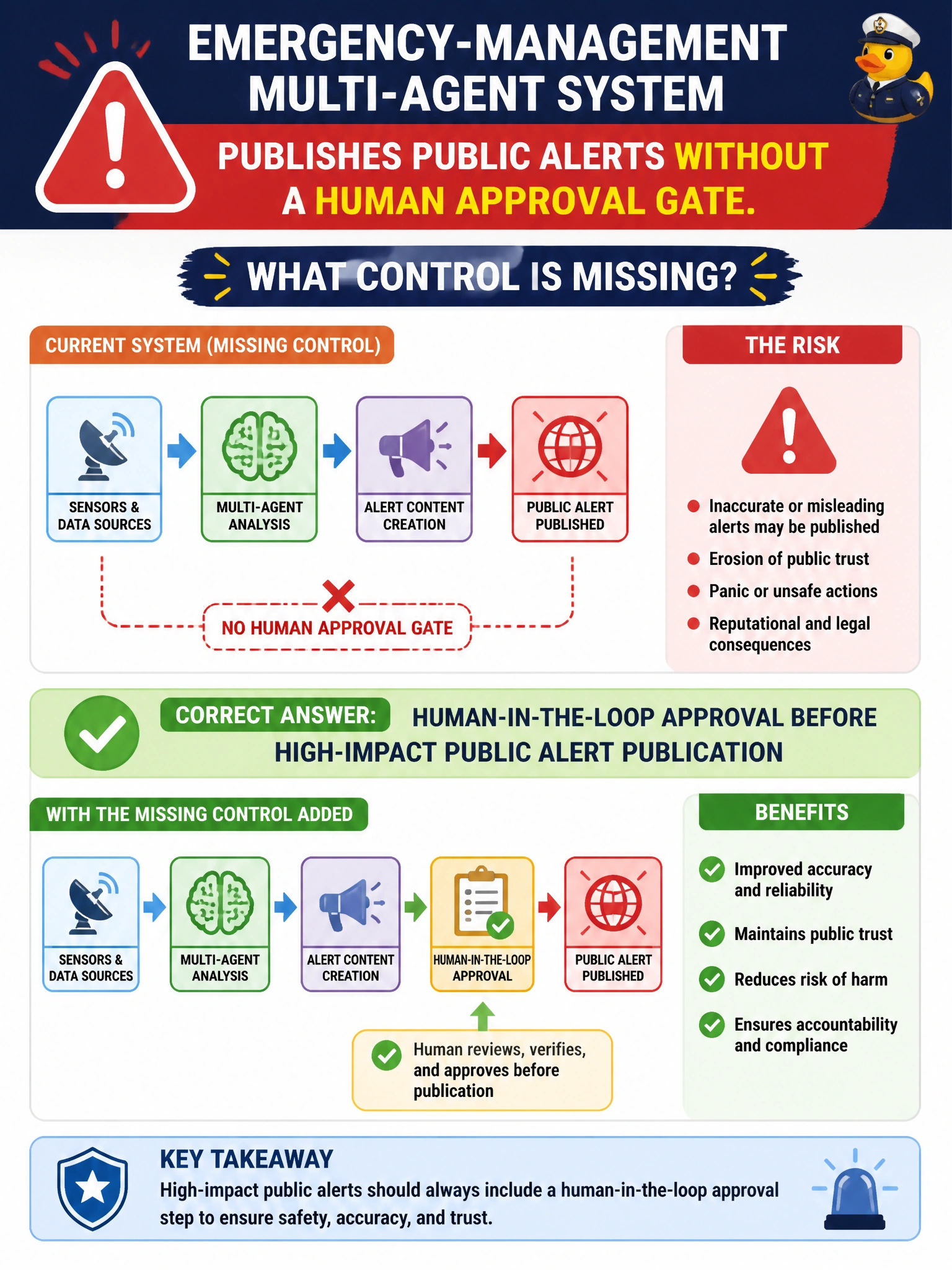
An emergency-management multi-agent system can publish public alerts without a human approval gate. What control is missing?
Select an answer to reveal the explanation.
Short Explanation
Public emergency alerts are not the place for “ship it and hope.” Put a human approval gate before agents can blast the city. Automated publish without HITL is how a confused agent becomes a false-alarm factory.
Full Explanation
An emergency-management multi-agent system that can publish public alerts without a human approval gate lacks human-in-the-loop control for high-impact civic communications. Requiring human-in-the-loop approval before high-impact public alert publication prevents erroneous, injected, or prematurely drafted alerts from reaching the public. In municipal emergency operations, false or malformed alerts erode trust and can create harmful public response; agents should prepare drafts, but humans authorize citywide dissemination.
Automatic alert spam to every resident contact every five minutes fails by concept: it is abusive notification design, not a safety gate, and increases panic and opt-out risk. Disabling message authentication so alerts send faster removes integrity protections that prove alerts come from the authorized emergency channel. Letting any visitor chatbot escalate alerts to citywide broadcast widens who can trigger mass notification and contradicts privileged publish paths.
Exam caveat: human approval is required for high-impact public publication; lower-risk internal drafts or pre-approved template fills may still be automated if policy explicitly allows and authenticity controls remain. Operational check: attempt an agent-generated public alert in a non-production emergency channel and confirm it remains pending until an authorized operator approves; verify unauthenticated or visitor-originated escalate attempts are rejected and logged.