
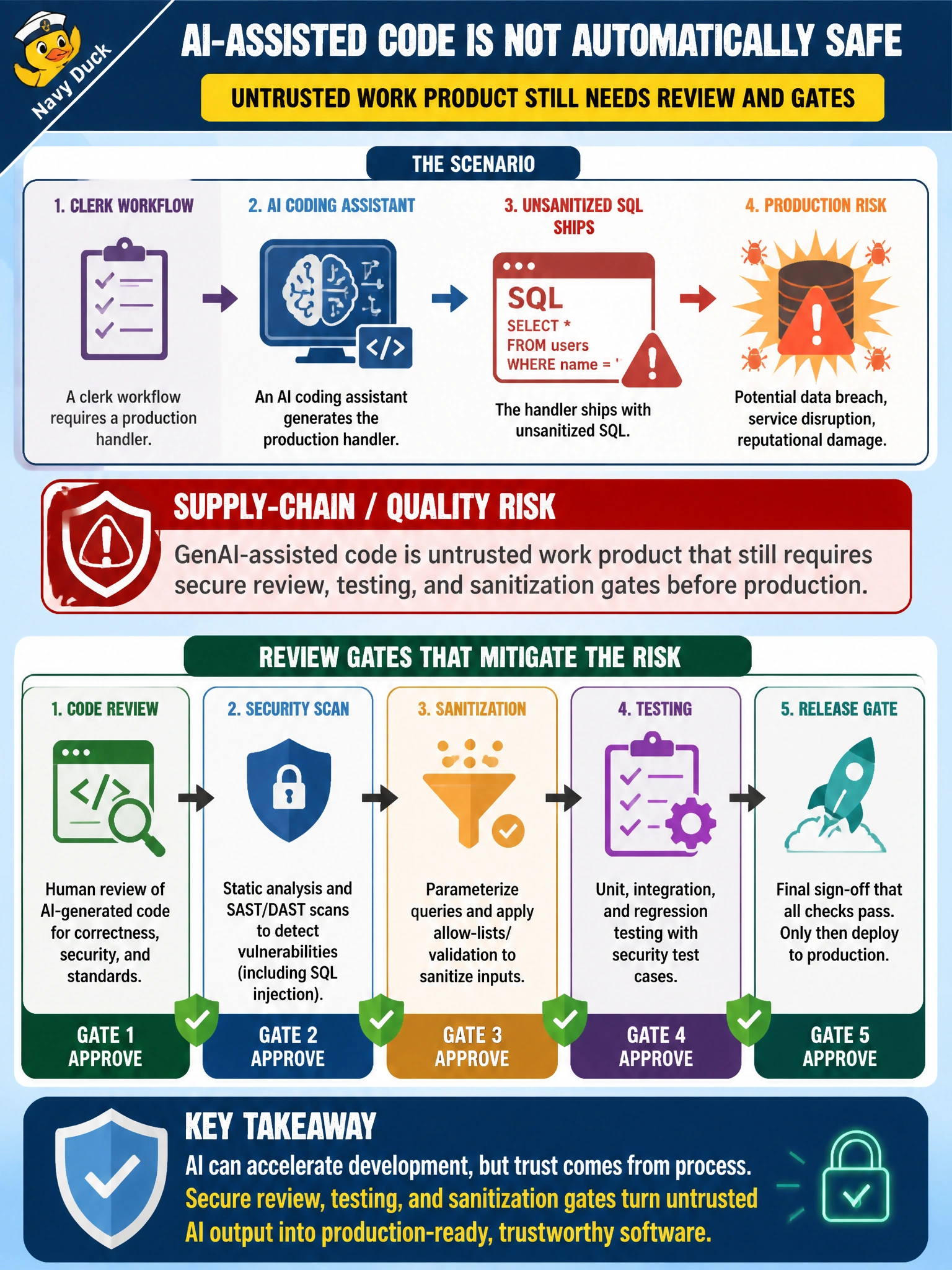
A clerk workflow uses an AI coding assistant to generate production handlers that ship with unsanitized SQL. What supply-chain or quality risk should review gates address?
Select an answer to reveal the explanation.
Short Explanation
The coding assistant is a fast junior who never signed your secure-coding oath. Treat its handlers as untrusted drafts that still need review, tests, and SQL sanitization. Speed without gates is how civic apps inherit injection bugs from autocomplete.
Full Explanation
AI coding assistants can accelerate municipal development but introduce supply-chain and quality risk when generated handlers ship without human secure review. Unsanitized SQL in production clerk workflows is a concrete injection failure: GenAI-assisted code remains untrusted work product that still requires secure code review, testing, and sanitization or parameterized-query gates before production. Development speed does not confer application safety for civic systems.
AI-generated code is inherently safe because models refuse insecure patterns is false—models routinely emit insecure snippets under incomplete or conflicting prompts. Compile errors alone prove the absence of injection flaws fails because compilable code can still concatenate untrusted input into SQL statements. Clerks pushing assistant output directly to production to save sprint time institutionalizes unverified supply into municipal case-handling paths.
Exam caveat: treat assistant output like a junior developer's pull request—useful draft, mandatory review—not like a signed secure module from a vetted vendor. Operational check: require PR review and SAST/SQL-injection checks on GenAI-assisted handlers, ban string-built SQL in clerk services, add integration tests with malicious input, and block pipelines that skip security gates.