
A housing authority GenAI BFF aggregates tools from three vendors with inconsistent authentication schemes. What integration improvement is most important?
Select an answer to reveal the explanation.
Short Explanation
Three door locks with three different key habits is how the softest door becomes the entrance. Make the BFF demand consistent strong auth to every housing tool backend. Letting the model pick which lock to skip is not architecture — it is hope.
Full Explanation
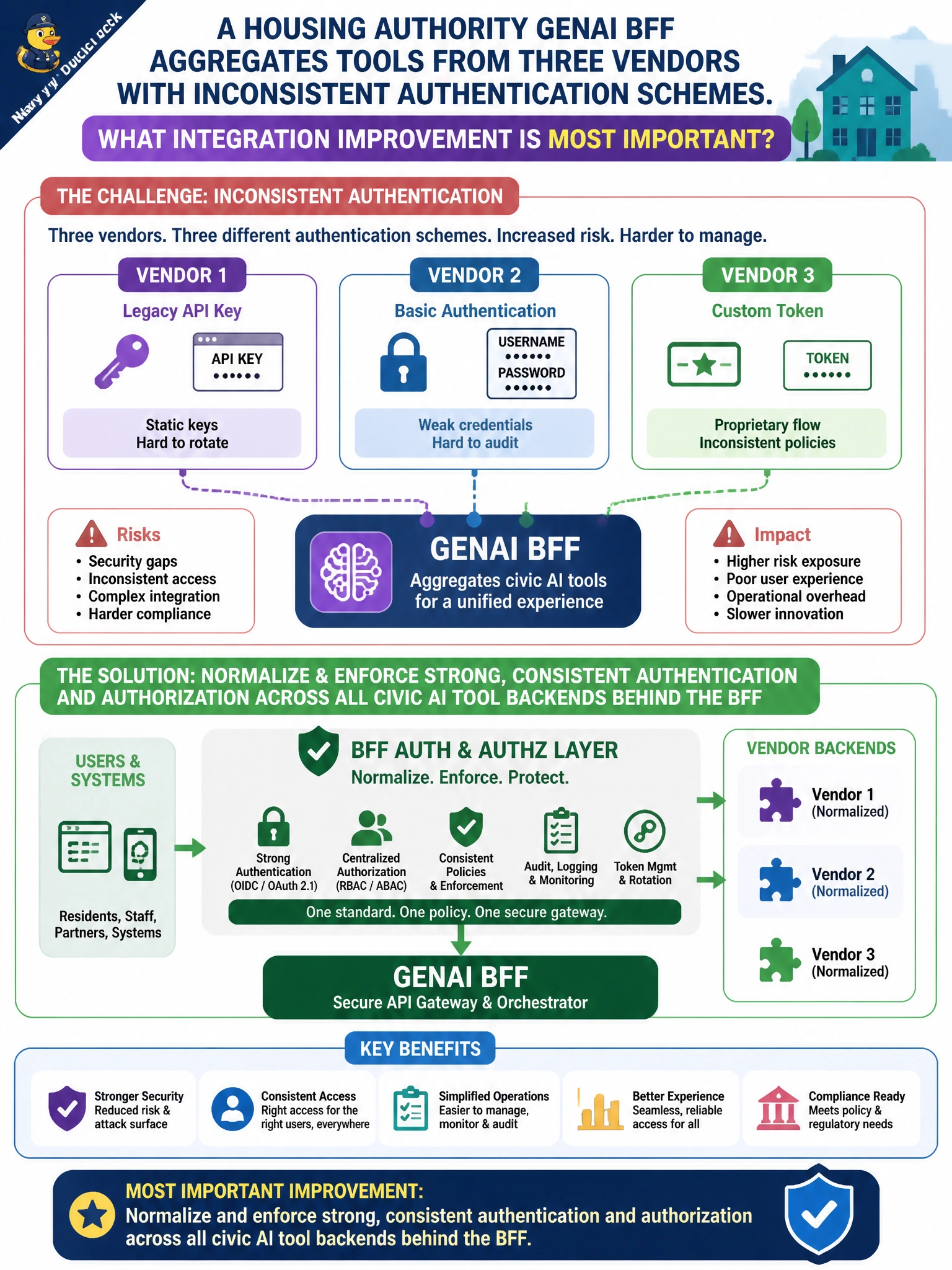
A housing authority GenAI BFF that aggregates tools from three vendors inherits the weakest authentication practice unless it normalizes requirements. The most important integration improvement is to enforce strong, consistent authentication and authorization across all civic AI tool backends behind the BFF—mutual TLS or signed service tokens, scoped roles, and uniform denial for unauthenticated calls—so one weak vendor path cannot become the soft entrance to housing data and actions.
Dropping authentication on the weakest vendor to match the others levels down to the least secure peer and expands exposure across the entire tool mesh. Storing each vendor's long-lived master key in the mobile app places high-value secrets on resident devices where extraction and reuse are trivial. Allowing the model to choose which auth scheme to skip per request substitutes probabilistic judgment for deterministic access control and invites tool-path bypass.
Exam caveat: a BFF is a control point—use it to raise peers to a municipal security baseline, not to average down to the weakest vendor's habits. Operational check: inventory auth schemes for each housing tool backend, implement BFF-side credential brokering with short-lived tokens, prohibit mobile storage of master keys, and verify every tool call is authenticated and authorized before execution.