
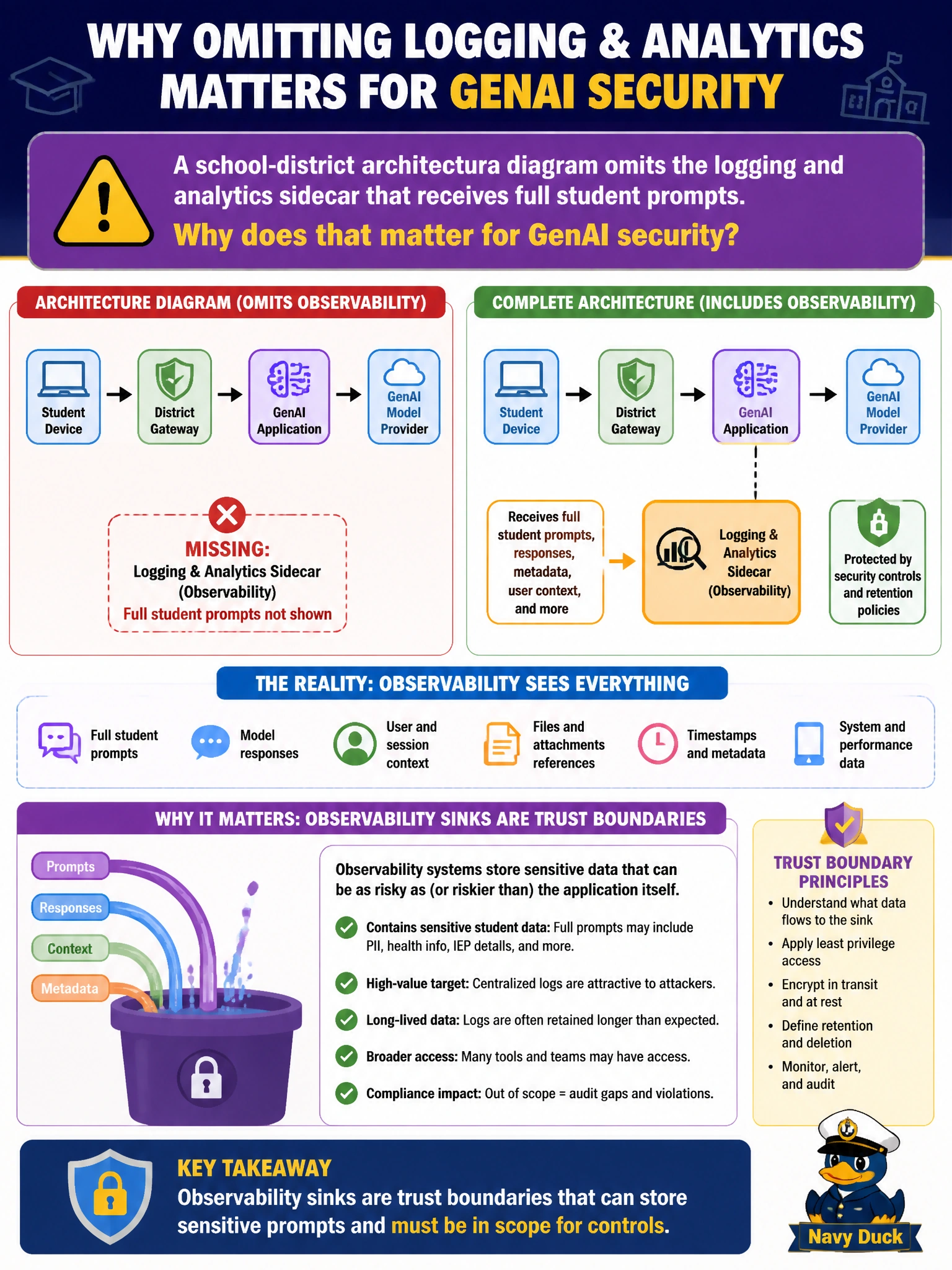
A school-district architecture diagram omits the logging and analytics sidecar that receives full student prompts. Why does that matter for GenAI security?
Select an answer to reveal the explanation.
Short Explanation
If the analytics sidecar drinks every prompt, it is part of the castle — not a decorative bush outside the wall. Miss it on the diagram and you miss encryption, access, and retention for student text. Observability is a trust boundary in GenAI apps.
Full Explanation
Prompt and completion logs frequently contain sensitive student or municipal content, so observability and analytics sidecars that receive full prompts are part of the GenAI trust boundary. Omitting them from a school-district architecture diagram hides real stores that need access control, encryption, retention limits, minimization, and vendor review. Security reviews must treat logging sinks as in-scope systems, not decorative infrastructure outside the threat model.
Sidecars cannot receive data unless the model temperature is set above 1.0 is factually wrong—temperature governs sampling randomness, not whether telemetry pipelines ingest prompts. Logging systems are exempt from education privacy rules by default is incorrect; education privacy and records obligations often apply to logs that hold student content. Diagrams should only show GPU nodes to keep reviews short fails by optimizing for brevity at the expense of accurate trust-boundary mapping.
Exam caveat: "out of band" analytics still process in-band sensitive data when prompts are forwarded—diagram omission does not create a compliance exemption. Operational check: update architecture diagrams to include logging/analytics paths, classify prompt/completion data, enforce encryption and least-privilege access on the sidecar, set retention aligned to education policy, and verify redaction or tokenization where full prompts are unnecessary.