
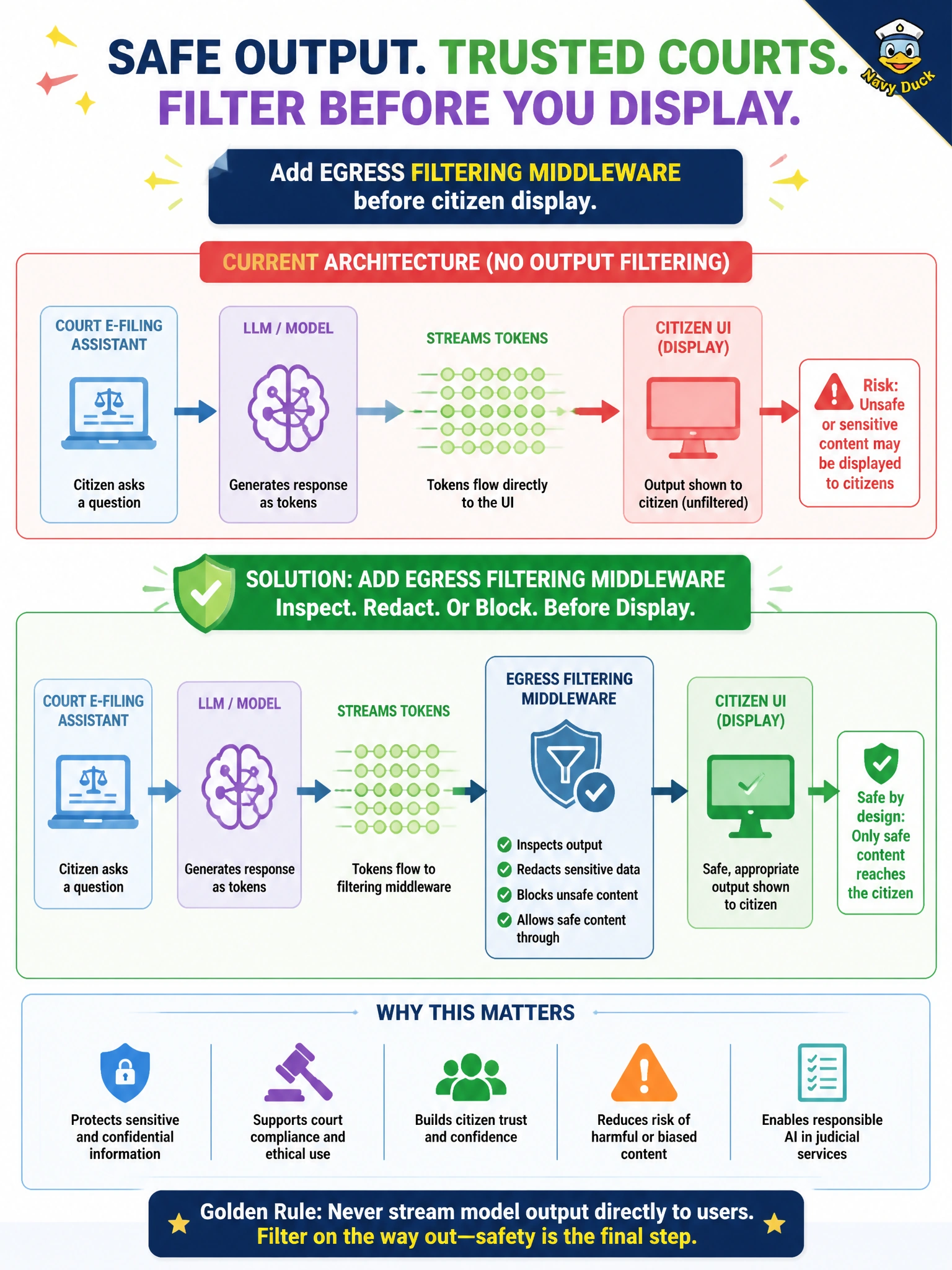
A court e-filing assistant streams tokens to the UI without output filtering middleware. What should architecture add before citizen display?
Select an answer to reveal the explanation.
Short Explanation
Streaming answers straight to the clerk screen is a firehose with no strainer. Put filtering middleware on the way out so sealed or toxic bits do not hit citizen display. Pretty CSS hide-and-seek is not a court-grade control.
Full Explanation
Streaming GenAI responses without an output-control layer can expose sealed, sensitive, or policy-violating content to citizens and clerks before anyone intervenes. Court e-filing assistants should insert egress filtering middleware that inspects streamed tokens or assembled spans, then redacts, blocks, or holds unsafe output before citizen display. Architecture must treat model output as untrusted content crossing a trust boundary into the UI.
A larger context window so more sealed text can stream at once worsens exposure rather than controlling it. Direct WebSocket access from the browser to the raw model host removes municipal mediation entirely and bypasses filtering, authZ, and audit. Client-side only CSS that hides text matching the word "confidential" fails because CSS is not a security boundary—view-source, DOM inspection, or alternate clients still receive the content, and sealed material is not reliably marked by a single keyword.
Exam caveat: streaming improves UX latency but does not remove the need for server-side output policy; filters must run on the trusted path before bytes reach the citizen. Operational check: place filtering middleware on the e-filing stream path, test with synthetic sealed phrases and PII, confirm blocked/redacted events are logged, and ensure the browser never opens a raw socket to the model host.