
A permitting app wires frontend to API gateway to LLM to RAG with no dedicated policy enforcement point. Where should security place authorization and content-policy checks in that GenAI architecture?
Select an answer to reveal the explanation.
Short Explanation
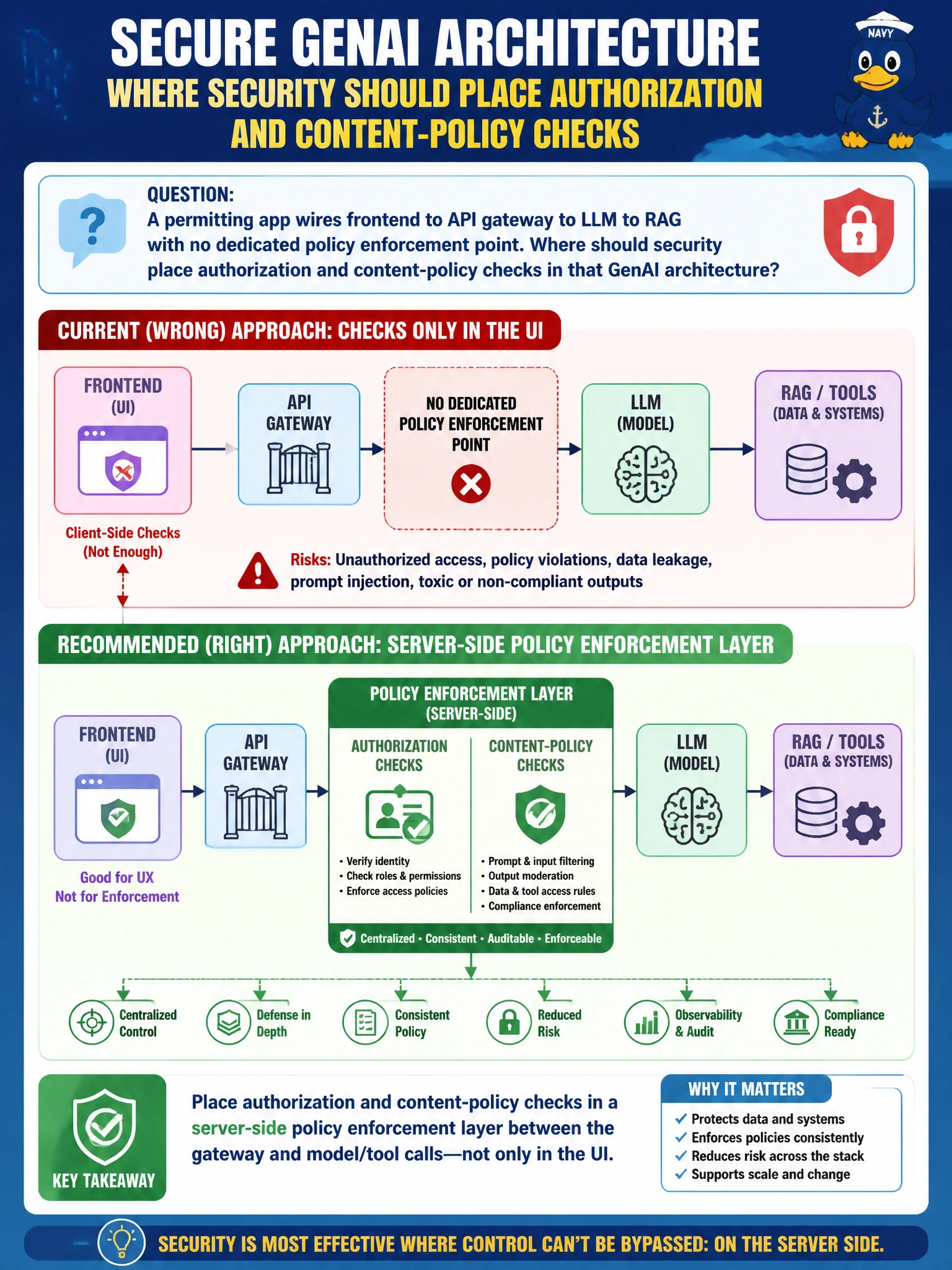
A pretty frontend gate is like a velvet rope that anyone can walk around. Put the real bouncer on the server path between the gateway and the model or tools so policy sticks even when clients are hostile. Civic GenAI needs enforcement in the architecture, not just paint on the lobby.
Full Explanation
Layered GenAI architectures for permitting and similar civic workflows need a reliable policy enforcement point that authorizes callers and applies content and tool policies before model inference and retrieval or tool actions execute. Placing those checks in a server-side enforcement layer between the API gateway and model/tool invocations ensures policy still holds when the browser is modified, bypassed, or scripted. Authorization and content-policy decisions belong on the trusted path the city operates, not solely in resident-controlled UI logic.
Only inside the browser before the request leaves the resident's device fails because client-side gates are advisory to a hostile or compromised client; attackers can call the gateway and model path directly. Solely in the vector database backup job that runs overnight fails on timing and purpose—backup jobs are not request-time authorization or content-policy enforcement and cannot stop an unauthorized permitting query as it happens. Only after answers are emailed to applicants as a weekly PDF digest fails on the same latency and control-point concepts: post-hoc digests do not prevent unsafe generation, tool use, or disclosure at interaction time.
Exam caveat: UI hints and progressive disclosure improve usability but are not substitutes for server-side enforcement; do not confuse presentation with authorization. Operational check: confirm a dedicated enforcement component or gateway policy sits on every path to the LLM and RAG tools, logs allow/deny decisions for permitting traffic, rejects unauthenticated or overscoped callers, and applies content/tool rules before tokens or retrieval results are returned to applicants.