
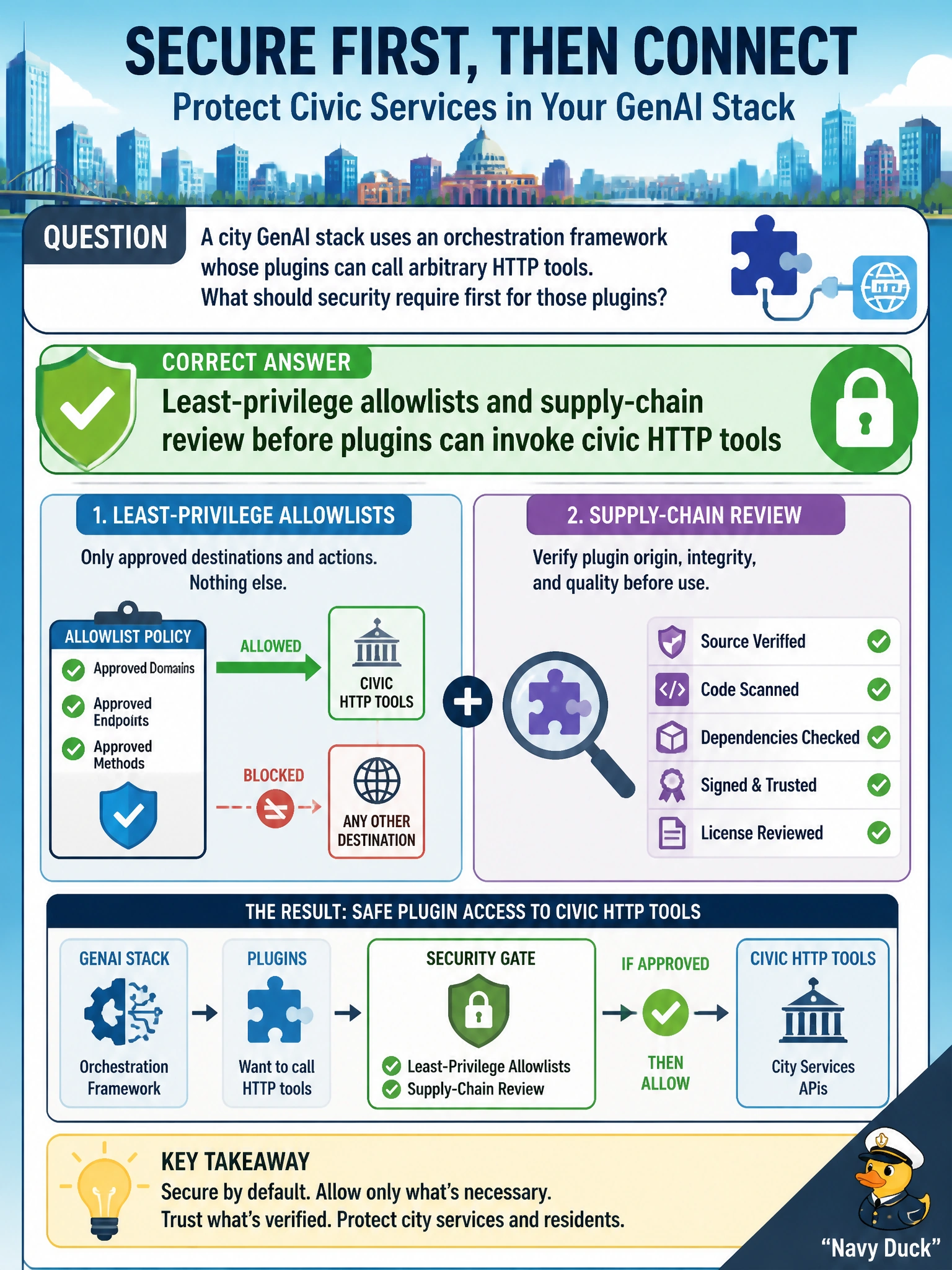
A city GenAI stack uses an orchestration framework whose plugins can call arbitrary HTTP tools. What should security require first for those plugins?
Select an answer to reveal the explanation.
Short Explanation
Think of plugins like spare keys on a city janitor ring — you do not hand out master keys to every bolt-on tool. Lock them to an allowlist and vet the supply chain before they can hit municipal HTTP endpoints. Broad plugin powers are how a helpful assistant becomes a roaming webhook.
Full Explanation
In a municipal GenAI stack, orchestration frameworks that expose plugins capable of arbitrary HTTP tool calls expand the city's outbound integration attack surface. Security's first requirement should be least-privilege allowlists that constrain which civic endpoints and methods a plugin may invoke, combined with supply-chain review of the plugin itself (provenance, integrity, known vulnerabilities, and maintenance posture) before it can reach municipal systems. That pairing prevents both reckless tool reach and the introduction of a compromised or poorly maintained plugin into the civic path.
Disabling TLS so plugins can inspect municipal traffic more easily fails on the confidentiality and integrity axis: cleartext inspection widens eavesdropping and tampering risk and is never a legitimate substitute for controlled debugging with approved TLS termination and logging. Granting every plugin the same service account used by the payroll API fails on identity and blast-radius concepts—shared high-privilege credentials mean a single malicious or injected plugin action can touch payroll and other sensitive workloads. Publishing plugin source on a public gist so residents can fork it confuses transparency with security controls; public forks do not authorize HTTP reach into city systems and can leak internal integration details without providing allowlisting or provenance assurance.
Exam caveat: allowlists alone are insufficient if the plugin binary or package is untrusted—supply-chain diligence and runtime constraints travel together. Operational check: inventory GenAI plugins, map each outbound destination, enforce destination/method allowlists in the orchestrator or egress proxy, require signed or hashed plugin artifacts from approved registries, and verify that no plugin inherits payroll or other high-value service identities.