
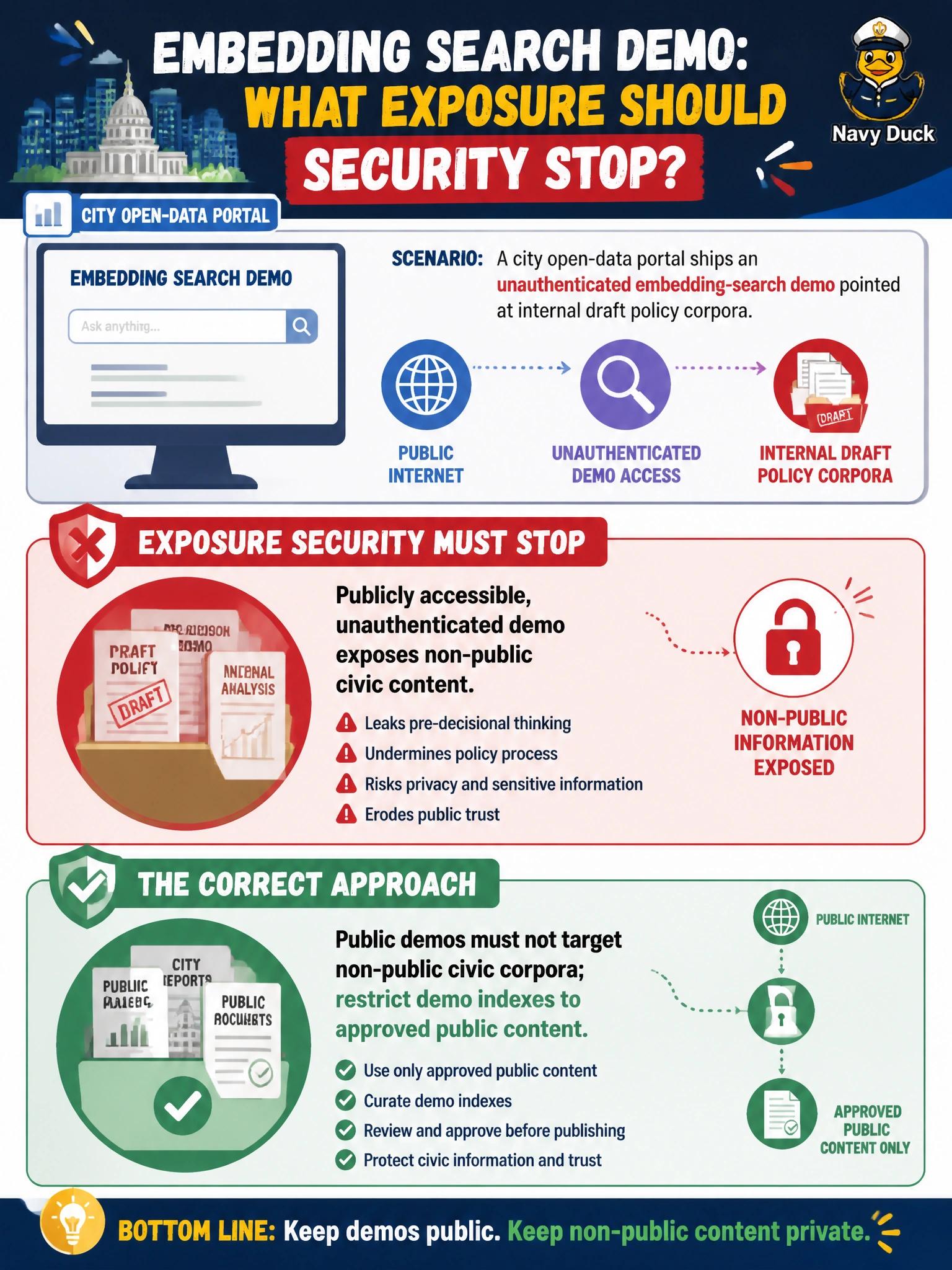
A city open-data portal ships an unauthenticated embedding-search demo pointed at internal draft policy corpora. What exposure should security stop?
Select an answer to reveal the explanation.
Short Explanation
A “harmless” demo search box aimed at draft policies can become a side door into City Hall’s unpublished binder. Keep your demo index public-only, using corpora already cleared for release.
Full Explanation
Public demos must not target non-public civic corpora; restrict demo indexes to approved public content. An unauthenticated open-data portal demo pointed at internal draft policy corpora can expose unpublished municipal policy text through embedding search, without the controls applied to internal tools. Demo convenience does not authorize bypassing draft confidentiality. Point demos only at corpora cleared for public release, or require authentication and the same access-control path as production. Omitting PDF filenames does not make an unauthenticated demo safe: substantive draft text in result snippets is still a disclosure. Converting draft policies into searchable vector embeddings does not automatically make them public records; embedding is not a publication decision. The claim that embedding search cannot return substantive policy text also fails: retrieval-augmented generation demos can return readable content or close paraphrases from those drafts. Exam caveat: demo and production indexes are separate trust decisions, so never aim public unauthenticated search at internal draft civic corpora. Practical check: repoint the demo at a public-only index, confirm draft-policy queries return nothing sensitive, scan portal configurations for other demo endpoints, and require security sign-off before any public embedding demo ships.